Exact2Pass

Last Update 14 hours ago Total Questions : 736
The Certified Professional Ethical Hacker (CPEH) content is now fully updated, with all current exam questions added 14 hours ago. Deciding to include CPEH-001 practice exam questions in your study plan goes far beyond basic test preparation.
You'll find that our CPEH-001 exam questions frequently feature detailed scenarios and practical problem-solving exercises that directly mirror industry challenges. Engaging with these CPEH-001 sample sets allows you to effectively manage your time and pace yourself, giving you the ability to finish any Certified Professional Ethical Hacker (CPEH) practice test comfortably within the allotted time.
Which mode of IPSec should you use to assure security and confidentiality of data within the same LAN?
This asymmetry cipher is based on factoring the product of two large prime numbers.
What cipher is described above?
Which of the following is the structure designed to verify and authenticate the identity of individuals within the enterprise taking part in a data exchange?
You are performing a penetration test. You achieved access via a buffer overflow exploit and you proceed to find interesting data, such as files with usernames and passwords. You find a hidden folder that has the administrator ' s bank account password and login information for the administrator ' s bitcoin account.
What should you do?
A hacker has successfully infected an internet-facing server which he will then use to send junk mail, take part in coordinated attacks, or host junk email content.
Which sort of trojan infects this server?
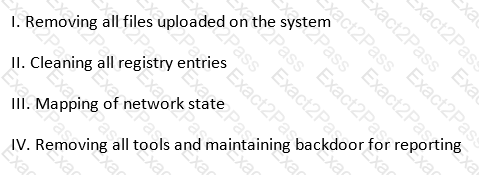
Under the " Post-attack Phase and Activities " , it is the responsibility of the tester to restore the systems to a pre-test state.
Which of the following activities should not be included in this phase? (see exhibit)
Exhibit:
Your team has won a contract to infiltrate an organization. The company wants to have the attack be as realistic as possible; therefore, they did not provide any information besides the company name.
What should be the first step in security testing the client?
You have successfully gained access to a linux server and would like to ensure that the succeeding outgoing traffic from this server will not be caught by a Network Based Intrusion Detection Systems (NIDS).
What is the best way to evade the NIDS?
Initiating an attack against targeted businesses and organizations, threat actors compromise a carefully selected website by inserting an exploit resulting in malware infection. The attackers run exploits on well-known and trusted sites likely to be visited by their targeted victims. Aside from carefully choosing sites to compromise, these attacks are known to incorporate zero-day exploits that target unpatched vulnerabilities. Thus, the targeted entities are left with little or no defense against these exploits.
What type of attack is outlined in the scenario?
Perspective clients want to see sample reports from previous penetration tests.
What should you do next?
env x=`(){ :;};echo exploit` bash -c ' cat /etc/passwd '
What is the Shellshock bash vulnerability attempting to do on a vulnerable Linux host?
You are a Network Security Officer. You have two machines. The first machine (192.168.0.99) has snort installed, and the second machine (192.168.0.150) has kiwi syslog installed. You perform a syn scan in your network, and you notice that kiwi syslog is not receiving the alert message from snort. You decide to run wireshark in the snort machine to check if the messages are going to the kiwi syslog machine.
What wireshark filter will show the connections from the snort machine to kiwi syslog machine?
Which statement is TRUE regarding network firewalls preventing Web Application attacks?
Which of the following is assured by the use of a hash?
Which of the following is the BEST way to defend against network sniffing?

