Exact2Pass

Last Update 13 hours ago Total Questions : 98
The Certified Tester Advanced Level Agile Technical Tester content is now fully updated, with all current exam questions added 13 hours ago. Deciding to include CTAL-ATT practice exam questions in your study plan goes far beyond basic test preparation.
You'll find that our CTAL-ATT exam questions frequently feature detailed scenarios and practical problem-solving exercises that directly mirror industry challenges. Engaging with these CTAL-ATT sample sets allows you to effectively manage your time and pace yourself, giving you the ability to finish any Certified Tester Advanced Level Agile Technical Tester practice test comfortably within the allotted time.
Consider the following section of pseudocode
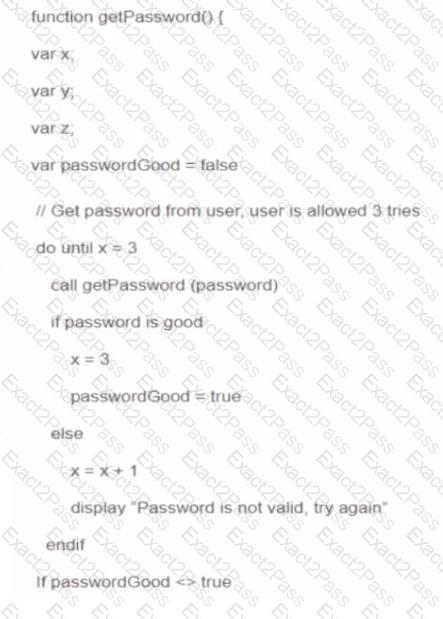
Display " You exceeded the number of tries to enter a password. Your account is now locked. Call customer.
For this section of code, which of the following issues should be identified during a code review?
1. Variables have not been properly defined with meaningful names
2. There are unused variables defined
3. Divisors are not tested for zero
4. Loop counters are not properly initialized
5. There are endless loops
6. There are statements within the loop that should be outside the loop
You are defining the test approach for an Agile project release which is to develop an improved user interface for a golf club ' s booking system plus some additional features that will provide more flexible bookings across the three courses The improvements have been primarily driven by customer complaints that the booking system is difficult to follow and restrictive The release will be divided into six two-week sprints
The stakeholders have performed a risk assessment for the release and have determined that whilst the system is not mission critical, customer business could be lost and thus a risk level of High has been agreed. As there is may be a high degree of change to the screen design and functionality across the sprints, a regression-averse strategy is recommended.
Which option in the table below represents the BEST test approach for this release, where the following symbols apply?
♦+ (highly recommended)
♦ (recommended)
o (neutral/optlonal)
• (not recommended)
- (not to be used)
Option Test Automation Exploratory Testing (manual) Black-box testing
1 ♦+ 0 ♦♦
2 - +♦ +
3 ♦+ 0 -
4 ♦ ♦♦ ♦
SELECT ONE OPTION
Whose perspective should be used when a user story is created?
You are working in a project that developed a product that has reached a stable state and is
deployed on different HW configurations all over Europe.
You management decided to use your project as Proof of Concept for adopting CI as a new way of
working. The POC was implemented on one set of hardware and was successful.
Which of the following actions is a good next step?
Which of the following correctly describes positive characteristic of unit tests?
Refactoring of test cases is needed in agile projects for many reasons.
Which of the following statements about the refactoring of test cases is correct?
If you are targeting your testing for a particular group of users with particular defined characteristics, what requirements engineering technique would be most helpful when designing your tests?
What is the characteristic of a unit test that makes it “deterministic”?
You are testing a mission-critical system and want to use exploratory testing for part of the testing. According to the syllabus, what is the correlation between this type of testing and the risk level of the item being tested?
The following user story has been written for a new application being developed to pre-book a space at a National Car Park.
As a vehicle driver
i want to be able to pre-book a car parking space online, selecting a disabled driver ' s space if needed
So that l can pay in advance and receive confirmation of my parking space number.
The following acceptance criteria have also been written:
• Payment can be made via PayPal, Debit or Credit Card
• Confirmation of payment and car parking details should be sent after the booking process is completed
• Driver information is stored in the reservation database
The database has been built and tested in a previous sprint, but the interface to the different payment methods have yet to be developed
As a tester in an agile team, you have been asked to review the user story You have detected some issues with this story:
1. it needs to cater for different user groups: a driver or disabled driver
2. it needs to cater for different vehicle types: a car. 4x4. van or motorbike
3. There are no acceptance criteria relating to how quick the booking process should be
4. How confirmation is to be sent for payment and space number, and other important details, have not been specified
5. A stub will be needed to test the payment method
Which pair of requirements engineering techniques are you MOST LIKELY to have used to uncover these issues’
SELECT ONE OPTION

