Exact2Pass

Last Update 19 hours ago Total Questions : 228
The Certified Tester Advanced Level Test Management (CTAL-TM) v3.0 content is now fully updated, with all current exam questions added 19 hours ago. Deciding to include CTAL-TM practice exam questions in your study plan goes far beyond basic test preparation.
You'll find that our CTAL-TM exam questions frequently feature detailed scenarios and practical problem-solving exercises that directly mirror industry challenges. Engaging with these CTAL-TM sample sets allows you to effectively manage your time and pace yourself, giving you the ability to finish any Certified Tester Advanced Level Test Management (CTAL-TM) v3.0 practice test comfortably within the allotted time.
You are a Test Manager at a company that develops mobile phone applications. Based on historical data in your company, you have calculated the following average metrics for system testing:
• for each 100 LOC (Lines Of Code). 4 test cases are executed
• each test case takes on average 15 minutes to execute and check
• for each 1000 LOC, 5 defects are found
You have used this information to create an estimate for the system testing of a new mobile phone application being developed to submit gas and electricity readings.
The application delivered for system testing has 50.000 lines of code. At the end of system testing, 250 defects are discovered.
Assume that:
• the system test of the new mobile phone application will require the same amount of effort as previous applications
• defect density = number of defects/1000 LOC
• no new tools or processes have been introduced to the test team
Based only on the given information, which one of the following statements is true about this new mobile phone application?
SELECT ONE OPTION
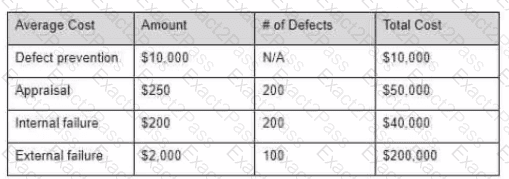
You have assembled the following cost of quality numbers 200 defects were found prior to release and 100 were found after.
Given this information what is the total cost of quality for this project?
You have been looking at the actual vs expected defects in one high risk area of the software The actual is much higher than the expected value What should you do?
While mining the defect database for patterns of problems in the last release, a Test Manager notices that many of the most damaging failures were caused by defects
injected during the low-level design phase.
Which of the following actions will likely give this project the most effective solution to this problem? [3]
You are Test Manager working on a project which is improving the user interface for its call centre staff handling customer enquiries. The project has completed UAT for the first iteration; however a large number of defects were raised by call centre staff seconded to help with the User Acceptance testing.
The defects described the user interface as not being intuitive enough with a poor 'help' facility. A user representative spent a week working with developers and system testers to explain the issues, which were subsequently agreed to have resulted from poorly specified usability requirements.
The requirements were defined separately for each iteration and have been formally reviewed by business analysts, developers and the IT director.
The user representative was also able to answer a number of other questions that the system test team had regarding call centre workflows, which improved their domain knowledge.
You have been asked to conduct a project retrospective and recommend improvements for the next iteration which introduces further user interface changes. Which of the following would be the MOST effective improvement for the next iteration?
You plan to use a heavyweight approach to risk-based testing on a safety-critical system and have the following information available for each documented product risk:
The estimated cost of testing the risk
How likely a failure would arise for the risk item
How much the failure would cost, in terms of loss Which technique would be MOST suitable?
Which one of the following metrics would be MOST suitable for helping to determine whether test analysis and design is complete? SELECT ONE OPTION
How does a risk based testing approach address risks in a software product? SELECT ONE OPTION
Which of the following Is a way in which risk analysis drives test analysis?
Which of the following Is considered a heavyweight risk-based testing technique'

