Exact2Pass

Last Update 16 hours ago Total Questions : 1076
The Certified Treasury Professional content is now fully updated, with all current exam questions added 16 hours ago. Deciding to include CTP practice exam questions in your study plan goes far beyond basic test preparation.
You'll find that our CTP exam questions frequently feature detailed scenarios and practical problem-solving exercises that directly mirror industry challenges. Engaging with these CTP sample sets allows you to effectively manage your time and pace yourself, giving you the ability to finish any Certified Treasury Professional practice test comfortably within the allotted time.
A real estate development company has excess cash that it would like to invest in one of its properties:
Property A has shown an ROI of 40%, a residual income of $25,675, and an EVA of $32,678.
Property B has shown an ROI of 45%, a residual income of $27,635, and an EVA of $29,523.
Property C has shown an ROI of 55%, a residual income of $22,658, and an EVA of $30,678.
Property D has shown an ROI of 52%, a residual income of $19,675, and an EVA of $31,523.
In which property should the company invest?
A company has average monthly sales of $2,700, of which 5 percent is on a cash basis, with the remaining sold on open account. The company ' s accounts receivable aging schedule at the end of March is as follows:
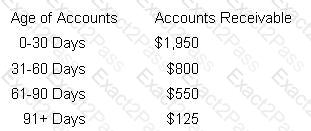
What is the company ' s DSO?
All of the following staff would be involved in the evaluation of an outsourced accounts payable solution EXCEPT:
A manufacturing company experienced a system failure that lasted more than 24 hours. The company did not have any contingency plans in place and as a result the cash manager was unable to process the following payments:
P-card issuer: $25,000
Payroll: $125,000
Bond interest payment: $200,000
Vendor payments: $260,000
Utilities: $50,000
The cash manager does not have a way to confirm the receivable amounts deposited at the bank. The suppliers are threatening to stop shipments due to the delay in payment and the loss of supplier shipments would threaten the company’s just-in-time production. What concern should the company have?
Of the following card transactions, which would likely incur the highest interchange fees?
Company A purchases materials on cash-before-delivery terms, while Company B uses paid-on-production terms. Both companies are diligent with the protection of assets, but Company B has concerns with respect to transfer of title of the materials. Company B is MOST LIKELY what type of business?
A company decided to lease a car 4 years ago for its daily driving business. The company maintained the car as per the lease agreement. Last year, the company decided to expand into event hosting and experienced an increase in business, especially when hosting overnight events. The company decided to purchase a minivan and return the car at lease expiration. When returning the car, the company had to pay $1,500 to the lessor. What was the MOST LIKELY cause of the additional expense?
A consumer’s personal check written to pay an electronics store charge-account bill is returned three times by the depositor’s bank as NSF. What process is being used?
Companies following an aggressive strategy for financing working capital and other assets have higher risk due to which of the following?
A U.S. company has a secured committed line of credit of $5.5 million and has an available balance of $4 million. The company successfully transmitted a $5.5 million wire transfer instruction out to the bank via SWIFT. The bank contacted the company and informed it that the wire transfer would not be processed. What is the MOST LIKELY reason the bank gave the company?
Fluctuations in interest rates and the availability of funds are more significant risks for companies that rely on:
Which of the following occurs when the U.S. dollar strengthens?
Which of the following are basic security issues to be considered in evaluating a treasury management system?
I. Data recovery
II. Anti-virus protection
III. Database access controls
IV. Data integration
Which of the following instruments is sold at multiple price bid auctions?
On a statement of cash flow, which of the following items are considered sources of cash?
I. Increase in short-term investments
II. Net income
III. Increase in accounts payable
IV. Decrease in long-term debt
Which of the following is LEAST important when a cash manager determines a company ' s short-term cash position?
Evaluating the liquidity needs of an organization is a function of:
An L/C in favor of a U.S. exporter is issued by a bank in an emerging-market country, and it is confirmed by the exporter’s bank. What risk is reduced for the U.S. exporter?
An analysis of variances from expected cash flows is used to:
Multi-divisional or multi-subsidiary companies have opportunities to optimize their working capital position and overall liquidity by doing which of the following?

