Spring Sale Special Limited Time 70% Discount Offer - Ends in 0d 00h 00m 00s - Coupon code: buysanta

Exact2Pass Menu

MuleSoft Certified Developer - Level 2 (Mule 4)

Last Update 1 hour ago Total Questions : 60

The MuleSoft Certified Developer - Level 2 (Mule 4) content is now fully updated, with all current exam questions added 1 hour ago. Deciding to include MCD-Level-2 practice exam questions in your study plan goes far beyond basic test preparation.

You'll find that our MCD-Level-2 exam questions frequently feature detailed scenarios and practical problem-solving exercises that directly mirror industry challenges. Engaging with these MCD-Level-2 sample sets allows you to effectively manage your time and pace yourself, giving you the ability to finish any MuleSoft Certified Developer - Level 2 (Mule 4) practice test comfortably within the allotted time.

Question # 1

Which command is used to convert a JKS keystore to PKCS12?

A.

Keytool-importkeystore –srckeystore keystore p12-srcstoretype PKCS12 –destkeystore keystore.jks –deststoretype JKS

B.

Keytool-importkeystore –srckeystore keystore p12-srcstoretype JKS –destkeystore keystore.p12 –deststoretype PKCS12

C.

Keytool-importkeystore –srckeystore keystore jks-srcstoretype JKS –destkeystore keystore.p13 –deststoretype PKCS12

D.

Keytool-importkeystore –srckeystore keystore jks-srcstoretype PKCS12 –destkeystore keystore.p12 –deststoretype JKS

Question # 2

When a client and server are exchanging messages during the mTLS handshake, what is being agreed on during the cipher suite exchange?

A.

A protocol

B.

The TLS version

C.

An encryption algorithm

D.

The Public key format

Question # 3

A Mule application deployed to multiple Cloudhub 2.0 replicas needs to temporarily persist large files over 10MB between flow executions, and routinely needs to query whether the file data exists on separate executions.

How can this be achieved?

A.

Store the contents of the file on separate storage, and store the key and location of the file Object using Object Store v2

B.

Use an in-memory Object Store

C.

Store the key and full contents of the file in an Object Store

D.

Store the key and full contents of the file, caching the filename and location between requests

Question # 4

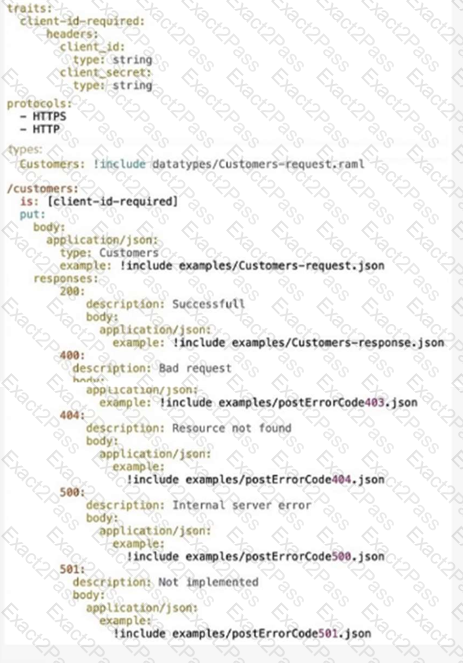
Refer to the exhibit.

A developer generates the base scaffolding for an API in Anypoint Studio.

Which HTTP status code is returned while testing using the API Kit console if no values are entered in client-secret?

A.

HTTP status code:200

B.

HTTP status code:403

C.

HTTP status code:400

D.

HTTP status code:500

Question # 5

Two APIs are deployed to a two-node on-prem cluster. Due to a requirements change, the two APIs must communicate to exchange data asynchronously.

A.

If the two APIs use the same domain, the VM Connector can be leveraged

B.

The VM Connector is used to inter-application communication, so it is not possible to use the VM Connector

C.

Instead of using the VM Connector use < flow-ref > directly

D.

It is not possible to use the VM Connector since the APIs are running in a cluster mode and each mode has it own set of VM Queues

Question # 6

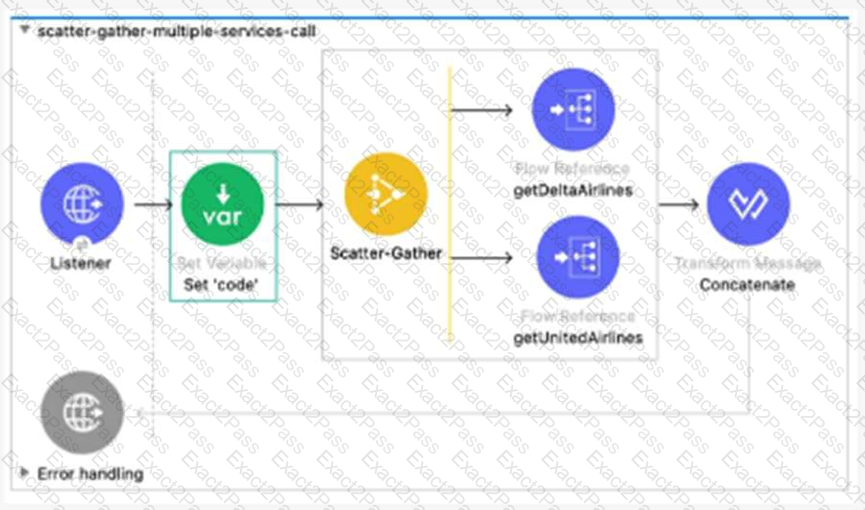
Refer to the exhibit.

What required changes can be made to give a partial successful response in case the United Airlines API returns with a timeout?
A.

Add a Scatter-gather component inside a Try scope.

Set the payload to a default value ‘Error’ inside the error handler using the On Error Propagate scope.

B.

Add Flow Reference components inside a Try scope.

Set the payload to a default value’’ insider the error handler using the ON Error Continue scope

C.

Add Flow Reference components inside a Try scope

Set the payload to a default value ‘’ inside the error handler using the On Error Propagate scope

D.

Add a Scatter-Gather component inside a Try scope.

Set the payload to a default value ‘Error’’ inside the error handler using the On Error Continue scope.

Question # 7

A mule application exposes and API for creating payments. An Operations team wants to ensure that the Payment API is up and running at all times in production.

Which approach should be used to test that the payment API is working in production?

A.

Create a health check endpoint that listens on a separate port and uses a separate HTTP Listener configuration from the API

B.

Configure the application to send health data to an external system

C.

Create a health check endpoint that reuses the same port number and HTTP Listener configuration as the API itself

D.

Monitor the Payment API directly sending real customer payment data

Question # 8

Which statement is true when using XML SDK for creating custom message processors?

A.

Properties are fields defined by an end user of the XML SDK component and serve as a global configuration for the entire Mule project in which they are used

B.

An XML SDK provides both inbound and outbound operations

C.

Operations can be reused in recursive calls

D.

All operations are public

Question # 9

A company has been using CI/CD. Its developers use Maven to handle build and deployment activities.

What is the correct sequence of activities that takes place during the Maven build and deployment?

A.

Initialize, validate, compute, test, package, verify, install, deploy

B.

Validate, initialize, compile, package, test, install, verify, verify, deploy

C.

Validate, initialize, compile, test package, verify, install, deploy

D.

Validation, initialize, compile, test, package, install verify, deploy

Question # 10

A custom policy needs to be developed to intercept all cutbound HTTP requests made by Mule applications.

Which XML element must be used to intercept outbound HTTP requests?

A.

It is not possible to intercept outgoing HTTP requests, only inbound requests

B.

http-policy:source

C.

htt-policy:operation

D.

http-policy:processor

Go to page: