Spring Sale Special Limited Time 70% Discount Offer - Ends in 0d 00h 00m 00s - Coupon code: buysanta

Exact2Pass Menu

Fortinet NSE 5 - FortiManager 7.2

Last Update 18 hours ago Total Questions : 101

The Fortinet NSE 5 - FortiManager 7.2 content is now fully updated, with all current exam questions added 18 hours ago. Deciding to include NSE5_FMG-7.2 practice exam questions in your study plan goes far beyond basic test preparation.

You'll find that our NSE5_FMG-7.2 exam questions frequently feature detailed scenarios and practical problem-solving exercises that directly mirror industry challenges. Engaging with these NSE5_FMG-7.2 sample sets allows you to effectively manage your time and pace yourself, giving you the ability to finish any Fortinet NSE 5 - FortiManager 7.2 practice test comfortably within the allotted time.

Question # 4

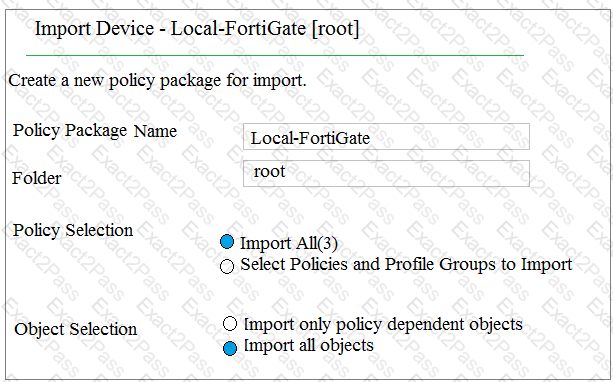
View the following exhibit.

An administrator is importing a new device to FortiManager and has selected the shown options. What will happen if the administrator makes the changes and installs the modified policy package on this managed FortiGate?

A.

The unused objects that are not tied to the firewall policies will be installed on FortiGate

B.

The unused objects that are not tied to the firewall policies will remain as read-only locally on FortiGate

C.

The unused objects that are not tied to the firewall policies locally on FortiGate will be deleted

D.

The unused objects that are not tied to the firewall policies in policy package will be deleted from the

FortiManager database

Question # 5

Which two conditions trigger FortiManager to create a new revision history? (Choose two.)

A.

When configuration revision is reverted to previous revision in the revision history

B.

When FortiManager installs device-level changes to a managed device

C.

When FortiManager is auto-updated with configuration changes made directly on a managed device

D.

When changes to device-level database is made on FortiManager

Question # 6

An administrator would like to authorize a newly-installed AP using AP Manager. What steps does the administrator need to perform to authorize an AP?

A.

Authorize the new AP using AP Manager and wait until the change is updated on the FortiAP. Changes to the AP ' s state do not require installation.

B.

Changes to the AP ' s state must be performed directly on the managed FortiGate.

C.

Authorize the new AP using AP Manager and install the policy package changes on the managed FortiGate.

D.

Authorize the new AP using AP Manager and install the device level settings on the managed FortiGate.

Question # 7

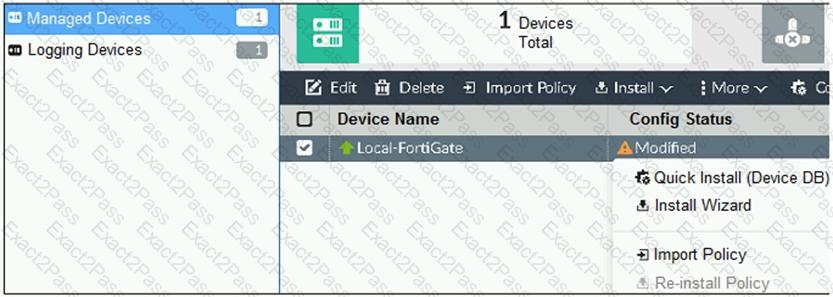
Exhibit.

Which two statements about the output are true ' ' (Choose two.)

A.

Configuration changes have been installed on FortiGate. which means the FortiGate configuration has been changed

B.

The latest revision history for the managed FortiGate does match the FortiGate running configuration

C.

Configuration changes directly made on FortiGate have been automatically updated to the device-level database

D.

The latest revision history for the managed FortiGate does not match the device-level database

Question # 8

Which two settings are required for FortiManager Management Extension Applications (MEA)? (Choose two.)

A.

When you configure MEA, you must open TCP or UDP port 540.

B.

You must open the ports to the Fortinet registry

C.

You must create a MEA special policy on FortiManager using the super user profile

D.

The administrator must have the super user profile.

Question # 9

Which of the following statements are true regarding reverting to previous revision version from the revision history? (Choose two.)

A.

To push these changes to a managed device, it required an install operation to the managed FortiGate.

B.

Reverting to a previous revision history will generate a new version ID and remove all other history

versions.

C.

Reverting to a previous revision history will tag the device settings status as Auto-Update .

D.

It will modify device-level database

Question # 10

In the event that one of the secondary FortiManager devices fails, which action must be performed to return the FortiManager HA manual mode to a working state?


A.

The FortiManaqer HA state transition is transparent to administrators and does not require any reconfiguration.

B.

Manually promote one of the working secondary devices to the primary role, and reboot the old primary device to remove the peer IP of the failed device.

C.

Reconfigure the primary device to remove the peer IP of the failed device.

D.

Reboot the failed device to remove its IP from the primary device.

Go to page: