Exact2Pass

Last Update 12 hours ago Total Questions : 17
The SOA Design & Architecture Lab with Services & Microservices content is now fully updated, with all current exam questions added 12 hours ago. Deciding to include S90.08B practice exam questions in your study plan goes far beyond basic test preparation.
You'll find that our S90.08B exam questions frequently feature detailed scenarios and practical problem-solving exercises that directly mirror industry challenges. Engaging with these S90.08B sample sets allows you to effectively manage your time and pace yourself, giving you the ability to finish any SOA Design & Architecture Lab with Services & Microservices practice test comfortably within the allotted time.
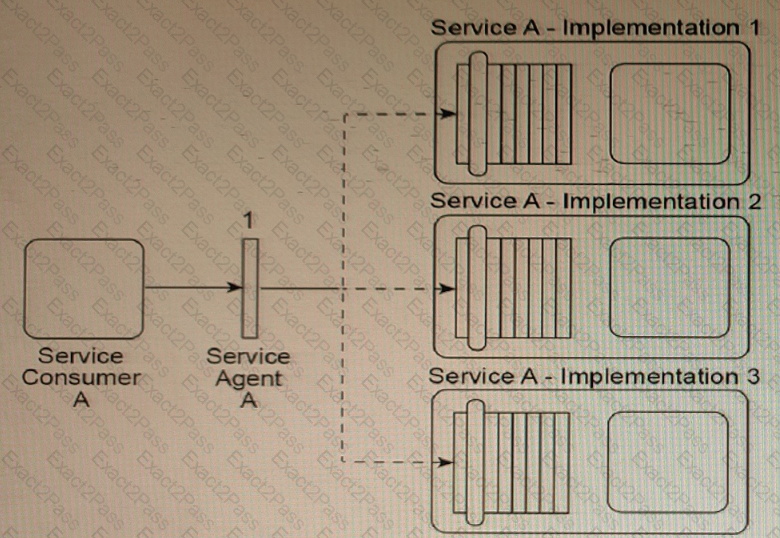
Service Consumer A sends a message to Service A. There are currently three duplicate implementations of Service A (Implementation 1, Implementation 2 and Implementation 3). The message sent by Service Consumer A is intercepted by Service Agent A (1), which determines at runtime which implementation of Service A to forward the message to. All three implementations of Service A reside on the same physical server.
You are told that despite the fact that duplicate implementations of Service A exist, performance is still poor at times. You are also informed that a new service capability will soon need to be added to Service A to introduce functionality that will require access to a shared database being used by many other clients and applications in the IT enterprise. This is expected to add further performance demands on Service A.
How can this service architecture be changed to improve performance in preparation for the addition of the new service capability?
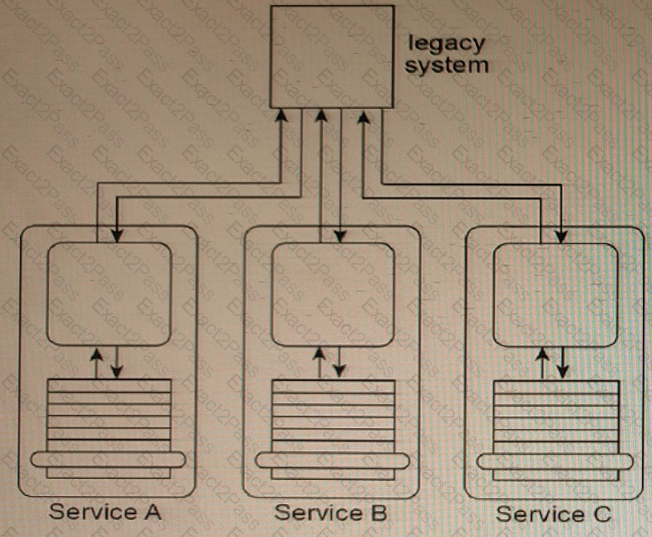
Service A, Service B, and Service C are entity services, each designed to access the same shared legacy system. Service A manages order entities, Service B manages invoice entities, and Service C manages customer entities. Service A, Service B, and Service C are REST services and are frequently reused by different service compositions. The legacy system uses a proprietary file format that Services A, B, and C need to convert to and from.
You are told that compositions involving Service A, Service B, and Service C are unnecessarily complicated due to the fact that order, invoice, and customer entitles are all related to each other. For example, an order has a customer, an invoice has an order, and so on. This results In calls to multiple services to reconstruct a complete order document. You are asked to architect a solution that will simplify the composition logic by minimizing the number of services required to support simple business functions like order management or bill payment. Additionally, you are asked to reduce the amount of redundant data transformation logic that is found in Services A, B, and C.
How will you accomplish these goals?
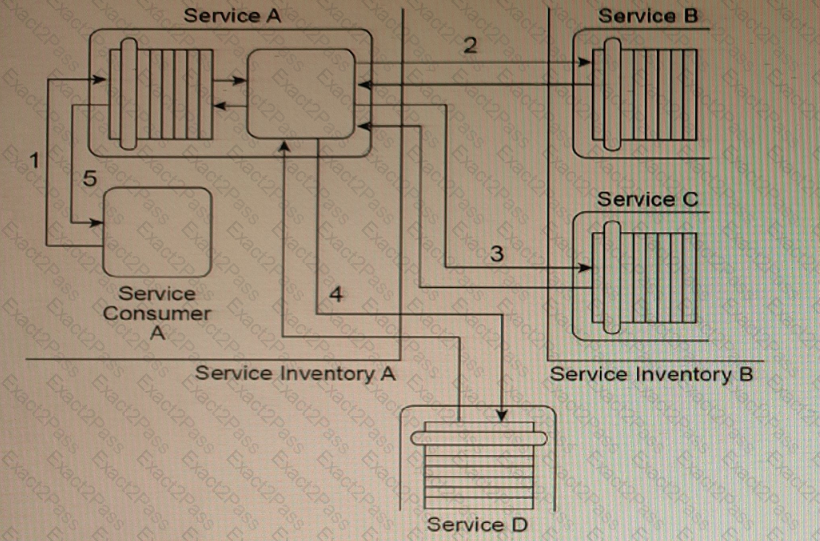
Service Consumer A and Service A reside in Service Inventory A. Service B and Service C reside in Service Inventory B. Service D is a public service that can be openly accessed via the World Wide Web. The service is also available for purchase so that it can be deployed independently within IT enterprises. Due to the rigorous application of the Service Abstraction principle within Service Inventory B, the only information that is made available about Service B and Service C are the published service contracts. For Service D, the service contract plus a service level agreement (SLA) are made available. The SLA indicates that Service D has a planned outage every night from 11:00pm to midnight.
You are an architect with a project team that is building services for Service Inventory A. You are told that the owners of Service Inventory A and Service Inventory B are not generally cooperative or communicative. Cross-inventory service composition is tolerated, but not directly supported. As a result, no SLAs for Service B and Service C are available and you have no knowledge about how available these services are. Based on the service contracts you can determine that the services in Service Inventory B use different data models and a different transport protocol than the services in Service Inventory A. Furthermore, recent testing results have shown that the performance of Service D is highly unpredictable due to the heavy amount of concurrent access it receives from service consumers from other organizations. You are also told that there is a concern over how long Service Consumer A will need to remain stateful while waiting for a response from Service A.
What steps can be taken to solve these problems?
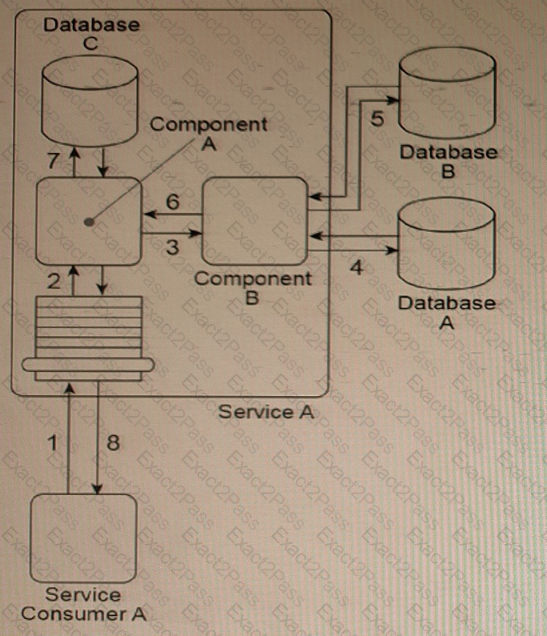
Service Consumer A sends Service A a message containing a business document (1). The business document is received by Component A, which keeps the business document in memory and forwards a copy to Component B (3). Component B first writes portions of the business document to Database A (4). Component B then writes the entire business document to Database B and uses some of the data values from the business document as query parameters to retrieve new data from Database B (5).
Next, Component B returns the new date* back to Component A (6), which merges it together with the original business document it has been keeping in memory and then writes the combined data to Database C (7). The Service A service capability invoked by Service Consumer A requires a synchronous request-response data exchange. Therefore, based on the outcome of the last database update, Service A returns a message with a success or failure code back to Service Consumer A (8).
Databases A and B are shared, and Database C is dedicated to the Service A service architecture.
There are several problems with this architecture. The business document that Component A is required to keep in memory (while it waits for Component B to complete its processing) can be very large. The amount of runtime resources Service A uses to keep this data in memory can decrease the overall performance of all service instances, especially when it is concurrently invoked by multiple service consumers. Additionally, Service A can take a long time to respond back to Service Consumer A because Database A is a shared database that sometimes takes a long time to respond to Component B. Currently, Service Consumer A will wait for up to 30 seconds for a response, after which it will assume the request to Service A has failed and any subsequent response messages from Service A will be rejected.
What steps can be taken to solve these problems?

