Exact2Pass

Last Update 12 hours ago Total Questions : 85
The Brocade Certified vRouter Engineer content is now fully updated, with all current exam questions added 12 hours ago. Deciding to include 170-010 practice exam questions in your study plan goes far beyond basic test preparation.
You'll find that our 170-010 exam questions frequently feature detailed scenarios and practical problem-solving exercises that directly mirror industry challenges. Engaging with these 170-010 sample sets allows you to effectively manage your time and pace yourself, giving you the ability to finish any Brocade Certified vRouter Engineer practice test comfortably within the allotted time.
Which two show commands will verify that a Brocade Vyatta vRouter upgrade completed successfully? (Choose two.)
You are configuring a static route to the Internet on Router A.
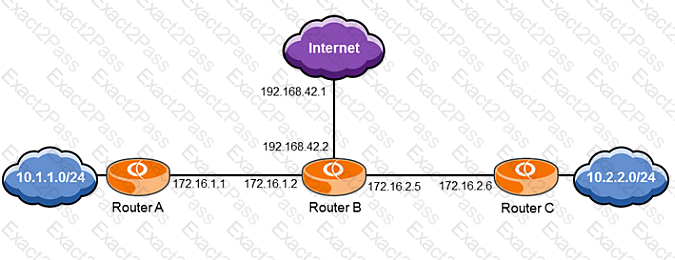
What is the correct next-hop address?
Some of your internal users are complaining that they can't get to the mail server at 10.6.7.22.
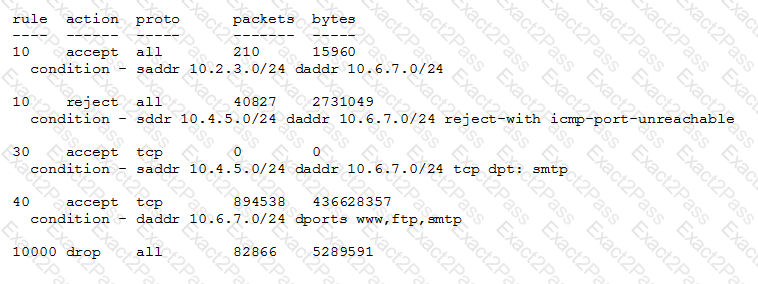
Looking at the firewall rulebase in the exhibit, what is the problem?
vyatta@vyatta:~$ show interfaces
Codes: S - State, L - Link, u - Up, D - Down, A - Admin Down
Interface IP Address S/L Description
--------- ---------- --- -----------
eth0 172.24.42.52/24 u/u
eth1 192.168.12.2/24 u/u
eth2 192.168.23.2/24 u/u
eth3 192.168.128.2/24 u/u
lo 127.0.0.1/8 u/u
::1/128
vyatta@vyatta:~$ show dns forwarding nameservers
-----------------------------------------------
Nameservers configured for DNS forwarding
-----------------------------------------------
172.24.42.1 available via 'system'
216.134.160.13 available via 'system'
Based on the output shown, which two statements are true? (Choose two.)
Which statement about NAT is true?
Which three commands can display rule details, such as protocols and ports? (Choose three.)
What are three characteristics of TCP? (Choose three.)
Which two steps are required to enable logging of firewalled packets? (Choose two.)
vyatta@VYA1:~$ show ip route ospf
O 192.168.12.0/24 [110/1] is directly connected, eth2, 00:07:36
O 192.168.13.0/24 [110/1] is directly connected, eth3, 00:07:36
O * > 192.168.23.0/24 [110/2] via 192.168.12.2, eth2, 00:05:05
* > [110/2] via 192.168.13.3, eth3, 00:05:05
O 192.168.101.0/24 [110/1] is directly connected, eth1, 00:07:36
O * > 192.168.128.0/24 [110/2] via 192.168.12.2, eth2, 00:05:53
O * > 192.168.129.2/32 [110/11] via 192.168.12.2, eth2, 00:05:53
O * > 192.168.130.2/32 [110/11] via 192.168.12.2, eth2, 00:05:53
O * > 192.168.131.2/32 [110/11] via 192.168.12.2, eth2, 00:05:53
O * > 192.168.160.0/24 [110/2] via 192.168.13.3, eth3, 00:05:05
O * > 192.168.161.3/32 [110/11] via 192.168.13.3, eth3, 00:05:05
O * > 192.168.162.3/32 [110/11] via 192.168.13.3, eth3, 00:05:05
O * > 192.168.163.3/32 [110/11] via 192.168.13.3, eth3, 00:05:05
vyatta@VYA1:~$ show ip route summary
IP routing table name is Default-IP-Routing-Table(0)
IP routing table maximum-paths is 8
Route Source Networks
connected 7
static 1
ospf 9
Total 17
FIB 9
vyatta@VYA1:~$
Based on the output, what is the reason not all OSPF routes have been added to the FIB?
vyatta@Vyatta1:~$ show firewall name PublicServers statistics
IPv4 Firewall "PublicServers":
Active on (eth0,IN)
rule packets bytes action source destination
---- ------- ----- ------ ------ -----------
10 210 15960 ACCEPT 10.2.3.0/24 10.6.7.0/24
20 40827 2731049 ACCEPT 10.4.5.0/24 10.6.7.0/24
30 69381 4192375 REJECT 10.4.5.0/24 10.6.7.0/24
40 89538 5366257 ACCEPT 0.0.0.0/0 10.6.7.0/24
10000 82866 5289591 DROP 0.0.0.0/0 0.0.0.0/0
Based on the output shown, which statement is true about this firewall configuration?

