
Spring Sale Special Limited Time 70% Discount Offer - Ends in 0d 00h 00m 00s - Coupon code: buysanta

Exact2Pass Menu

Oracle Order Management Cloud Order to Cash 2025Implementation Professional

Last Update 12 hours ago Total Questions : 149

The Oracle Order Management Cloud Order to Cash 2025Implementation Professional content is now fully updated, with all current exam questions added 12 hours ago. Deciding to include 1z0-1077-25 practice exam questions in your study plan goes far beyond basic test preparation.

You'll find that our 1z0-1077-25 exam questions frequently feature detailed scenarios and practical problem-solving exercises that directly mirror industry challenges. Engaging with these 1z0-1077-25 sample sets allows you to effectively manage your time and pace yourself, giving you the ability to finish any Oracle Order Management Cloud Order to Cash 2025Implementation Professional practice test comfortably within the allotted time.

Question # 1

Your client will use the Configure to Order application to guide a customer through the ordering process for a new tablet. As part of the selection flow, if a customer chooses the widescreen display, the font camera option is not available.

Which two Configurator model components should the client use to enforce this?

A.

Configurator Rules

B.

Contra-product Rules

C.

User Parameters

D.

Model Structure

Question # 2

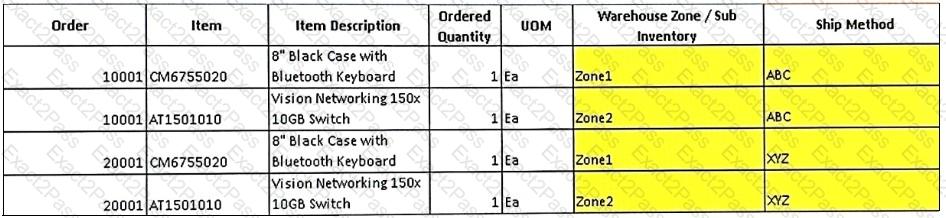
Your company has a warehouse that is classified as two different zones to enforce allocation and picking from only one subinventory at a time. The business has a contract with a specific outbound logistics carrier to deliver all orders for a particular customer zone or postal code.

How do you release orders that are scheduled to be fulfilled from a particular subinventory and delivered through a specific carrier?
A.

Define pick wave release rules specifying the shipment method and the subinventory on the Demand Selection Criteria tab.

B.

Define a release sequence rule using the attribute as subinventory.

C.

Use a picking rule specifying the pickling order for the subinventory.

D.

Define pick wave release rules specifying the shipment method and pick from a subinventory under the Options tab.

E.

Define a release sequence rule using the attribute as shipment priority.

Question # 3

Which change mode takes a snapshot at the stages mentioned below:

    When the orchestration process starts

    When a change order is received at an orchestration process step

A.

Incremental

B.

Simple

C.

None

D.

Advanced

Question # 4

In the Cloud Order Management system, identify the function performed by the External Interface Layer.

A.

It manages the communication between Order Management and external or internal fulfillment systems.

B.

It sends information to downstream fulfillment systems, and interprets responses and updates from those systems.

C.

It receives information from upstream order capture systems, sends information to downstream fulfillment systems, and interprets responses and updates from those systems.

D.

It imports orders and processes them to fulfillment lines before assigning them to fulfillment systems.

Question # 5

Which process requires the Process Supply Chain Orchestration Interface process to be executed manually so that a supply order gets created?

A.

Planned Order Releases

B.

Drop Shipment

C.

Back-to-Back Procurement

D.

Back-to-Back Contract Manufacturing

E.

Min-Max planning replenishing a purchase request

Question # 6

Identify three ongoing maintenance tasks that a user is required to execute from the Order Management Work Area after the Order Management Implementation is completed. (Choose three.)

A.

Manage Fulfillment Line Exceptions

B.

Manage Order in Errors

C.

Manage Order Orchestration Messages

D.

Manage Source Systems

E.

Manage Orchestration Statuses

Question # 7

A global Power Systems manufacturer sells Uninterrupted Power Supply (UPS) products through its online portal. To gain competitive advantage, the manufacturer wants to enhance the ability of buyers to select a desired configuration of the high-end UPS models through guided selling options on its online selling portal. The company’s product development team has finalized the enhancements, and needs your help to get them implemented on their online selling portal that is supported by Oracle Cloud Configurator.

What four actions would you take in Oracle Cloud Configurator to enhance a buyer’s experience? (Choose four.)

A.

You can allow buyers to raise requests if an expected product functionality is not offered.

B.

You can create enhancements to the model structure that supplements the imported configurable structure of a model item.

C.

You can create rules that will guide users in creating a valid model.

D.

You can create user interfaces that will be dynamically presented to users based on the options chosen in the Configurator model.

E.

You can test the behavior of the configured model anytime when you are editing it.

F.

You can enable a checkout option for a model when a valid configuration is finalized.

G.

You can display product reviews of customers who have purchased the same configuration earlier.

Question # 8

Which action must be performed on the orchestration process user interface to activate an orchestration process after the order orchestration configurations are completed?

A.

Download the generated orchestration process.

B.

Validate the orchestration process.

C.

Release the orchestration process.

D.

Release and deploy the orchestration process.

Question # 9

You want to decrease the implementation time for Order Management by using the Quick Start feature. Select the accurate list of four areas that you can configure by using the Quick Start feature.

A.

Objects in receiving, objects in advanced fulfillment, default pick release attributes for the shipping parameters of inventory facilities, and orchestration process for shipping and returning an order

B.

Default general shipping parameters, objects in order management parameters, default pick release attributes for the shipping parameters of inventory facilities, and orchestration process for shipping and returning an order

C.

Default general shipping parameters, objects in order management parameters, objects in advanced fulfillment, and orchestration process for shipping and returning an order

D.

Objects in advanced fulfillment, default pick release attributes for the shipping parameters of inventory facilities, objects in receiving, objects in order management parameters

E.

Default general shipping parameters, objects in receiving, default pick release attributes for the shipping parameters of inventory facilities, and orchestration process for shipping and returning an order

Question # 10

Your company is using Order Management Cloud to capture orders, and has integrated with a legacy inventory application for order fulfillment. A fulfillment request needs to be aggregated and sent to an external inventory application.

What step would you perform to aggregate the request?

A.

Create a new custom task by using the Shipment Task Layer.

B.

Create a new custom task by using the Fulfillment Task Layer.

C.

Create a new custom task by using the Supply Task Layer.

D.

Configure a fulfillment task routing rule with aggregation criteria based on time limit or total number of lines.

Go to page:
