Spring Sale Special Limited Time 70% Discount Offer - Ends in 0d 00h 00m 00s - Coupon code: buysanta

Exact2Pass Menu

Oracle Database 19c: Program with PL/SQL

Last Update 9 hours ago Total Questions : 65

The Oracle Database 19c: Program with PL/SQL content is now fully updated, with all current exam questions added 9 hours ago. Deciding to include 1z0-149 practice exam questions in your study plan goes far beyond basic test preparation.

You'll find that our 1z0-149 exam questions frequently feature detailed scenarios and practical problem-solving exercises that directly mirror industry challenges. Engaging with these 1z0-149 sample sets allows you to effectively manage your time and pace yourself, giving you the ability to finish any Oracle Database 19c: Program with PL/SQL practice test comfortably within the allotted time.

Question # 11

Examine this statement which is submitted for compilation:
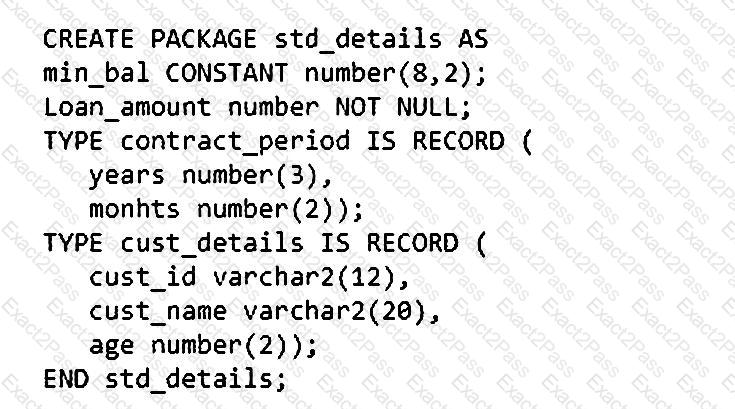
Which three are true? (Choose three.)

A.

This is a PACKAGE specification. A PACKAGE BODY is needed to use this.

B.

This will not compile successfully because the loan_amount variable is declared NOT NULL but lacks an initialization assignment.

C.

This program unit will compile successfully.

D.

Initialization of min_bal can be done while using this packaged constant in another program.

E.

Initialization of loan_amount can be done while using this packaged variable in another program.

F.

This will not compile successfully because the min_bal constant must be initialized.

G.

This is BODILESS PACKAGE. A PACKAGE BODY is not required to use this.

Question # 12

Examine these statements:

Which is true?

A.

It will result in a compilation error for protected_proc because calling_proc does not exist.

B.

It will result in a compilation error for protected_proc because calling_proc must be prefixed with the schema name.

C.

It will result in a successful compilation because objects referenced in an ACCESSIBLE BY clause are not checked at compile time.

D.

With adequate privileges, PROTECTED_PROC procedure can be called by other programs apart from CALLING_PROC.

Question # 13

Sequence S and table PRODUCTS exist in your schema.

Examine the table description:

Now, examine this block of code:
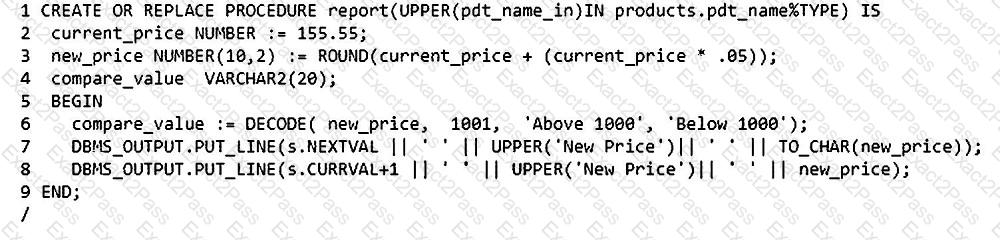
Which two lines each result in a compilation error? (Choose two.)

A.

line 1

B.

line 6

C.

line 8

D.

line 2

E.

line 3

F.

line 7

Question # 14

Which two are true about using the ACCESSIBLE BY clause? (Choose two.)

A.

It can be used in the declaration of object types.

B.

It must be specified in the heading of a package specification.

C.

The check is enforced by this clause for direct access and access through dynamic SQL.

D.

It can be used for individual procedures and functions declared in a package specification.

E.

It must be specified in the heading of a package body.

Question # 15

Which three are true about user-defined functions? (Choose three.)

A.

They can be used in ORDER BY and GROUP BY clauses.

B.

They can be executed as standalone commands.

C.

They must be defined with at least one parameter.

D.

They need not return any values.

E.

They can appear in the select list of a SELECT statement.

F.

Functions can call only other functions.

G.

They can be used in CONNECT BY and START WITH clauses.

Question # 16

Which two are true about the PLSQL_CODE_TYPE parameter? (Choose two.)

A.

Changing the parameter setting automatically changes the setting for existing PL/SQL library units.

B.

The default value is NATIVE.

C.

If set to NATIVE, programs are stored in platform dependent machine code.

D.

It can use the REUSE SETTINGS clause to recompile a program unit without changing to the current session settings.

E.

If set to NATIVE, programs are stored in a PL/SQL bytecode format.

Question # 17

Examine the EMPLOYEES table structure:
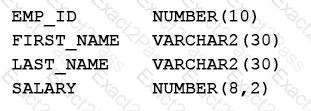
Now, examine this code:
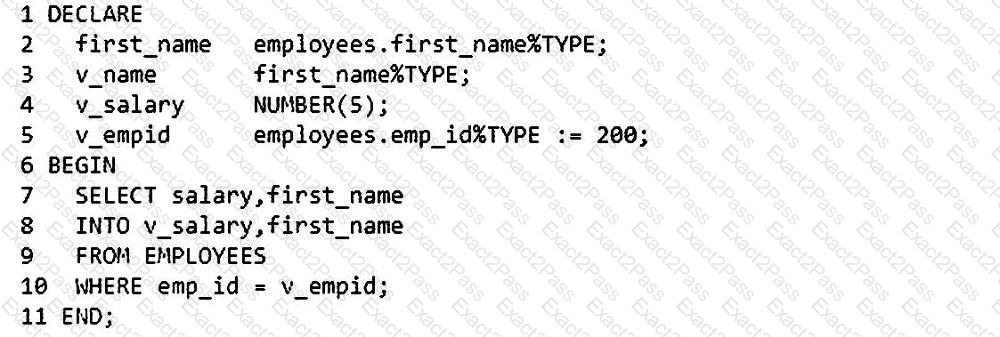
Which statement is true about the result of executing this block?

A.

It will execute successfully provided the salary of EMP_ID 200 does not exceed the value 99999.

B.

It will return an error at line 2.

C.

It will return an error at line 3.

D.

It will return an error at line 8.

E.

It will execute successfully by rounding up the salary of EMP_ID 200 to the appropriate value.

Question # 18

Which three are valid PL/SQL variable names? (Choose three.)

A.

printer_name#

B.

1to7number

C.

yesterday's_date

D.

leap$year

E.

Number_of_days_between_March_and_April

F.

#printer_name

G.

v_fname

Question # 19

Examine these facts:

Table EMP exists in schema USERA with columns SALARY and EMP_ID.

EMP_ID is the primary key with values ranging from 1 to 100.

USERA now executes these statements successfully:
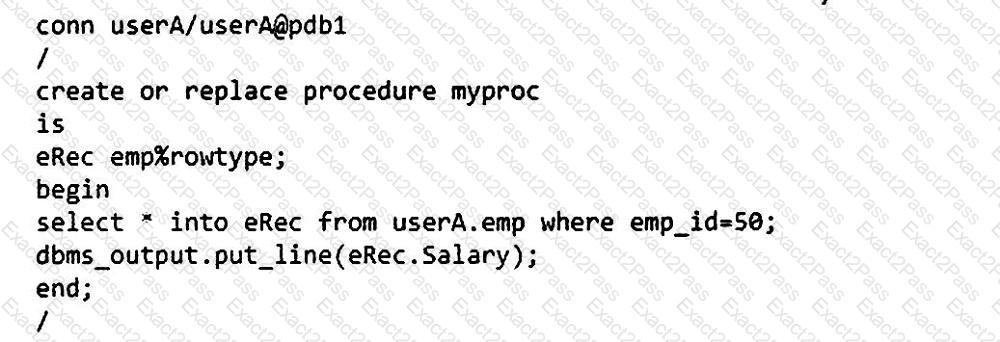
USERA then grants execute privilege on procedure MYPROC to USERB.

USERB exists in the database identified by pdb1 but does not have select privilege on USERA.EMP.

USERB now executes these statements:

conn userB/userB@pdb1

execute userA.myproc;

Which is true?

A.

It results in an error because Authid Current_User is missing from MYPROC.

B.

It results in an error because Authid Definer is missing from MYPROC.

C.

It results in an error because USERB doesn't have select privilege on USERA.EMP.

D.

It executes successfully.

Go to page: