Spring Sale Special Limited Time 70% Discount Offer - Ends in 0d 00h 00m 00s - Coupon code: buysanta

Exact2Pass Menu

Oracle Hyperion Data Relationship Management Essentials

Last Update 8 hours ago Total Questions : 73

The Oracle Hyperion Data Relationship Management Essentials content is now fully updated, with all current exam questions added 8 hours ago. Deciding to include 1z0-588 practice exam questions in your study plan goes far beyond basic test preparation.

You'll find that our 1z0-588 exam questions frequently feature detailed scenarios and practical problem-solving exercises that directly mirror industry challenges. Engaging with these 1z0-588 sample sets allows you to effectively manage your time and pace yourself, giving you the ability to finish any Oracle Hyperion Data Relationship Management Essentials practice test comfortably within the allotted time.

Question # 11

The images or icons in the first two columns of the properties Tab indicate the following about a property:

1. Local property or global property

2. Locally inherited or globally inherited

3. Value is overridden

4. Value is default

5. Value is calculated

6. Value is manually entered

A.

1, 2 only

B.

1, 2, 3 only

C.

1, 2, 4 only

D.

1, 4 only

E.

1, 2, 3, 4, 6 only

F.

1, 2, 3, 4, 5 only

Question # 12

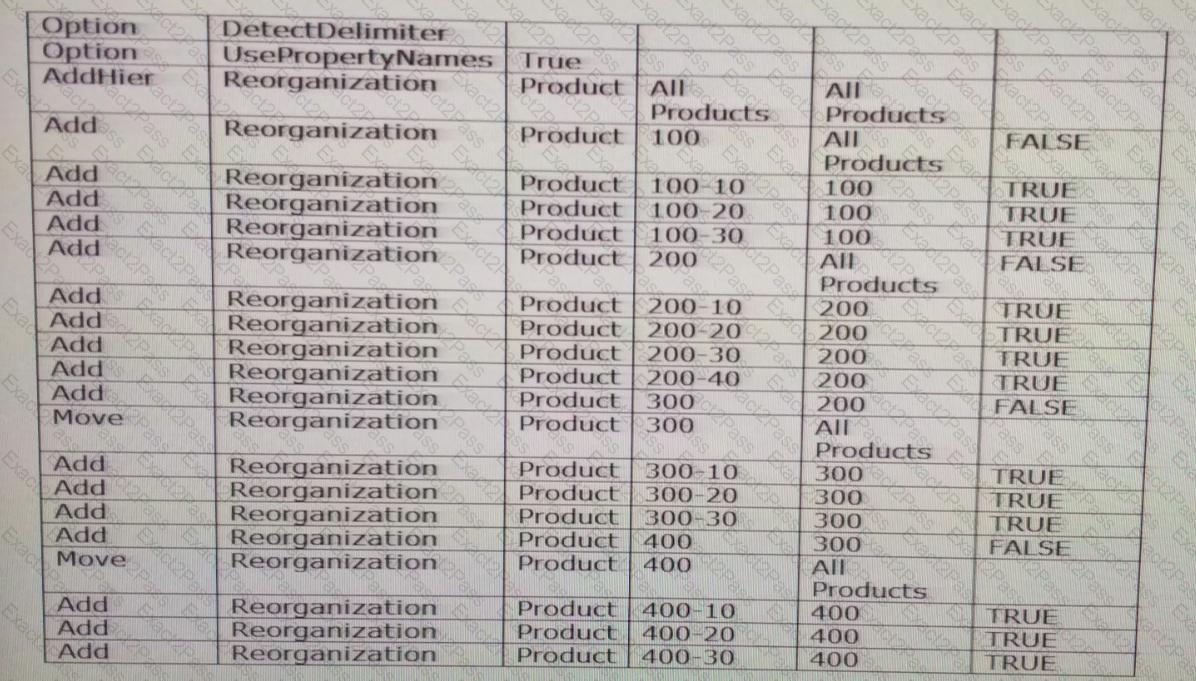
Per the example:

What are the three outcomes after running the action script?

A.

Nothing changes in DRM, because the action script will fail to import due to formatting issues.

B.

A hierarchy called "Product" will be created in the Reorganization version in DRM.

C.

The top node in the hierarchy is All Products.

D.

Products 100, 200, 300, and 400 are first created under the incorrect parent but are subsequently moved in the action script.

E.

The two lines with the "Move" command will fail, because a value is missing from the last column for those lines.

F.

Products 100-10, 100-20, 100-30, 200-10, 200-20, 200-40, 400-10, and 400-30 are some of the leaf nodes in the hierarchy.

Question # 13

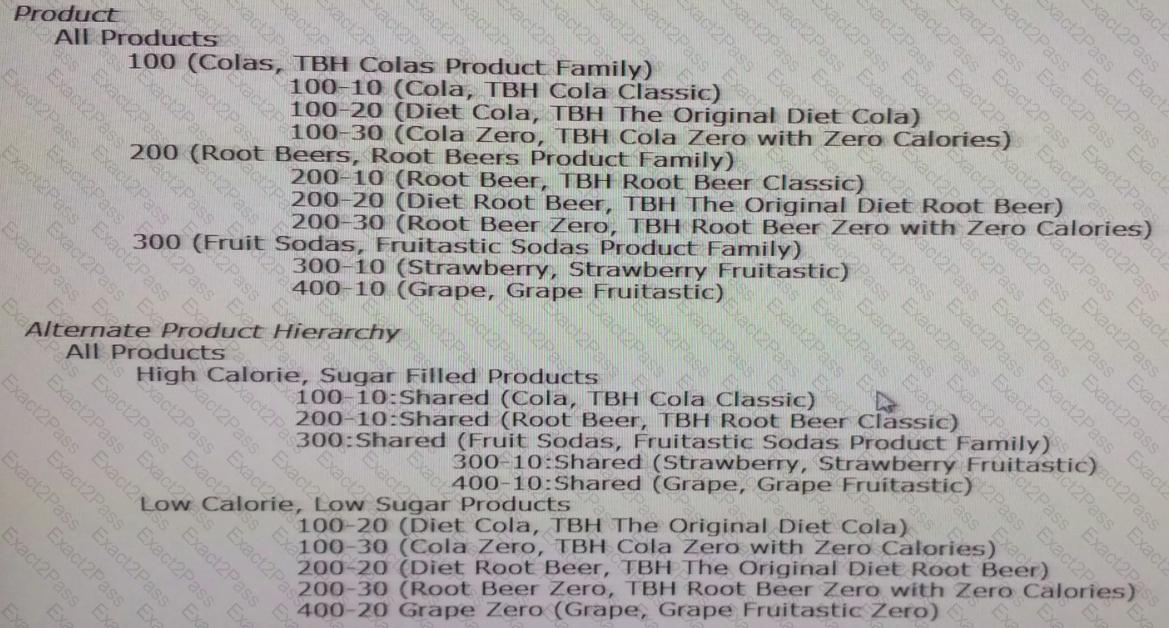
Per the example:

Identify the two true Statements about the Product hierarchy and its alternate hierarchy.

A.

300-10 is called an Explicit Shared Node.

B.

300-10 is called an Implicit Shared Node.

C.

300 is not a valid shared node because only leaf nodes may be shared.

D.

You can delete the node 300-10 in the alternate product hierarchy,

E.

You can change local property values in the alternate product hierarchy.

F.

You can change any of the system generated property values on the Shared Node property category for the alternate product hierarchy.

Question # 14

Identify the two true statements about node access groups.

A.

Node access groups use inheritance to assign the same access to descendants of a node but this inherited security may be overwritten at lower levels.

B.

Valid node access levels are Read, Edit, LimitedEdit, Insert, Inactivate, and Add.

C.

Access levels are assigned separately for leaf and limb nodes.

D.

Node access groups can be used to filter the display of the hierarchy so that users only see the section of the hierarchy for which they have access.

E.

Node access groups may be assigned by the Application Administrator or Access Manager.

Question # 15

You decide to implement node type? for the Account dimension. What are the required steps that must be completed to implement a node type?

1. Under Administer, create node types with valid assigned DRM elements.

2. Create a hierarchy property that contains a list of values that matches the node types defined.

3. Create a local node property called "HierarchyNodeType".

4. For version, set the HierarchyNodeType to "Dimension".

5. For the hierarchy, set the Dimension property to the desired Node type value (for example. Account dimension type for the Account hierarchy).

6. Upload a glyph for each node type.

A.

1, 2, 3, 5 only

B.

1, 3, 4, 5 only

C.

1, 2, 3, 4, 5 only

D.

1, 2, 3, 5, 6 only

E.

1, 2, 3, 4, 5, 6

Question # 16

Identify the two true statements about user permissions.

A.

Administrators assign a permission level to a user; and based on that permission, a role is associated to that user.

B.

If a user has conflicting levels of access, the lowest level of access is assigned.

C.

You can set up a security administrator who only has access to user management and no access to create or manage data and metadata within DRM.

D.

DRM uses Property Categories to assign security access for Property Definitions.

E.

Security in DRM can be assigned by Version, Hierarchy, Property Category, and Property Definition.

Question # 17

Identify the three true statements about Workflow in DRM.

A.

Change requests are stored in a draft state for approval.

B.

Change requests are validated against a version and committed to the draft version.

C.

Change requests pending approval cannot be changes until the change has been approved.

D.

Change requests are committed to a version once the request is approved.

E.

Workflow is exposed through the API.

Question # 18

The Time Balance property definition is applicable to the Account hierarchy only and is not valid for any other hierarchy. You would like to simplify the view for end users so they do not see the Time Balance property for the Entity dimension.

What method will achieve this requirement?

A.

Assigning the Time Balance property to the Account hierarchy

B.

Assigning security to the Time Balance property

C.

Choosing the property definition option to hide the Time Balance property for all hierarchies except Account

D.

Creating a node type for the Account hierarchy

E.

Assigning a glyph for the Account hierarchy

Question # 19

An issue exists in which "reserved" key words have been used or included in the custom alias property for a downstream system. The reserved words are "Dynamic" and "MBRNAME".

The steps for creating a real-time validation are:

1. Create a custom property to verify that the value input in the custom alias property does not contain the reserved words.

2. Test the custom property.

3. Create a custom Validation with the "Property Equals Value" class.

4. Test the validation.

5. Assign the Validation to a version.

A.

1, 2 only

B.

3, 5 only

C.

1, 2, 3, 4 only

D.

1, 3, 5 only

E.

1, 2, 3, 4, 5

Question # 20

The Data Relationship Management API Adapter is required for the DRM API. Identify three other components that are required to use the DRM API.


A.

Oracle WebLogic Server 11g

B.

JDeveloper

C.

EPM Workspace

D.

Oracle Web Services Manager (OWSM)

E.

Shared Services

Go to page: