Spring Sale Special Limited Time 70% Discount Offer - Ends in 0d 00h 00m 00s - Coupon code: buysanta

Exact2Pass Menu

Java SE 11 Developer

Last Update 19 hours ago Total Questions : 296

The Java SE 11 Developer content is now fully updated, with all current exam questions added 19 hours ago. Deciding to include 1z0-819 practice exam questions in your study plan goes far beyond basic test preparation.

You'll find that our 1z0-819 exam questions frequently feature detailed scenarios and practical problem-solving exercises that directly mirror industry challenges. Engaging with these 1z0-819 sample sets allows you to effectively manage your time and pace yourself, giving you the ability to finish any Java SE 11 Developer practice test comfortably within the allotted time.

Question # 61

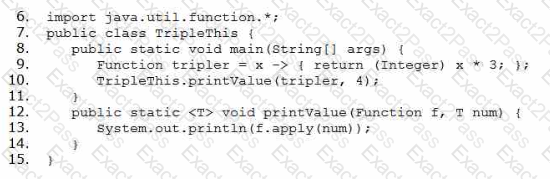
Given TripleThis.java:

Compiling TripleThis.java gives this compiler warning:

Note: TripleThis.java uses unchecked or unsafe operations.

Which two replacements done together remove this compiler warning?

A.

Replace line 9 with function < Integer > tripler = x- > - { return (Integer) X * 3 ; }.

B.

Replace line 12 with public static void printValue function < Integer > f, int num) {.

C.

Replace line 12 with public static int printValue function < Integer, Integer > , f, T num {.

D.

Replace line 12 with public static < T > void printValue (Function < T, T > f, T num ) {,

E.

Replace line 9 with function < Integer > , Integer > = X - > { return (integer) x * 3; }.

Question # 62

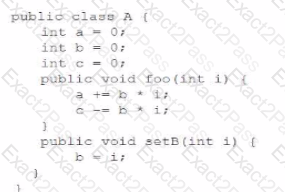
Given:

Which make class thread safe?

A.

Make foo and sets synchronized.

B.

Make setB synchronized.

C.

Make foo synchronized.

D.

Class A is thread safe.

E.

Make a synchronized.

Question # 63

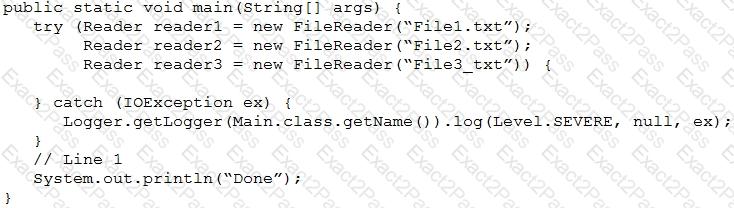
Given:

When run and all three files exist, what is the state of each reader on Line 1?

A.

All three readers are still open.

B.

All three readers have been closed.

C.

The compilation fails.

D.

Only reader1 has been closed.

Question # 64

Given:

Which two statements are valid to be written in this interface? (Choose two.)

A.

public abstract void methodB();

B.

final void methodG(){System.out.println(“G”);}

C.

private abstract void methodC();

D.

public String methodD();

E.

public int x;

F.

final void methodE();

G.

public void methodF(){System.out.println(“F”);}

Question # 65

Which interface in the java.util.function package will return a void return type?

A.

Supplier

B.

Predicate

C.

Function

D.

Consumer

Question # 66

Given:

List < String > longlist = List.of(“Hello”,”World”,”Beat”);

List < String > shortlist = new ArrayList < > ();

Which code fragment correctly forms a short list of words containing the letter “e”?
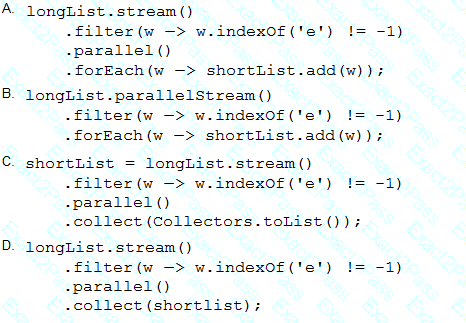
A.

Option A

B.

Option B

C.

Option C

D.

Option D

Question # 67

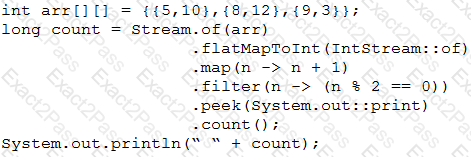
Given:

What is the result?

A.

6910 3

B.

10126 3

C.

3

D.

6104 3

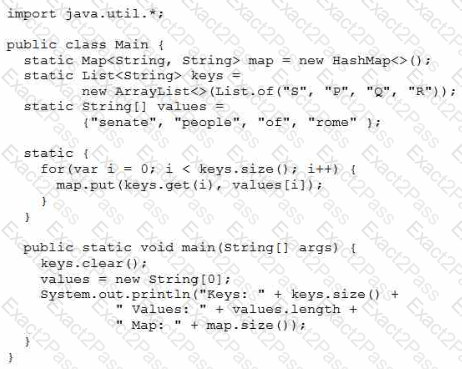
Question # 68

Given:

What is the result?

A.

Keys: 4 Values: 4 Map: 0

B.

Keys: 4 Values: 4 Map: 4

C.

The compilation fails.

D.

Keys: 0 Values: 0 Map:

E.

Keys: 0 Values: 0 Map: 0

Question # 69

Given:

Which statement on line 1 enables this code to compile?

A.

Consumer function = (String f) - > (System.out.println(f);};

B.

Supplier function = () - > fruits.get (0);

C.

Predicate function = a - > a.equals( " banana " );

D.

Function function = x - > x.substring(0,2);

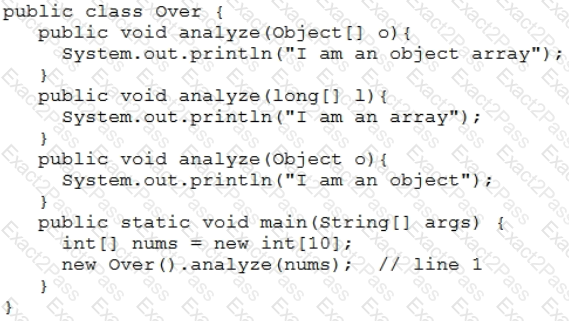
Question # 70

Given:

What is the output?

A.

I am an object array

B.

The compilation fails due to an error in line 1.

C.

I am an array

D.

I am an object

Go to page: