
Spring Sale Special Limited Time 70% Discount Offer - Ends in 0d 00h 00m 00s - Coupon code: buysanta

Exact2Pass Menu

Upgrade to Oracle Solaris 11 System Administrator

Last Update 22 hours ago Total Questions : 133

The Upgrade to Oracle Solaris 11 System Administrator content is now fully updated, with all current exam questions added 22 hours ago. Deciding to include 1z0-820 practice exam questions in your study plan goes far beyond basic test preparation.

You'll find that our 1z0-820 exam questions frequently feature detailed scenarios and practical problem-solving exercises that directly mirror industry challenges. Engaging with these 1z0-820 sample sets allows you to effectively manage your time and pace yourself, giving you the ability to finish any Upgrade to Oracle Solaris 11 System Administrator practice test comfortably within the allotted time.

Question # 21

You are setting up a local IPS package repository on your Oracle Solaris 11 server; solans example.com

You want to point the existing local IPS publisher to the new local IPS repository located in /repo. These are the steps that you have followed:

1 Download and rsync the contents of the Oracle Solaris 11 repository ISO image to the /repo directory.

2. Configure the repository server service properties. The svcprop command displays the IPS-related properties:

pkg/inst_root astnng /repo pkg/readonly boolean true

The Is command displays the contents of the /repo directory:

#ls /repo

pkg5 repository publisher

The svcs command shows the svc:/application/pkg/server:default service is online.

The pkg publisher command still displays:

PUBLISHERTYPESTATUSURI solarisoriQinonlinehttp://DkQ.Qracle.conVsolaris/release/

Which step needs to be performed to set the local IPS publisher to the local IPS repository /repo?

A.

issue the pkgrepo refresh -s command to refresh the repository.

B.

Restart the svc:/application/pkg/server:default service.

C.

issue the pkg set-publisher command to set the new repository location.

D.

issue the pkgrepo rebuild command to rebuild the repository.

E.

issue the pkgrepo set command to set the new repository location-

Question # 22

you are 10 create a l\-z > me system witn ine roiiowing specmcaiions:

Izjb compression enabled

cannot consume more than 2 GB from the storage pool

redundant data at the block level eliminated

mounted as /data

Which command creates the desired file system?

A.

zfs create -o mountpoint=/data,compression=on,algorithm=lzjb,deduplication=on,quota=2g/pool1/data

B.

zfs create -o mountpomt=/data compression=on algonthm=lzjb deduphcation=on quota=2g pool!/data

C.

zfs create -o mountpoint=/data -o compression=on -o dedup=on -o quota=2g pooll/data

D.

zfs create -o mountpomt=/data -o compression=on -o algorithm=lzjb -o deduplication=on -o quota=2g pool 1/data

E.

zfs create pool 1 /data zfs set mountpoint=/data,quota=2g.dedup=on,compression=on /pooM/data

Question # 23

The core dump configuration for your system is:
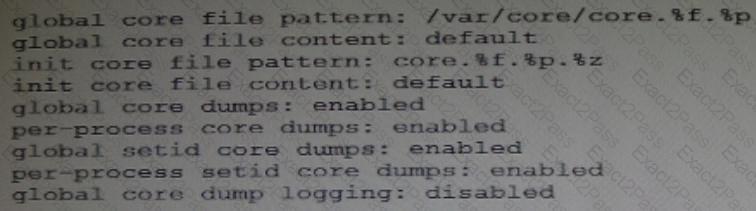
A user is running a process in the global zone and the process crashes. The process information is:

User1 2663 2618 0 17:46:42 pts/2 0:00 /usr/bin/bash

The server host name is: zeus

What will the per-process core file be named?

A.

core.bash.2663.global

B.

core.bash.2663.zeus

C.

/var/core/core.bash.2663

D.

/var/core/core.bash.2663.global

Question # 24

You need to remove the gzip software package.

Before you remove the package, you want to create a backup of the operating environment.

Which IPS command should you use?

A.

Use the pkg remove command with the -require-backup-be option

B.

Use the beadm create command to create a new boot environment

Use the pkg remove command to remove the gzip package from the current boot environment.

C.

Use the luucreate command to create a new boot environment.

Use the pkgrm command to remove the gzip package from the current boot environment

D.

Use the pkg unmstall command with the -backup-be-name option

Question # 25

After installing the OS, you boot the system and notice that the syslogd daemon is not accepting messages from remote systems.

Which two options should you select to modify the syslogd daemon configuration so that it accepts messages from remote systems?

A.

svccfg -s svc:/system/system -log setprop start/exec= “syslogd -t”

Restart the syslogd daemon.

B.

Set the following parameter in the /etc/syslogd.conf file: LOG_FROM_REMOTE= YES

Restart the syslogd daemon.

C.

svcadm enable svc:/system/system -log/config/log_from_remote

Restart the syslogd daemon.

D.

svccfg -s svc:/system/system-log setprop config/log_from_remote=true

Restart the syslogd daemon.

E.

Set the following parameter in the /etc/default/syslogd file: LOG_FROM_REMOTE=YES

Restart the syslogd daemon.

Question # 26

You are asked to troubleshoot networking issues on an unfamiliar system.

Select the correct command to display what network devices are installed.

A.

ifconfig -a

B.

dladm show-dev

C.

dladm show-phys

D.

dladm show-ether

E.

netadm show-dev

F.

netadm show-ether

Question # 27

Review the output from a ZFS file system:

NAMEPROPERTYVALUESOURCE

pool1/encryptencryptionaes-256-ccmlocal pool1/encryptkeysourceraw,file///mykeylocal

You need to recreate the pooM/encrypt file system exactly as it is listed above Which two commands can you use to recreate the pooM/encrypt file system?

(Choose two.)

A.

pktool genkey keystone=file outkey=/mykey keytype=aes keylen=256

B.

genkey pktool keystore=file outkey=/mykey keytype=aes keylen=256

C.

zfs create -o encryption=aes-256-ccm -o keysource=raw,file://mykey pooll/encrypt

D.

zfs create -o encryption=aes-256-ccm -o keysource=raw,file:///mykey pooM/encrypt

E.

zfs create -o encryption=aes-256-ccm -o keysource=raw,file:///mykey source=local pooll/encrypt

Question # 28

You need to migrate a UFS file system named /production_ufs to a ZFS file system named /production_ufs. The /production_ufs file system cannot be taken down or be out of production during the migration, and the current /production_ufs file system must remain active until the /ptoduction_zfs file system is copied and ready.

Which method allows you to meet both requirements?

1. Copy live data from /production_ufs to /production_zfs while /production_ufs is in use.

2. When the copy is complete, /production_zfs will contain an up-to date copy of /production_ufs

A.

Create a snapshot of the UFS file system.

Create the new ZFS file system.

Use cpio to copy data from the snapshot to the new ZFS file system.

B.

Create a new Boot Environment.

Create the ZFS file system.

Use lucreate -m to copy data from the Current UFS file system to the new ZFS file system.

C.

Mirror the existing UFS file system by using SVM.

After both submissions are in sync, migrate one of the submissions to a ZFS file System by using Live Upgrade.

D.

Create the new ZFS file system by using zfs create import to import data from the existing UFS file system into the new ZFS file system

E.

Create the new zfs file system by using the zfs create -o shadow.

Question # 29

View the Exhibit, and review the zpool and ZFS configuration information from your system
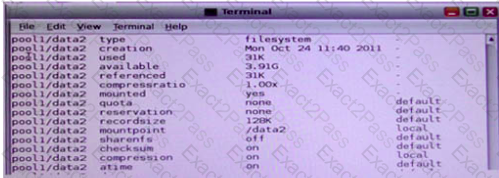
The application development team requested an up-to-date copy of the data from the /prod_data file system. You decide to give the team one of the disk drives containing the data by breaking the mirror, removing the disk c4t1d0 and mounting c4t1 dO under a new mount point named /dev_data. Identify the correct procedure for breaking the mirror, removing c4t1d0. and making the data on that drive accessible under the /dev_data mount point

A.

zfs destroy pooh /prod_data

zfs create pool1/prod_data c4t1d0 zfs create pool1/dev_data c4t1d0

B.

zfssplitpool1/prod_data

zfs mount -F zfs pool1/dev_data c4t1d0

C.

zpool split pooll pool2 zpool import pool2 zfs set mountpoint=/dev_data pool2/prod_data

D.

zpool split pool1/prod_data -n pool2/dev_data

zpool import -o mountpoint=/dev_data pool2/dev_data

3 e zfs split pool1/prod_data -n pool2/dev_data zfs set mountpoint=/dev_data pool2/dev_data

Question # 30

ServerA contains two ISO images of a package repository named so1.repo.iso-a and so1.repo.iso-b respectively. You need to create a single local package repository on server that clients can connect to. The package repository will be stored on the /export/IPS file system and named repo. The preferred publisher will be named solaris and the publisher URL will be http://serverA.example.com.

Which is the correct procedure to perform on ServerA to create the local Package repository?

A.

cat so1.repo.iso-a sol.repo.iso-b > so1.full.iso

Mount the ISO image and use the rsync command to extract the contents of the ISO file to the /export/IPS file system.

Set the pkg/inst_root property to /export/IPS/repo and the pkg/readonly property to true.

Set the preferred publisher by using pkg set-publisher -G

http://pkg.oracle.com/solaris/release/ \

-g

B.

cat so1.repo.iso-a so1.repo.iso-b > /export/IPS/repo

Set the pkg/inst_root property to true and the pkg/readonly property to /export/IPS

Set the preferred publisher by using pkg set-publisher -G http://serverA.example.com/ \

-g http://pkg/oracle.com/solaris/rekease/solaris

C.

cat so1.repo.iso-a so1.repo.iso-b > so1.full.iso

Mount the ISO image and use the rsync command to extract the contents of the ISO file to /export/IPS/repo

Set the pkg/inst_root property to /export/IPS/repo and the pkg/readonly property to true

Set the preferred publisher by using pkg set-publisher solaris \

-g http://pkg.oracle.com/

D.

cat so1.repo,iso-a so1.repo.iso-b > /export/IPS/repo.iso

Mount the ISO image and copy the repo directory from the ISO image to /export/IPS/repo

set the pkg/inst_root property and the pkg/readonly property to /export/IPS/repo

set the preferred pkg/inst_root property by using pkg set-publisher - G http://serverA.example.com/ \

- g
