
Spring Sale Special Limited Time 70% Discount Offer - Ends in 0d 00h 00m 00s - Coupon code: buysanta

Exact2Pass Menu

Nokia IS-IS Routing Protocol

Last Update 3 hours ago Total Questions : 40

The Nokia IS-IS Routing Protocol content is now fully updated, with all current exam questions added 3 hours ago. Deciding to include 4A0-112 practice exam questions in your study plan goes far beyond basic test preparation.

You'll find that our 4A0-112 exam questions frequently feature detailed scenarios and practical problem-solving exercises that directly mirror industry challenges. Engaging with these 4A0-112 sample sets allows you to effectively manage your time and pace yourself, giving you the ability to finish any Nokia IS-IS Routing Protocol practice test comfortably within the allotted time.
Question # 1

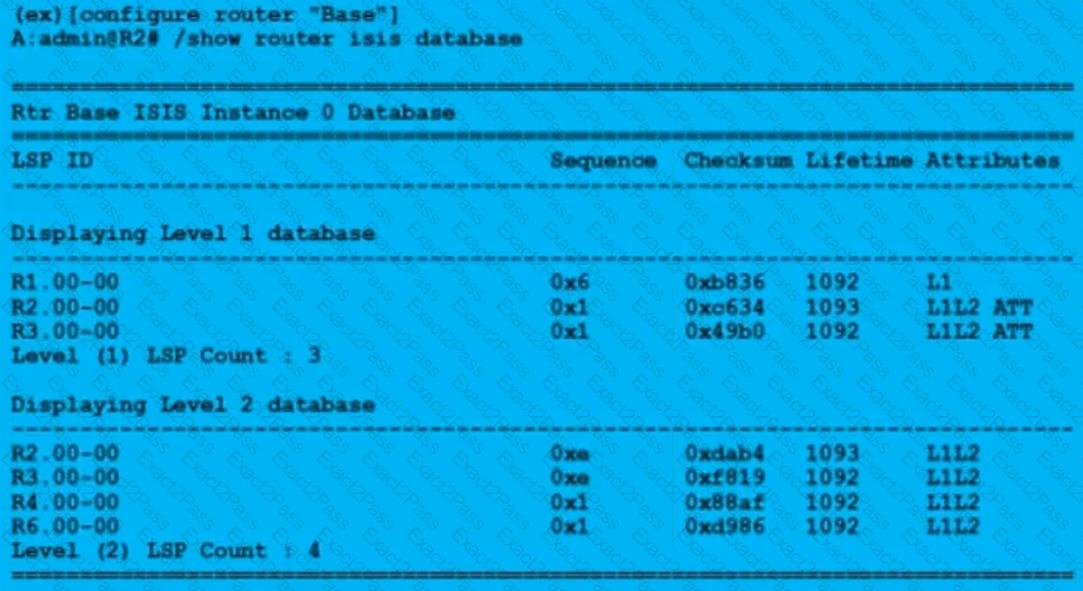
Which of the following statements best describes the IS-IS domain to which the command output corresponds?

A.

Single-area IS-IS domain with no broadcast interfaces.

B.

Multi-area IS-IS domain with no broadcast interfaces.

C.

Single-area IS-IS domain with broadcast interfaces.

D.

Multi-area IS-IS domain with broadcast interfaces.

Question # 2

When a router performs the SPF calculation, which router is used as the root of the shortest path tree?

A.

The router with the fewest links.

B.

The router with the lowest router ID.

C.

The router's closest neighbor.

D.

The router doing the calculation.

Question # 3

Two IS-IS routers are exchanging Hello packets. One is configured to use authentication and the other is not. Which of the following statements is TRUE?

A.

An adjacency will be established with authentication using the default parameters defined for IS-IS routers.

B.

The two routers will negotiate the authentication parameters and the establish an adjacency.

C.

An adjacency will be established without authentication.

D.

An adjacency will not be established.

Question # 4

A routing domain is using a single-area link-state routing protocol. Which of the following is NOT information that a router can share with other routers in the domain using protocol-specific messages?

A.

The IP prefixes of subnets directly attached to the router.

B.

IP prefixes known by the router because it is running ad additional routing protocol.

C.

A copy of the local routing table.

D.

The local router ID and the router IDs of neighboring routers.

Question # 5

Which component of the Nokia 7750 SR is in charge of performing the longest prefix match lookup on packets that arrive on the physical interfaces?

A.

Control Processing Module (CMP)

B.

Media Dependent Adapter (MDA)

C.

Switch Fabric (SF)

D.

Input/Output Module (IOM)

Question # 6

A routing domain uses a link-state routing protocol. Which of the following would NOT be an advantage of dividing the entire routing domain into areas?

A.

Detailed topology information is only shared among routers within the same area, thus reducing the complexity of the SPF calculation.

B.

Route tables can be reduced by summarizing the IP prefixes advertised between areas.

C.

Less-capable routers can be isolated from having to keep track of IP prefixes that are external to the local routing domain.

D.

Fewer routers are required to handle the same amount of traffic, as compared to a single-area domain.

Question # 7

What do the address resolution protocol (ARP) for IPv4 and the neighbor discovery procedures for IPv6 have in common?

A.

Both detect duplicate MAC address assignments.

B.

Both detect duplicate IP address assignments.

C.

Both resolve a host device's MAC address using its IP address.

D.

Both resolve a host device's IP address using its MAC address.

Question # 8

Which of the following statements about router interfaces on a Nokia 7750 SR is FALSE?

A.

They can be used in pairs on the same subnet for redundancy.

B.

They can be assigned IPv4 and/or IPv6 addresses.

C.

They can be logical or physical.

D.

The system interface exists by default.

Question # 9

A router is trying to establish an IS-IS adjacency with the DIS on a broadcast link. What event causes the adjacency to change from “Initializing” to “UP”?
A.

Receiving a Hello packet from the DIS that contains the local router’s own MAC address in the neighbor list.

B.

Receiving the first CSNP packet from the DIS that lists the LSPs in the DIS’s link-state database.

C.

Receiving a CSNP packet from the DIS acknowledging the last transmitted LSP.

D.

Receiving the last LSP requested from the DIS.

Question # 10

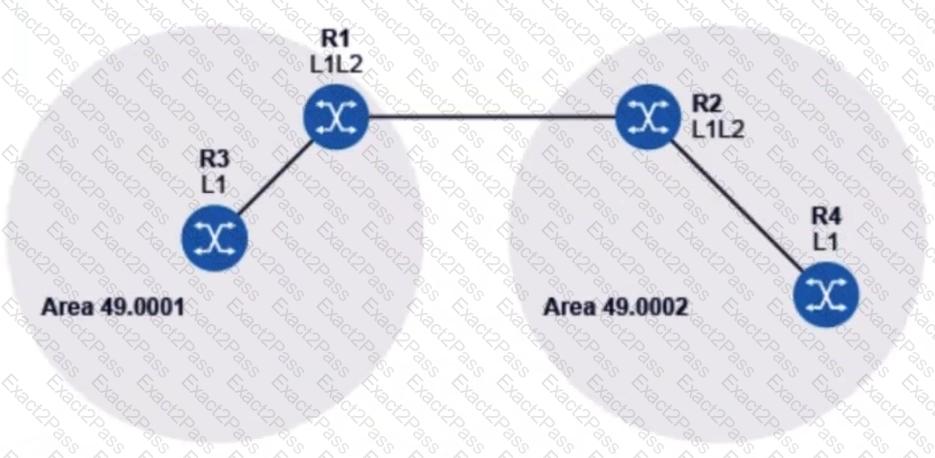
Routers R1 through R4 in the diagram have established IS-IS adjacencies. Router R1 is L1/L2 and is the DIS of its two broadcast interfaces. How many LSPs will it generate?


A.

2

B.

3

C.

4

D.

5

Go to page: