Summer Sale Special Limited Time 70% Discount Offer - Ends in 0d 00h 00m 00s - Coupon code: buysanta

Exact2Pass Menu

Nokia OSPF Routing Protocol Exam

Last Update 20 hours ago Total Questions : 104

The Nokia OSPF Routing Protocol Exam content is now fully updated, with all current exam questions added 20 hours ago. Deciding to include 4A0-113 practice exam questions in your study plan goes far beyond basic test preparation.

You'll find that our 4A0-113 exam questions frequently feature detailed scenarios and practical problem-solving exercises that directly mirror industry challenges. Engaging with these 4A0-113 sample sets allows you to effectively manage your time and pace yourself, giving you the ability to finish any Nokia OSPF Routing Protocol Exam practice test comfortably within the allotted time.

Question # 21

Which of the following cannot be used as a matching criterion in route policy statements?

A.

Source IP address

B.

TCP source port

C.

Prefix list

D.

Protocol type

Question # 22

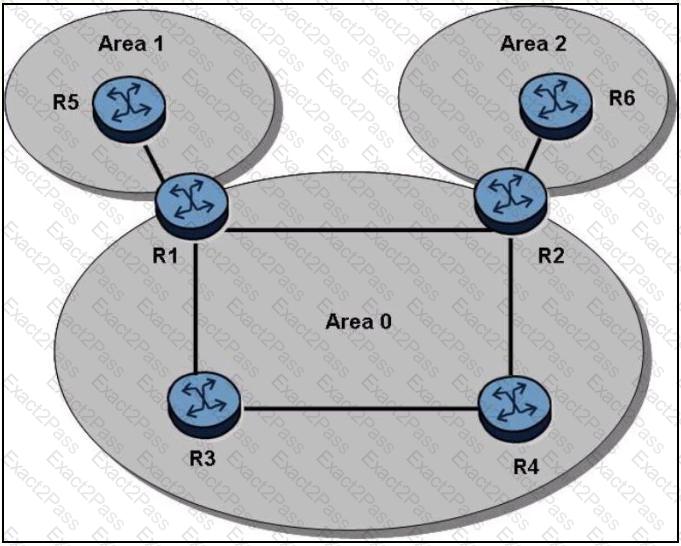
Refer to the exhibit.

Assume that OSPFv3 is properly configured on all routers and that R4 advertises its system prefix into Area 0. Which of the following statements best describes how R5 learns R4's IPv6 system prefix?

A.

With a Router LSA originated by R1

B.

With a Router LSA originated by R5

C.

With a Router LSA originated by R4

D.

With an Inter-Area Prefix LSA originated by R1

E.

With an Inter-Area Prefix LSA originated by R5

F.

With an Inter-Area Prefix LSA originated by R4

Question # 23

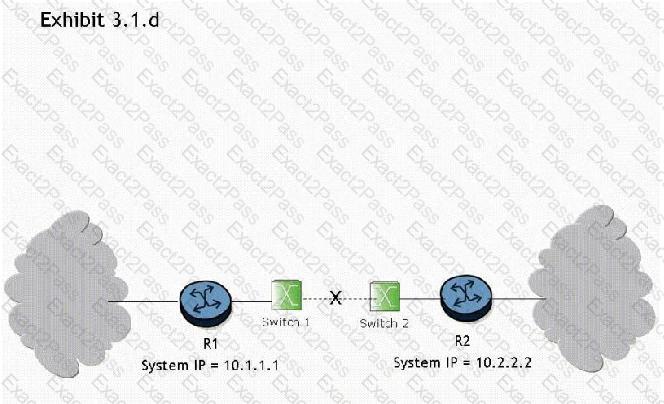
Click the exhibit button.

What triggers convergence of the routing protocol when the link between switch 1 and switch 2 goes down?

A.

Convergence is triggered when the adjacency between routers R1 and R2 drops as a result of Hello timeouts. At this point, both routers R1 and R2 re-compute their link state database and send updates to their adjacent routers. Once the process is complete for all routers, the networks have converged.

B.

Convergence is triggered when the physical interfaces between routers R1 and R2 go down. At this point, both routers R1 and R2 re-compute their link state database and send updates to their adjacent routers. Once the process is complete for all routers, the networks have converged.

C.

Convergence will not be triggered because switches cannot run routing protocols between them.

D.

Convergence is triggered when the switches notify the routers about the link state information. At this point, both routers R1 and R2 re-compute their link state database and send updates to their adjacent routers. Once the process is complete for all routers, the networks have converged.

E.

Convergence is triggered when an LSA is sent from router R1 to router R2 to indicate that the link is down. At this point, both routers R1 and R2 re-compute their link state database and send updates to their adjacent routers. Once the process is complete for all routers, the networks have converged.

Question # 24

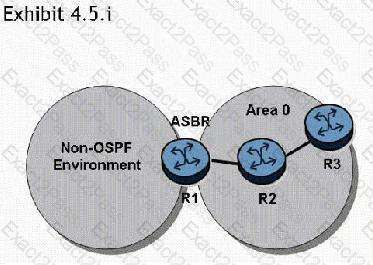
Click the exhibit button.

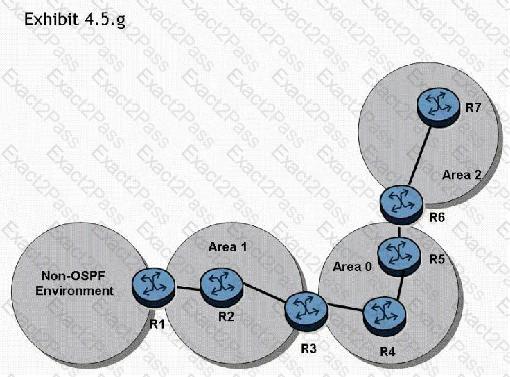
In the topology shown, router R1 is an ASBR configured to export external routes to OSPF. How many type 4 LSAs will be present in the network?

A.

One.

B.

One for each of the routers in area 0

C.

One for each of the external routes exported by router R1.

D.

Type 4 LSAs are not generated in this network topology.

Question # 25

Which of the following statements regarding area border routers in an OSPF network is true?

A.

The term backbone router has the same definition as the term area border router.

B.

An OSPF network needs at least one area border router to function.

C.

Area border routers connect the backbone area to other areas in an OSPF network.

D.

By definition, an area border router must perform route summarization between areas.

Question # 26

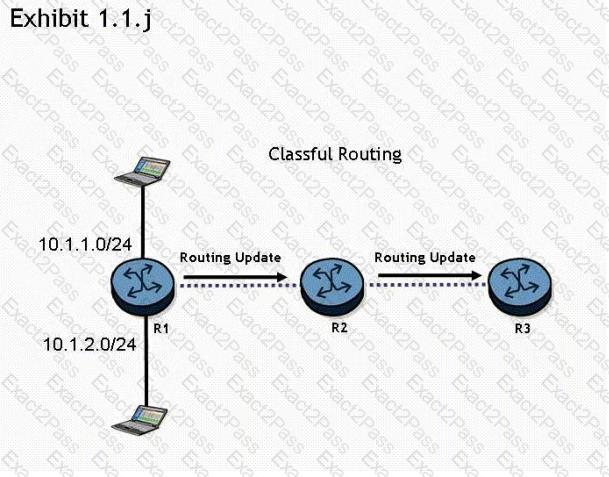
Click the exhibit button.

Routers R1 „ R2, and R3 are running a classful routing protocol between them. Assuming that router R1 advertises all directly connected networks, how will these networks be represented in router R3's routing table?

A.

Router R3's routing table can only contain one of the routes, which will result in route flapping.

B.

Router R3's routing table will have one entry for 10.1.1.0/24 and one entry for 10.1.2.0/24.

C.

The networks will be represented with one entry of 10.0.0.0/8 in router R3's routing table.

D.

The networks will be represented with one entry of 10.0.0.0/24 in router R3's route table.

Question # 27

Click the exhibit button.

In the topology shown, router R1 is an ASBR configured to export external routes to OSPF. Assuming that there are no stub networks, which of the following statements regarding type 4 LSA generation is true?

A.

Router R1 generates a type 4 LSA that is flooded to areas 0, 1, and 2.

B.

Router R3 generates a type 4 LSA that is flooded to areas 0, 1, and 2.

C.

Router R3 generates a type 4 LSA that is flooded to areas 0 and 2.

D.

Router R3 generates a type 4 LSA that is flooded to area 0, and router R6 generates a type 4 LSA that is flooded to area 2.

Question # 28

In an OSPF environment, what must a router receive after it sends out an update?

A.

The router must receive an acknowledgment

B.

The router must receive a Hello

C.

The router must receive a new sequence number

D.

The router must receive a Link State Packet

Question # 29

An OSPF router receives an update in which the sequence number, age, and checksum are the same as the entry already in the topological database. What action is taken by the router?

A.

The link state information is not populated in the database but is forwarded to all neighbors

B.

The link state information already in the database is overwritten and the age is reset

C.

The link state information is not populated in the database and an acknowledgement is sent

D.

The link state information is regarded as old and nothing is done.

Question # 30

The Nokia 7750 SR supports which two of the OSPF area types below?

A.

Not So Stubby Areas

B.

Level 1 Areas

C.

Stub Areas

D.

Partially Stubby Areas

Go to page: