Spring Sale Special Limited Time 70% Discount Offer - Ends in 0d 00h 00m 00s - Coupon code: buysanta

Exact2Pass Menu

Nokia Ethernet Virtual Private Network Services

Last Update 13 hours ago Total Questions : 40

The Nokia Ethernet Virtual Private Network Services content is now fully updated, with all current exam questions added 13 hours ago. Deciding to include 4A0-115 practice exam questions in your study plan goes far beyond basic test preparation.

You'll find that our 4A0-115 exam questions frequently feature detailed scenarios and practical problem-solving exercises that directly mirror industry challenges. Engaging with these 4A0-115 sample sets allows you to effectively manage your time and pace yourself, giving you the ability to finish any Nokia Ethernet Virtual Private Network Services practice test comfortably within the allotted time.

Question # 4

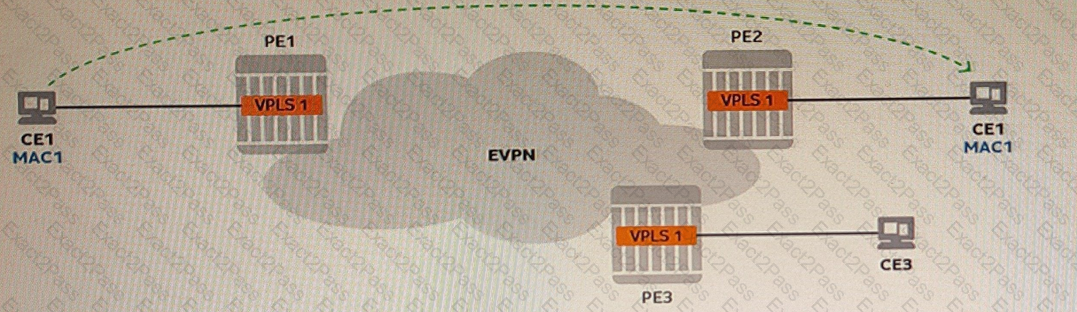
In the exhibit,

MACI moves from PEI to PE2. Which of the following actions related to this MAC address mobility is performed?

A.

CEI generates an update message to PEI withdrawing its MAC.

B.

PEI generates an update message to remote PES identifying the new location of CEI.

C.

PE2 advertises a MAC/IP route for MACI with a sequence number higher than that received from PEI.

D.

PE3 waits to receive a data packet from CEI to update its FDB entry for MACI.

Question # 5

Which of the following statements about PE-to-PE MAC address advertisement is FALSE?

A.

The service distinguisher (label or VNI) is advertised with the MAC/IP EVPN update.

B.

Route targets are used to uniquely identify routes between EVIS in the case of MAC address overlaps.

C.

A PE uses a single MP-BGP session with a remote peer to exchange the routes for all EVIs.

D.

A PE advertises locally-learned MAC addresses to remote PES using EVPN type-2 routes.

Question # 6

In the exhibit, the interface-less forwarding model is used for the Layer-3 EVPN service. Which of the following statements about traffic forwarding from Host 1 to Host 2 is FALSE?

A.

PEI consults the FDB of RVPLS 1 and forwards the traffic to the local interface of VPRN 11.

B.

PEI encapsulates the packet with two labels: an outer transport label and an inner service label.

C.

PE2 inspects the service label and determines that it is associated with RVPLS 2.

D.

PE2 consults the FDB of RVPLS 2 and forwards the traffic to Host 2.

Question # 7

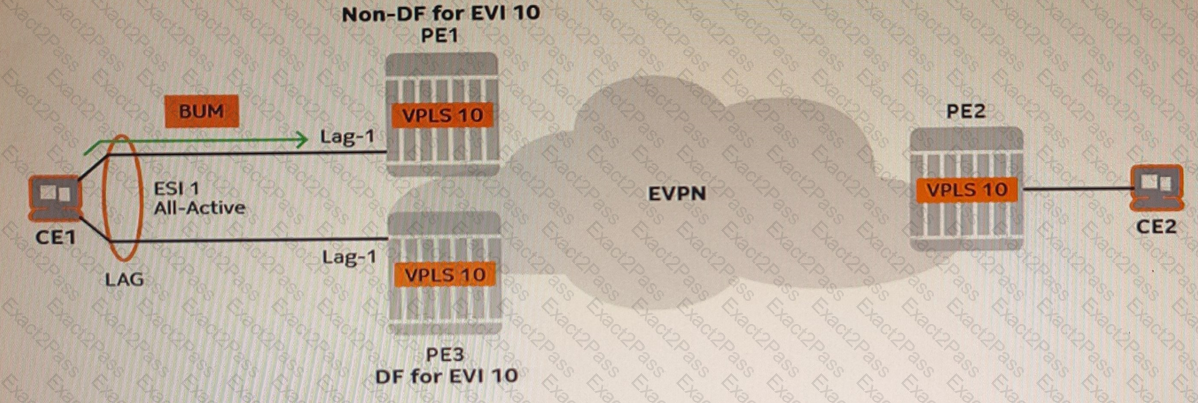
Examine the exhibit.

Which of the following actions is performed by PEI after it receives a BUM packet from CEI?

A.

PEI does not flood the packet because PEI is acting as non-designated forwarder (non-DF) for VPLS 10.

B.

PEI sends the packet to PE2 but not to PE3 because PE3 is connected to the originating ES.

C.

PEI sends the packet to PE2 and to PE3. An ESI label is included only in the packet sent to PE2.

D.

PEI sends the packet to PE2 and to PE3. An ESI label is included only in the packet sent to PE3.

Question # 8

In the exhibit, VPWS 4 enables communications between CEI and CE2. Which of the following statements regarding the operation of VPWS 4 is FALSE?

A.

PEI advertises an auto-discovery per EVPN instance (A-D per EVI) route to PE3 as soon as the SAP becomes operationally

B.

PE3 advertises an IMET route to PEI as soon as VPWS 4 is administratively enabled.

C.

PEI and PE3 exchange their service labels using A-D per EVI routes.

D.

PE3 and PE4 exchange their service labels over an established targeted LDP session.

Question # 9

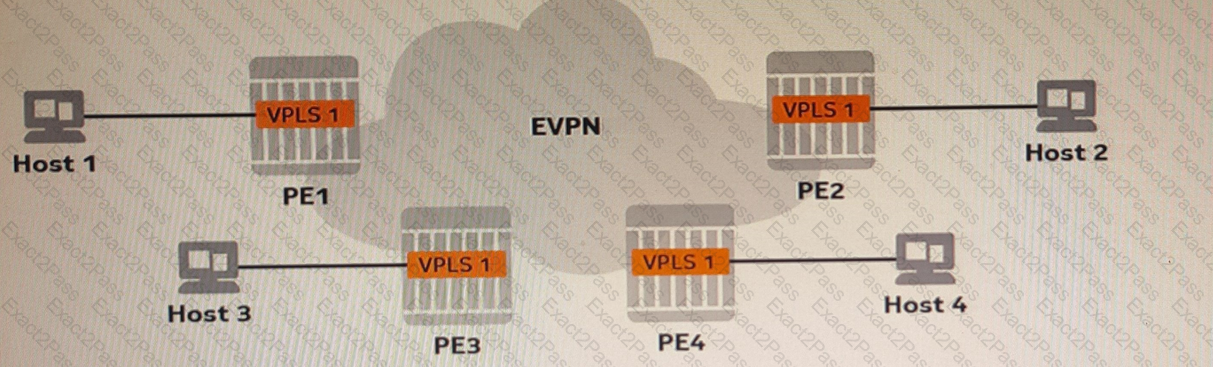
Based upon the exhibit, how many MAC-VRFs are there?

A.

1

B.

2

C.

3

D.

4

Question # 10

The interface-ful numbered model is used for a Layer-3 EVPN service. Which of the following statements is FALSE?


A.

EVPN routes are advertised with a service label associated with the SBD VPLS.

B.

IP-Prefix routes exchanged between PES include a non-zero gateway IP address as an overlay index.

C.

EVPN MAC/IP routes are used to advertise the MAC and IP addresses of local hosts.

D.

EVPN MAC/IP routes are used to advertise the MAC and IP addresses of SBD IRB interfaces.

Go to page: