
Spring Sale Special Limited Time 70% Discount Offer - Ends in 0d 00h 00m 00s - Coupon code: buysanta

Exact2Pass Menu

Nokia Segment Routing Exam

Last Update 17 hours ago Total Questions : 40

The Nokia Segment Routing Exam content is now fully updated, with all current exam questions added 17 hours ago. Deciding to include 4A0-116 practice exam questions in your study plan goes far beyond basic test preparation.

You'll find that our 4A0-116 exam questions frequently feature detailed scenarios and practical problem-solving exercises that directly mirror industry challenges. Engaging with these 4A0-116 sample sets allows you to effectively manage your time and pace yourself, giving you the ability to finish any Nokia Segment Routing Exam practice test comfortably within the allotted time.

Question # 1

In which of the following aspects does the configuration of flex-algo LSPs have an advantage over the configuration of SR-TE LSPs?

A.

Label stack size of the encapsulated data packets

B.

List of traffic-engineering constraint types available to choose from

C.

Ability to associate one primary and up to two secondary paths to the same LSP

D.

Flexibility of configuring each LSP with its own set of traffic-engineering constraints

Question # 2

Which of the following statements about SR-TE administrative constraints is FALSE?

A.

A strict hop must be adjacent to the previous hop in the list.

B.

The TE metric for a link is by default the same as the IGP metric.

C.

Shared-Risk-Link Groups are only taken into account when calculating the secondary path.

D.

The head-end router may calculate a path that takes into account max hop count and bandwidth constraints.

Question # 3

Which of the following is NOT an advantage of using a PCE for the computation of TE-constrained LSP paths, as compared to using CSPF locally on the PE router?

A.

The ability to create cross-area TE-constrained LSP paths

B.

The ability to create LSP paths with bandwidth reservation

C.

The ability to create LSPs with primary and secondary paths

D.

The ability to ensure that some LSP paths are disjoint

Question # 4

Which of the following statements about Multi-Protocol Label Switching networks is FALSE?

A.

MPLS uses a signaling protocol to exchange labels between routers.

B.

An LSR forwards data based on the MPLS labels.

C.

An LSP is a bi-directional tunnel that uses MPLS labels to forward data.

D.

The data is transparently carried from end to end.

Question # 5

Which of the following list of SR-TE attributes has to be advertised among routers?

A.

Administrative groups that each link belongs to, TE metric of links, bandwidth availability of each link, SRLG that each link belongs to.

B.

Administrative groups that each link belongs to, TE metric of links, SRLG that each link belongs to.

C.

Administrative groups that each link belongs to, TE metric of links, bandwidth availability of each link, SRLG that each link belongs to, link status up/down.

D.

Administrative groups that each link belongs to, TE metric of links, SRLG that each link belongs to, link status up/down.

Question # 6

Which of the following statements about the operation of seamless-BFD is FALSE?

A.

Seamless-BFD responses are sent back using the LSP label stack.

B.

To be able to respond to seamless-BFD messages, a router must be configured as a reflector.

C.

A seamless-BFD template needs to be configured on the head-end of the LSP.

D.

The routing protocol (OSPF or IS-IS) is used to carry the reflector discriminator information.

Question # 7

Which of the following statements about a Segment Routing SID is FALSE?

A.

A Node-SID is usually associated with a router's system interface.

B.

Adjacency-SID values are taken from the SRGB configured for the routing protocol.

C.

A Prefix-SID can be configured directly as a label value or indirectly as an index.

D.

An Adjacency-SID does not have to be configured.

Question # 8

Which of the following statements about segment routing fast re-route is FALSE?

A.

Fast re-route is a temporary fix that becomes active for a short period of time after a local network failure.

B.

Fast re-route typically protects the active segment of a tunnel, but under certain conditions it can protect an end-to-end multi-segment tunnel instead.

C.

On a Nokia 7750 SR, R-LFA and TI-LFA can be enabled independently of each other.

D.

The parameter "max-sr-frr-labels" limits the number of labels that R-LFA can add to the data packet encapsulation.

Question # 9

Which of the following steps is NOT required when configuring IS-IS to support Segment Routing?

A.

MPLS label range reserved for Segment Routing.

B.

Enable interfaces used for Segment Routing under

C.

The flooding scope of Segment Routing information.

D.

The Segment Routing Global Block range.

Question # 10

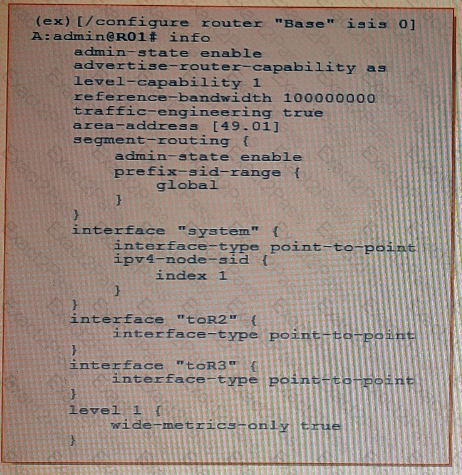
Based upon the exhibit, which of the following statements regarding the configuration is FALSE?
A.

Traffic engineering information will only be advertised for the interfaces that have both MPLS and RSVP enabled.

B.

The Node-SID assigned to this router is the second label in the defined range.

C.

Traffic engineering has been enabled on this router.

D.

Adjacency-SID labels will not be advertised as they have not been defined under the physical interfaces.

Go to page:

