Spring Sale Special Limited Time 70% Discount Offer - Ends in 0d 00h 00m 00s - Coupon code: buysanta

Exact2Pass Menu

Nokia SRA Composite Exam

Last Update 16 hours ago Total Questions : 639

The Nokia SRA Composite Exam content is now fully updated, with all current exam questions added 16 hours ago. Deciding to include 4A0-C02 practice exam questions in your study plan goes far beyond basic test preparation.

You'll find that our 4A0-C02 exam questions frequently feature detailed scenarios and practical problem-solving exercises that directly mirror industry challenges. Engaging with these 4A0-C02 sample sets allows you to effectively manage your time and pace yourself, giving you the ability to finish any Nokia SRA Composite Exam practice test comfortably within the allotted time.

Question # 181

On the Alcatel-Lucent 7750 SR, what is the maximum number of queues that a single SAP-ingress policy can support in a VPLS?

A.

16

B.

8

C.

32

D.

48

E.

56

Question # 182

Which of the following are the minimum requirements needed to classify traffic marked with DSCP AF11, AF12, and AF13 into the AF forwarding class and provide fair treatment to the drop precedence settings? (Choose three)

A.

Profile mode queues

B.

Priority mode queues

C.

1 queue

D.

3 queues

E.

3 forwarding classes

F.

1 forwarding class, with 2 subclasses

G.

1 forwarding class, with 3 subclasses

Question # 183

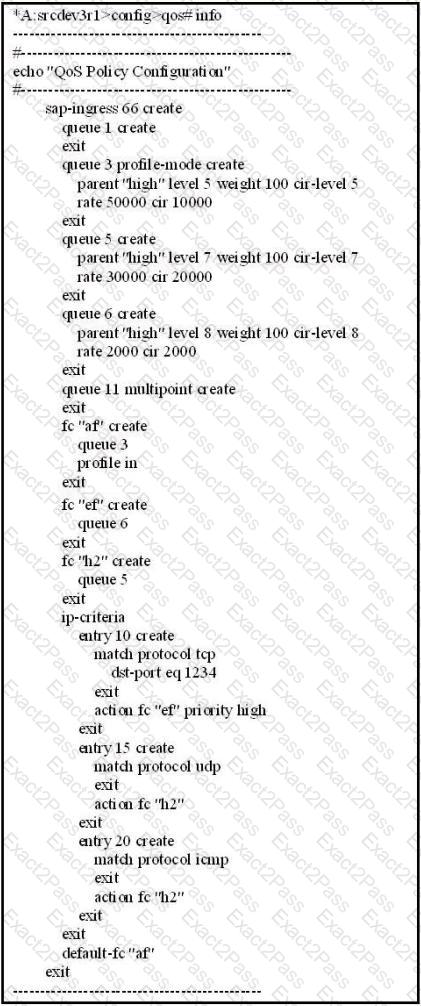
Click the exhibit button below. Given the SAP-ingress policy, which of the following statements are FALSE? (Choose three)
A.

Queue 5 is using priority mode.

B.

UDP traffic can be serviced at a maximum rate of 20 Mbps.

C.

Ping traffic is place in queue 5.

D.

Queues 5 and 6 will receive equal portions of any remaining available bandwidth to meet their above-CIR bandwidth requirements.

E.

Queue 3 is scheduled before queue 5.

Question # 184

Which of the following can be used as classifiers of customer traffic? (Choose three)

A.

DSCP value

B.

802.1p value

C.

IP DF bit

D.

TCP/UDP port numbers

E.

HTML version number

Question # 185

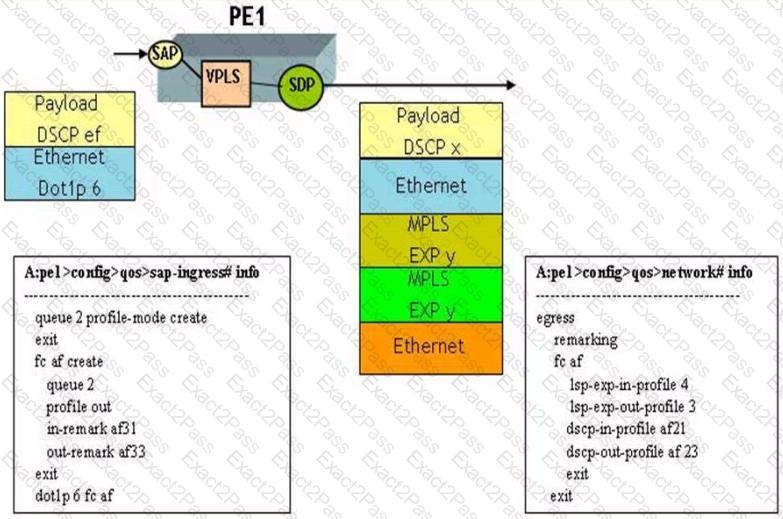
Click the exhibit button below.

At router PE1, customer packets are arriving tagged with a dotlp value of 6 and marked with a DSCP value of EF.

Based on the configuration shown below for a VPLS service, what will be the DSCP and EXP marking for the packet egressing the network port on this PE router? (Choose two)

A.

The DSCP value will be set to af21.

B.

The DSCP value will be set to af23.

C.

The DSCP value will remain as ef.

D.

The EXP value, in the MPLS headers, will be set to 4.

E.

The EXP value, in the MPLS headers, will be set to 3.

Question # 186

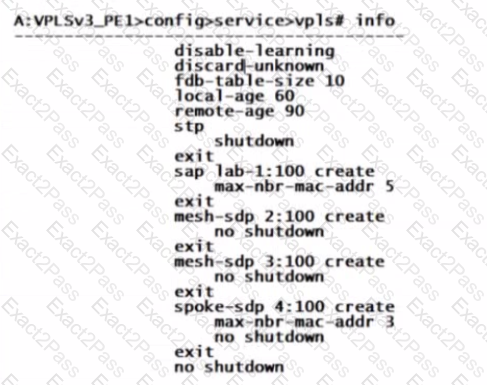
The FOB of the VPLS service shown below is empty. An Ethernet frame arrives from the customer on the SAP. Which of the following describes the action taken?
A.

The source MAC will be learned on the SAP. The frame will be replicated and flooded out of all SDPs.

B.

The source MAC will be learned on the SAP. The frame will be replicated and flooded out of all mesh SDP ' s.

C.

The source MAC will be learned on the SAP. The frame will be replicated and flooded out of all spoke SDPs.

D.

The frame will be discarded and no learning will take place.

Question # 187

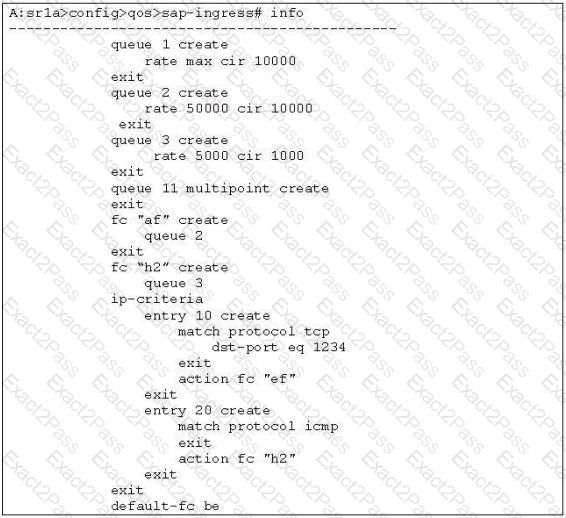
Click the exhibit button below. A network operator has configured the SAP-ingress policy below. Ping traffic is expected in queue 3. However, the network operator notices that all traffic is placed in queue 1. What is the most probable reason for this?
A.

The default forwarding class for all traffic, including ICMP, is BE, which is placed in queue 1.

B.

The SAP has been shut down.

C.

The IP-match criteria has been misconfigured for ICMP traffic.

D.

Queue 3 has no rate or CIR configured and thus cannot hold any packets.

E.

The SAP-ingress policy has not been applied to the SAP.

Question # 188

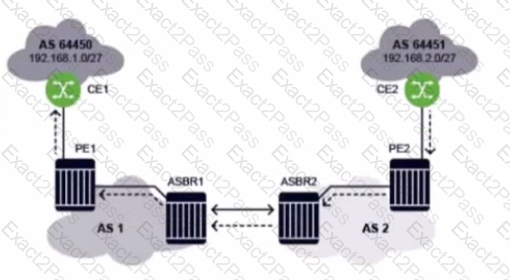
For the Inter-AS model A VPRN, which of the following is TRUE when CE2 sends an IP packet to 192.168.1. J?
A.

PE2 pushes one label on the IP packet and label-switches it to ASBR2.

B.

ASBR2 forwards an unlabeled IP packet to ASBR1.

C.

ASBR1 pushes one label on the IP packet and label-switches it to PEL

D.

PE1 pops one label and forwards the IP packet to CE1.

Question # 189

Which of the following about self-generated traffic QoS is TRUE?

A.

The DSCP marking stays ncl for all applications; only the internal forwarding class is manipulated across different applications.

B.

DSCP bits can be set per application, per routing instance.

C.

The internal forwarding class for self-generated traffic is set once and applied to the base router and all VPRN instances.

D.

Self-generated traffic can be marked at Layer 2 no matter what encapsulation is used on the network interfaces.

Question # 190

How many bits does DSCP use to provide QoS marking options?

A.

8

B.

16

C.

6

D.

4

E.

3

Question # 191

When allocating scheduling resources, which of the following statements BEST describes how the egress port scheduler allocates bandwidth?


A.

The egress port scheduler takes the ratio of requested bandwidth to total bandwidth request from all children. It allocates bandwidth fairly, using these percentages and not exceeding the egress interface speed.

B.

The egress port scheduler allocates bandwidth based on a WRR distribution method that takes into account the CIR and PIR requested at each level and the max speed, either default or configured, on egress.

C.

The egress port scheduler allocates bandwidth on a first come, first served distribution method that takes into account the total CIR and PIR requested at each level and the max PIR requested from a single level.

D.

The egress port scheduler will limit the bandwidth offered to the egress port based on the over-subscription factor, provisioned under the router interface, while using a WRR scheduler for the remaining bandwidth.

E.

The egress port scheduler will use the Russian Dolls Method to allocate bandwidth to each level of requested bandwidth. HPO-Only is automatically set to 100%, allowing only high priority traffic to be buffered during congestion.

Go to page: