
Ticking Clock Black Friday Special: 80% Off! Apply coupon code below to save on all exam bundles! - Ends in 0d 00h 00m 00s - Coupon code: 80OFFBF

Exact2Pass Menu

Nokia NRS II Composite Exam: IS-IS version

Last Update 50 minutes ago Total Questions : 145

The Nokia NRS II Composite Exam: IS-IS version content is now fully updated, with all current exam questions added 50 minutes ago. Deciding to include 4A0-C03 practice exam questions in your study plan goes far beyond basic test preparation.

You'll find that our 4A0-C03 exam questions frequently feature detailed scenarios and practical problem-solving exercises that directly mirror industry challenges. Engaging with these 4A0-C03 sample sets allows you to effectively manage your time and pace yourself, giving you the ability to finish any Nokia NRS II Composite Exam: IS-IS version practice test comfortably within the allotted time.

Question # 1

Consider an E-pipe service that is configured with SAP 1/1/1:5 and SAP 1/1/1:6.7. If SAP 1/1/1:5 accepts an ingress frame, which of the following statements is TRUE?

A.

The frame egresses 1/1/1:6.7 with an outer VLAN tag of 6 and inner tag of 7.

B.

The frame is dropped at the egress SAP 1/1/1:6.7.

C.

The frame egresses 1/1/1:6.7 with VLAN tag 5.

D.

The frame egresses 1/1/1:6.7 with VLAN tag 6

Question # 2

Which of the following statements regarding T-LDP is FALSE?

A.

Link-based and T-LDP sessions may be configured on the same LSR.

B.

T-LDP supports sessions between non-directly connected devices.

C.

T-LDP can be configured between directly connected devices.

D.

T-LDP Hello messages are sent to a multicast address.

Question # 3

Which option best characterizes a VPWS?

A.

Layer 3 direct Internet access service.

B.

Layer 2 point-to-point service.

C.

Layer 2 multipoint-to-multipoint service.

D.

Layer 3 IP multipoint-to-multipoint VPN service.

Question # 4

Which statement below most accurately describes route redistribution?

A.

It is the process of deciding at line-rate speed which packets will be dropped and which ones will be forwarded.

B.

It is the process of redirecting packets to be processed by an intermediate network function before allowing them to be forwarded to their intended final destination.

C.

It is the process of passing routing information from one routing domain to another, which usually means from one routing protocol to another.

D.

It is the process of controlling which route advertisements received from routing peers are accepted and/or deciding which locally known prefixes are advertised to routing peers.

Question # 5

A router using a link-state routing protocol discovers that one of its neighbors is no longer connected. It creates a new link-state advertisement to notify the other routers about the topology change. Which of the following is not an action triggered by this event?

A.

If a router receives the new link-state advertisement, it acknowledges it, stores it, and forwards it to its own neighbors.

B.

If a router receives multiple copies of the new link-state advertisement, it will simply ignore all copies received after the first one.

C.

Every router that receives the new link-state advertisement updates its age field before forwarding it.

D.

Every router that receives the new link-state advertisement runs the SPF algorithm to recalculate its shortest-path tree and its forwarding database.

Question # 6

When a VPN service extends across multiple regions operated by different providers, which statement about the way MP-BGP address families enhance the scalability of VPN control-plane signaling is TRUE?

A.

By signaling service labels between edge routers of adjacent regions, using VPN-IPv4 and VPN-IPv6 prefixes.

B.

By signaling transport tunnels between edge routers of adjacent regions for inter-region tunnel stitching, using VPN-IPv4 and VPN- IPv6 prefixes.

C.

By signaling end-to-end service labels between PE routers in different regions, using labeled IP prefixes.

D.

By signaling end-to-end inter-region transport tunnel, using labeled IP prefixes.

Question # 7

Consider an ePipe service that has a dot1Q SAP 1/1/1:5 at one site and a null SAP at the other site. If SAP 1/1/1:5 accepts an ingress frame, which statement is TRUE?

A.

The frame egresses the null SAP without the VLAN tag 5.

B.

The frame egresses the null SAP with VLAN tag 5.

C.

The frame egresses the null SAP with VLAN tag 0.

D.

The frame is dropped at the null SAP.

Question # 8

On a Nokia 7750 SR, which statement about IES interfaces is FALSE?

A.

An IES can only have one interface.

B.

An IES interface can have an SDP or a SAP.

C.

An IES can perform fragmentation.

D.

An IES must have an IP address assigned to it.

Question # 9

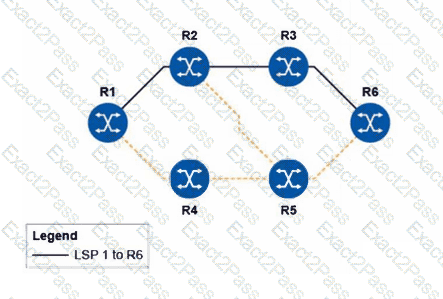
The RSVP state for LSP 1 has timed out on router R3. Which action will router R3 take to clear the RSVP session?

Exhibit:
A.

Send a RESV Tear message toward router R6.

B.

Send a RESV Tear message toward router R1.

C.

Send a RESV Error message toward router R6.

D.

Send a RESV Error message toward router R1.

Question # 10

Which of the following statements concerning an E-pipe that terminates on a VPLS is FALSE?

A.

The VC IDs used between the E-pipe and VPLS must match.

B.

The E-pipe must maintain a MAC FDB in order to connect to the VPLS.

C.

The service ID of the E-pipe can be different from that of the VPLS.

D.

The service MTU of the VPLS and E-pipe must match.

Go to page: