
Spring Sale Special Limited Time 70% Discount Offer - Ends in 0d 00h 00m 00s - Coupon code: buysanta

Exact2Pass Menu

SAS Data Integration Development

Last Update 22 hours ago Total Questions : 70

The SAS Data Integration Development content is now fully updated, with all current exam questions added 22 hours ago. Deciding to include A00-260 practice exam questions in your study plan goes far beyond basic test preparation.

You'll find that our A00-260 exam questions frequently feature detailed scenarios and practical problem-solving exercises that directly mirror industry challenges. Engaging with these A00-260 sample sets allows you to effectively manage your time and pace yourself, giving you the ability to finish any SAS Data Integration Development practice test comfortably within the allotted time.

Question # 11

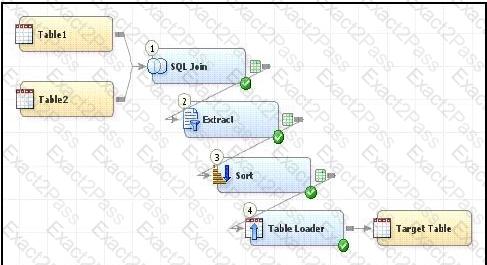
In the following display, can status handling be enabled for the Extract transformation?
A.

No. The Extract transformation does not have a status handling tab in its Properties window, and the Return Code Check transformation can only provide status handling at the job level.

B.

Yes. The Return Code Check transformation can be added to the END of the job flow - the Status Handling tab in the Return Code Check transformation properties can then establish the desired status handling.

C.

No. The Extract transformation does not have a Status Handling tab in its Properties window, therefore it is not possible to establish status handling for this transformation.

D.

Yes. The Return Code Check transformation can be added to the job flow immediately following the Extract - the Status Handling tab in the Return Code Check transformation properties can then establish the desired status handling.

Question # 12

In SAS Data Integration Studio, where must the columns included in a business key exist?

A.

in the source and standardization tables

B.

in the source and dimension tables

C.

in the target and fact tables

D.

in the source, dimension and standardization tables

Question # 13

You want to create a job that checks conditions for your data before that data is loaded into a data warehouse. The job should be able to detect error conditions such as missing data or duplicate data and take appropriate actions like registering error conditions in log, etc. Which SAS Data Integration Studio transformation should you use?

A.

Data Transfer

B.

Data Validation

C.

Data Quality

D.

Data Extract

Question # 14

When using the SCD Type 2 load method in SAS Data Integration Studio, which columns can be selected to check for changed data?

A.

business key columns

B.

Type 1 columns

C.

generated columns

D.

non-key columns

Question # 15

Which statement best describes a deployment directory as used in the Schedule Manager in SAS Management Console?

A.

A folder or directory location on a server where the SAS code from a deployed SAS Data integration Studio job is stored.

B.

A location in the metadata repository where job flows are deployed.

C.

A location in the SAS Management console job directory storing the metadata for jobs that can be added to job flows.

D.

A SAS Folder in the Schedule Manager plug-in within SAS Management Console containing listings of all flows organized by server type.

Question # 16

Within SAS Data Integration Studio, how is the internal code of a SAS Code transformation assigned to its options?

A.

SAS macro variables

B.

columns of SAS datasets

C.

SAS formats

D.

SAS macro calls

Question # 17

The profile reports generated in dfPower Profile jobs are viewed:

A.

in dfPower Profile (Viewer)

B.

in the Reports tab of dfPower Profile (Configurator)

C.

in any HTML viewer

D.

in any text viewer

Question # 18

A SAS administrator has performed the " Clear Projects " action to remove the lock on a SAS Data Integration Studio job called " Create Tables " that some user has checked out in their project repository. What will be the outcome of this action on the user ' s project repository?

A.

It will become empty and all new and checked out metadata objects will revert to the not checked out state.

B.

It will only contain the new metadata objects. All checked out metadata objects will revert to the not checked

out state.

C.

It will become empty and the DI job called " Create Tables " will no longer be in a checked out state.

D.

It will become empty and will not be accessible until the administrator grants permissions for it to be used

again.

Question # 19

Which statement best describes the DataFlux Integration Server?

A.

An application server that executes service requests based on Simple Object Access Protocol (SOAP) to call

dfPower Architect or dfPower Profile jobs.

B.

A plug-in to SAS Data Integration Studio allowing you to design jobs specialized for data cleansing

operations.

C.

An application interface that allows you to build dfPower Architect and dfPower Profile jobs specialized for

data cleansing operations.

D.

A third party server defined in the SAS metadata repository that allows you to build flows integrating

multiple jobs and establishing job dependencies within the flow.

Question # 20

Which statement correctly defines a System DSN?

A.

Not specific to an individual user. Anyone with permission to access the data source can use it.

B.

Specific to an individual user. It is available only to the user who creates it.

C.

Not specific to an individual user. It can be shared among users even though it is created locally.

D.

Specific to an individual user. But it can be shared among users.

Go to page:
