Exact2Pass

Last Update 22 hours ago Total Questions : 50
The Adobe Experience Platform Technical Foundations content is now fully updated, with all current exam questions added 22 hours ago. Deciding to include AD0-E600 practice exam questions in your study plan goes far beyond basic test preparation.
You'll find that our AD0-E600 exam questions frequently feature detailed scenarios and practical problem-solving exercises that directly mirror industry challenges. Engaging with these AD0-E600 sample sets allows you to effectively manage your time and pace yourself, giving you the ability to finish any Adobe Experience Platform Technical Foundations practice test comfortably within the allotted time.
A data architect responsible for maintaining existing schemas is notified that a previously defined mandatory field is no longer available due to some changes in the inbound data. The data architect confirms the existing schema has been saved and is currently being leveraged in data ingestion.
Which option does the data architect have?
A B2B business (the client) is migrating its data warehouse (DWH) solution to AEP. Currently, they are using what they call Recipient ID as the main identifier to recognize client employees. That Recipient 10 is generated inside the DWH. That solution will not be available once AEP is live, so the solution architect needs to consider potential alternatives.
After working with the client lead and a data engineer, the solution architect identifies that a combination of Company ID and Hashed Employee Email would be a good replacement for the Recipient ID to make it more unique.
How can the solution architect generate that identity within AEP?
A marketer needs to quickly validate that data ingested into a dataset processed to Profile successfully. Using the AEP in which two ways can the marketer perform this task? (Choose two.)
A data engineer creates a custom identity namespace within AEP. However, this custom Identity namespace is the wrong Identity type. What can the data engineer do to update the identity namespace?
When sending data through the RESTful API. how can data engineers make sure the payload being sent is formatted property in real time?
A data architect wants to create a new XDM field that represents a prize promotion called listOfPrizes. The field represents a list of prizes and contains three sub-fields: prizeld (string). monetaryValue (integer), and prize (Object).
This new field needs to be reusable multiple times within the same class, The sub-fields are created separately.
How should the data architect create the listOfPrizes field?
A marketer wants to send profile and attributes information to an RT-CDP Destination.
Which destination option should the marketer choose to send profile and attributes information?
A data engineer has a file they must ingest with all string fields. The engineer must keep precision of the data when converting string fields to numeric fields. Which two functions could the the data engineer use when making this conversion? (Choose two.)
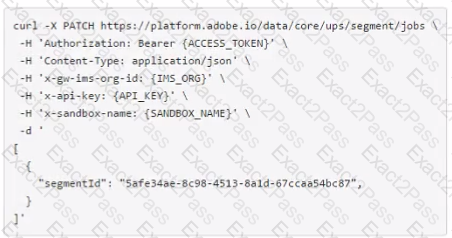
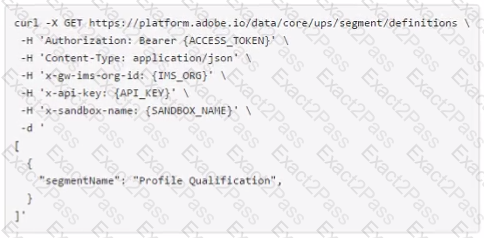
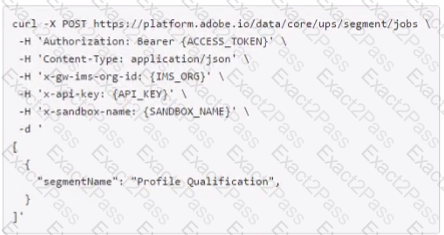
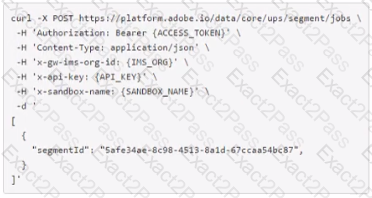
A daily scheduled segmentation job has already run and completed. However, the data engineer recently created a new segment.
Segment Name: Profile Qualification
Segment ID: Safe34ae-Sc98-4Sl3-8a1d-67ccaaS4bc87
The data engineer wants to evaluate this segment via API.
How should the data engineer proceed?
A)
B)
C)
D)
A data engineer must set up a Streaming Connection with new authentication via the AEP Ul to stream non XDM data into an existing Dataset. How should the data engineer proceed?

