Exact2Pass

Last Update 20 hours ago Total Questions : 64
The Salesforce Certified B2C Commerce Architect (Arch-303) content is now fully updated, with all current exam questions added 20 hours ago. Deciding to include B2C-Commerce-Architect practice exam questions in your study plan goes far beyond basic test preparation.
You'll find that our B2C-Commerce-Architect exam questions frequently feature detailed scenarios and practical problem-solving exercises that directly mirror industry challenges. Engaging with these B2C-Commerce-Architect sample sets allows you to effectively manage your time and pace yourself, giving you the ability to finish any Salesforce Certified B2C Commerce Architect (Arch-303) practice test comfortably within the allotted time.
A new project for a Client will involve a few different Integrations to their middleware system resulting in four different web services. All will use the same credentials to the middleware. Each will have the same timeout, but will require a separate log file prefix.
How should the Architect set this up with the Service framework using a minimal set of configuration?
While validating a LINK Cartridge for inclusion into the solution, an Architect notices that the UNK cartridge documentation requires the Architect to add a script node to a Pipeline in the storefront cartridge. The script is also a valid CommonJS module.
Which approach can the Architect use to Integrate this cartridge into a site that uses Controllers only?
A B2C Commerce Developer has just finished implementing a new promotion code form on checkout. During review, an Architect notes that the form it not using CSRF validation correctly.
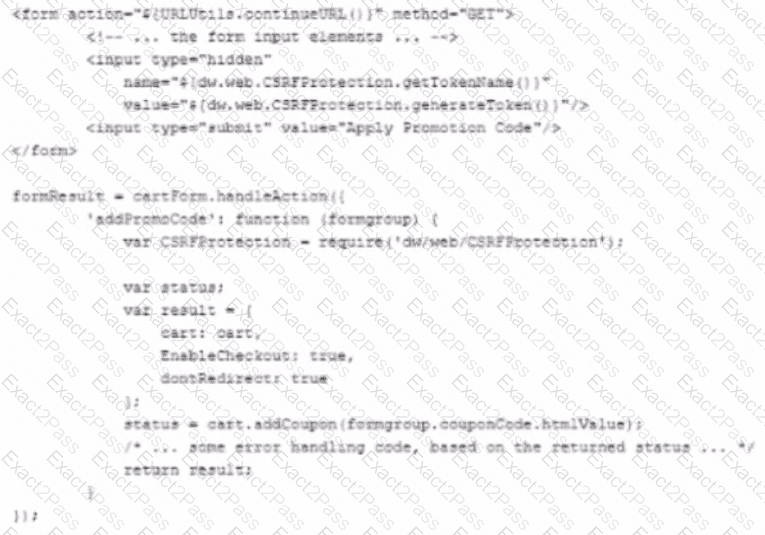
Which two options are best practice recommendations for dealing with CSRF validation? Choose 2 answers
The client provided these business requirements:
• The B2C Commerce platform will integratewith the Client s Order Management System (OMS).
• The OMS supports Integration using REST services.
• The OMS is hosted on the Clients infrastructure.
Whet configurations are needed for this integration with the OMS?
An Architect to notify by the Business that order conversion dramatically dropped a few hours after go live. Further investigation points out that customers cannot proceed to checkout anymore. The Architect is aware that a custom inventory checks with a third-party API is enforced at the beginning of checkout, and that customers are redirected to the basket page when items are no longer in stock
Which tool can dearly confirm that the problem is indeed caused by the inventory check?
An ecommerce site has dynamic shipping cost calculation. it allows the customers to see their potential shipping costs on the Product Detail Page before adding an item to the cart.
For this feature, shipping touts are calculated using the following logic:
• Set the shipping method on the Basket
• Add the item to the basket, calculate the basket total and get the shipping cost for this method
• Remove the item from the Basket to restore the original state
• The above process is repeated for each shipping method
During the testing it was discovered that the above code violates the spi.basket.addResolveInSameResquest quota.
What should the Architect do to resolve this issue and maintain the business requirement?
A client receives multiple feeds from third parties on the same SFTP location:
• Product prices (sftp: prod/prices)
• Stores information (sftp: prod/stores;
• Product information (sftp: prod/catalog)
• Categories information (sftp: prod/marketing)
• Content (sftp: prod/marketing)
Some of the feeds are placed on sftp multiple times a day, as the information is updated in the source system.
The Architect decides to have only two jobs:
• One that checks and downloads available feeds every hour
• One that imports the files from Webdav once a day before the data replication, using the standards steps available in the Job Framework
Which design is correctfor the import Job, taking the steps scope in consideration?
An integration cartridge implements communication between the B2C Commerce Storefront and a third-party service provider. The cartridge contains the localServiceRegistry code:
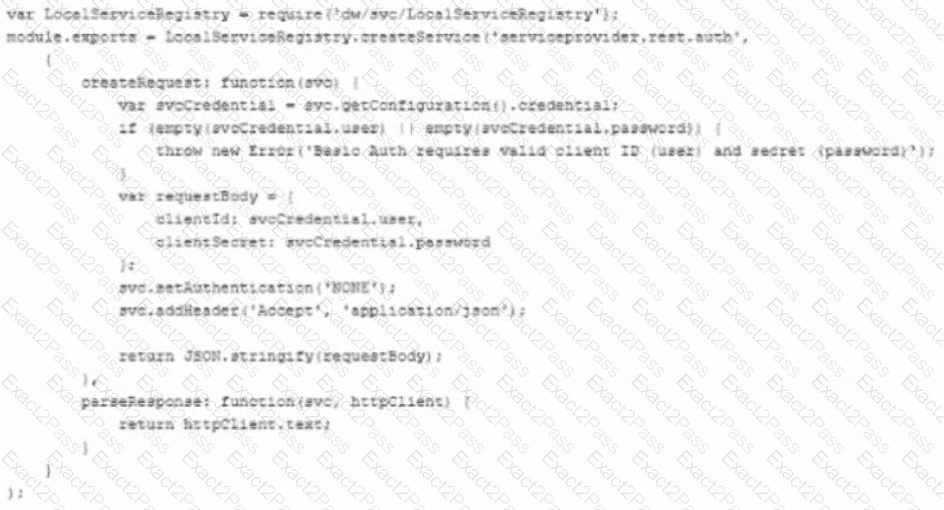
How does this code sample accomplish authentication to the service provider?
An Order Management System (OMS) handles orders from multiple brandspecific sites, as part of the processing, the OMS sends the processing detail to be added at notes to the orders in B2C Commerce. These processing details are captured temporarily in custom objects, and are later processed by a batch Job that:
• Processes the custom object to extract the orderid and note data.
• Tries to load the order.
• If the order is not found, it deletes the custom object and moves on.
• If the order is found, it updates notes In the Order, upon successful update of this order, it deletes the custom object.
There is an Issue reported that the job is constantly failing and custom objects are growing in number. On investigating the production look the message below is being logged on each failure:

What are three solution The Architect can take to fix this issue without losing meaningful data?
Choose 3 answers

