Weekend Special - 75% Discount Offer - Ends in 0d 00h 00m 00s - Coupon code: 75epass

Exact2Pass Menu

Claude Certified Architect - Professional

Last Update 1 hour ago Total Questions : 114

The Claude Certified Architect - Professional content is now fully updated, with all current exam questions added 1 hour ago. Deciding to include CCAR-P practice exam questions in your study plan goes far beyond basic test preparation.

You'll find that our CCAR-P exam questions frequently feature detailed scenarios and practical problem-solving exercises that directly mirror industry challenges. Engaging with these CCAR-P sample sets allows you to effectively manage your time and pace yourself, giving you the ability to finish any Claude Certified Architect - Professional practice test comfortably within the allotted time.

Question # 1

You are listing characteristics of robust guardrail design for an enterprise deployment.

Which two characteristics belong on the list? (Select two.)

Each correct answer presents a complete solution.

A.

Centralized log retention for guardrail violations with quarterly review by the security team.

B.

Per-role tool allow-lists enforced at the orchestration layer before any tool call executes.

C.

User feedback channels that route reported guardrail failures into the product backlog for triage.

D.

Periodic refresh of the system prompt wording to keep refusal language current and clear.

E.

Adversarial-input coverage in the evaluation set with regression tracking on guardrail performance.

Question # 2

You are distinguishing functional from non-functional requirements during discovery.

Which item is a non-functional requirement?

A.

The system must extract a defined set of specific fields from invoice attachments and populate a downstream data record.

B.

The system must produce a draft response that a human reviewer can edit before sending.

C.

The system must classify inbound tickets into a defined set of categories.

D.

The system must respond at p95 latency under 800 milliseconds at the expected request volume.

Question # 3

You are integrating AI-assisted tooling into the team’s documentation workflow. The team wants generated documentation that stays grounded in the actual code.

Which integration approach best fits this requirement?

A.

Generate documentation from the model’s training-data recall without reading any of the actual repository code, accepting that the output will not reflect the current implementation.

B.

Have the subagents publish generated documentation directly to the public-facing site without passing through the team’s normal review workflow or any human approval step.

C.

Configure subagents that read the relevant code files via filesystem and code-search tools, generate the documentation, and emit changes through the team’s normal review workflow.

D.

Disable all filesystem and code-search tools so the subagents cannot read any repository code, accepting that documentation generation will be entirely disconnected from the actual implementation.

Question # 4

You are comparing patterns for a batch document-classification job that follows fixed steps: extract metadata, classify, summarize, and persist.

Which pattern is the best fit and why?

A.

A workflow pattern, because agentic patterns do not support tool invocations and therefore cannot execute the persist step that writes results to the downstream store.

B.

An agentic pattern, because the open-ended planning capability of agents produces more consistent structured outputs than a fixed workflow graph on classification tasks.

C.

An agentic pattern, because agents are categorically more accurate than workflows and therefore always preferable regardless of step predictability.

D.

A workflow pattern, because the steps are well-defined and predictable per-request token cost is preferred over flexibility.

Question # 5

You are evaluating model-selection claims used by a peer team.

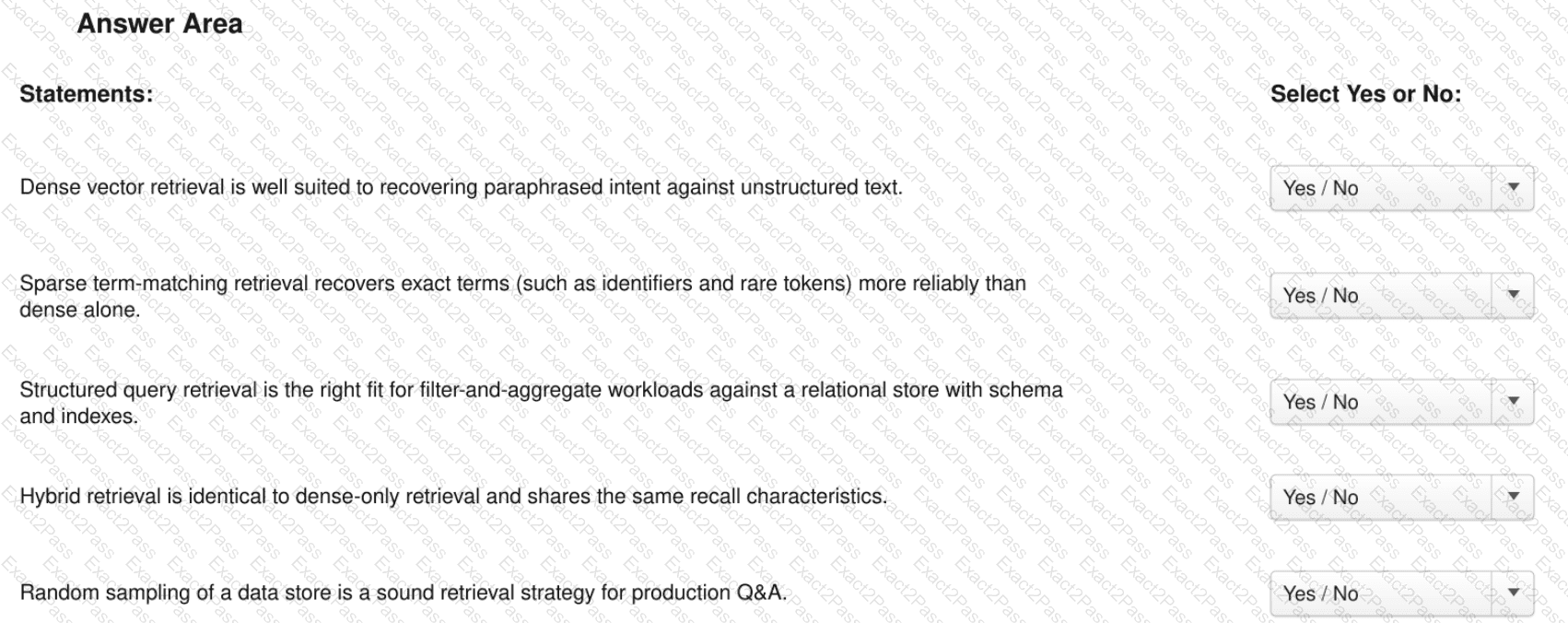
For each statement, select yes if the statement is generally true. Otherwise, select no.

Question # 6

You are building an ethics-review checklist for deployments supported by artificial intelligence.

Which two checks belong on the list? (Select two.)

Each correct answer presents a complete solution.

A.

Confirm that vendor licensing terms permit the planned production use of the model.

B.

Verify that outputs do not rely on generalizations about people that the underlying data does not support.

C.

Confirm that high-impact decisions retain human accountability rather than being attributed to the model.

D.

Restrict ethics review to outputs that exceed a defined model-confidence threshold.

E.

Confirm that latency and throughput targets are met across supported user populations.

Question # 7

You are a platform architect designing an internal Claude-based assistant that serves both finance analysts and external auditors. Each population must access only documents permitted by its role.

Where should role-based access control be enforced in the pipeline?

A.

Inside the system prompt as a natural-language instruction for Claude to ignore unauthorized documents.

B.

At the retrieval layer, before any role-restricted content reaches the prompt-construction step or the model.

C.

Nowhere in the pipeline; rely on the model’s general refusal behavior to reject unauthorized document access without any enforced access control.

D.

After the response is generated, by post-filtering content that should not have been retrieved.

Question # 8

You are integrating human review into a high-volume classification pipeline where reviewing every output is infeasible.

Which sampling strategy best balances throughput with quality oversight?

A.

No sampling, relying entirely on user complaints to reveal quality and safety problems after they affect users.

B.

Risk-stratified sampling that reviews all low-confidence and high-impact outputs and a smaller random sample of high-confidence routine outputs.

C.

Inverse sampling that reviews only high-confidence routine outputs and skips low-confidence and high-impact outputs.

D.

Universal review of every output regardless of confidence or throughput impact.

Question # 9

You are listing characteristics of strong architectural-decision communication.

Which two characteristics belong on the list? (Select two.)

Each correct answer presents a complete solution.

A.

Ownership and review cadence for revisiting the decision when conditions or assumptions change.

B.

Distribution to a standing review forum with mandatory attendance from senior engineering leaders.

C.

Omission of rejected alternatives to keep the decision document focused and concise for readers.

D.

Alternatives considered along with the criteria that were used to evaluate each alternative.

E.

Use of a consistent template across the team to standardize the visual presentation of decisions.

Question # 10

You are classifying token-management tactics by where each tactic applies in the request lifecycle: “Input Preparation,” “Prompt Construction,” or “Output Handling.”

Go to page: