Exact2Pass

Last Update 23 hours ago Total Questions : 124
The CMA Part 2: Strategic Financial Management Exam content is now fully updated, with all current exam questions added 23 hours ago. Deciding to include CMA-Strategic-Financial-Management practice exam questions in your study plan goes far beyond basic test preparation.
You'll find that our CMA-Strategic-Financial-Management exam questions frequently feature detailed scenarios and practical problem-solving exercises that directly mirror industry challenges. Engaging with these CMA-Strategic-Financial-Management sample sets allows you to effectively manage your time and pace yourself, giving you the ability to finish any CMA Part 2: Strategic Financial Management Exam practice test comfortably within the allotted time.
A group of nations is considering me formation of a cartel associated with the manufacture and distribution of a product that they each export. Which one of the following outcomes would not be consistent with me formation of a carter?
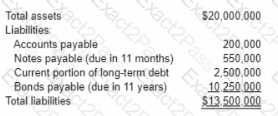
Marlow Company s partial balance sheet indicated the following.
Explain me concept of relevant cost in the season-making process and discuss whatever the €200, 000 course development coil is relevant to OLi ' s price decisions in future years
Essay
Online Learning Inc. lOLI) is a privately-held company based in the IUC that specializes in providing online courses in English as a Second Language (ESL). OLI is trying to set up a new sales office in a foreign country. It needs a business license to operate in that country. The license normally lakes six months to obtain. An official of that country said that he could expedite the process for a fee of €300.
OLI estimates the new sales office can bring €300,000 incremental profit annually OLI has just launched a new online 40-houi course to help adult ESL learners master basic business English. The price of the new course is €500 per student, the variable cost is €300 per student, and the total fixed cost of the new course is €300.000 per year OLI spent €200.000 to develop the new course before launching it. There are many online course providers in the marketplace, and each has its own feature However, OLI ' s highly qualified staff and good reputation have enabled it to charge a premium price compared to its major competitors. Recent market research indicates that if OLI raises the price of its new business English course by 10V the student enrollment would decrease by 5V A regional airlines company in Asia has approached OLI and offered to enroll 1.000 of its employees in the new course if OLI would agree to a special price of €350 per employee If OLI accepts this offer, an additional €10,000 onetime cost would be required to temporally expand its capacity to accommodate the new students.
A company has hired a consultant to propose a way to increase the company ' s revenues. The consultant has evaluated two mutually exclusive projects with me following information provided for each project.
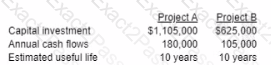
The company uses a discount rate of 9% to evaluate both projects Based on the net present value, the company should invest in
Javier makes hand-looted learner dog collars. The materials cost $10 per collar and the collars are sold for $50 each. Javier sells me collars at a local farmer ' s market mat charges S100 per month for space rental if Javier ' s income tax rate is 30%, how many collars must Javier sell each year to earn $1,000 net income?
A capital budgeting analysis involves an initial investment of $500. The expected cash inflow in Year 1 is $300, and the expected cash inflow in Year 2 is $350. Which one of the following equations can get the correct internal rate of return (IRR) of this project?
Amy Curtin sells used cars of a reliable bona Curtin has no knowledge of me history or any or the specific cars She believes that the brand is reliable, and is considering whether it is acceptable to offer only this general Information rather than specific information regarding me cars when trying to complete each sale The company has always preferred to make the sale and worry about any warranty issues later and there are no legal disclosure requirements in their jurisdiction Curtin considers herself to be an ethical person but she does not want to lose out on any potential sales of vehicles that are most likely in good mechanical condition Which one of the following statements best represents what Curtin should consider related to the meaning of ethics?
It there is sufficient capacity to fill the order, which of the following are relevant for a special order decision?
The best discount rate to the use for evaluate of investment opportunities is the
Which one of the following statements regarding working capital management is not correct?

