Exact2Pass

Last Update 20 hours ago Total Questions : 180
The Certified Professional Contract Manager content is now fully updated, with all current exam questions added 20 hours ago. Deciding to include CPCM practice exam questions in your study plan goes far beyond basic test preparation.
You'll find that our CPCM exam questions frequently feature detailed scenarios and practical problem-solving exercises that directly mirror industry challenges. Engaging with these CPCM sample sets allows you to effectively manage your time and pace yourself, giving you the ability to finish any Certified Professional Contract Manager practice test comfortably within the allotted time.
Scenario 4.0: 2 — “The Requirements of a Requirements Contract”
In 2019, the buyer awarded National Concrete Supply (NCS) the first of three consecutive contracts for concrete placement, asphalt surface treatments, and pavement markings at one of its facilities. The first one-year contract had an option to extend performance through April 30, 2022. The 2020 contract was a “requirements type contract to be ordered on individual delivery orders.” The scope of the contract required NCS to furnish all labor, materials, equipment, transportation, traffic control, and supervision for construction and repair services. The contract provided that services for concrete work would “include, but not be limited to” base course restoration, crack repair, joint repair, concrete headwalls, complete restoration, concrete curb and gutter, concrete porches, steps, and patios, slab jacking, concrete sidewalks, rapid-set concrete repair, culverts and drainage structures, repair or construction of roads, airfield surfaces, walkways, retaining walls, parking lots, and concrete footings.
The buyer reserved the right “to have work falling within the scope of the contract performed by in-house personnel, job order contracting, or by another contract where concrete placement, asphalt surface treatment, or pavement marking is incidental to other work.”
The 2020 contract also included clauses stating, among other things, that this was a requirements contract and that the estimated quantities were not the buyer’s total requirements, but only estimates of requirements exceeding quantities the buyer might furnish within its own capabilities.
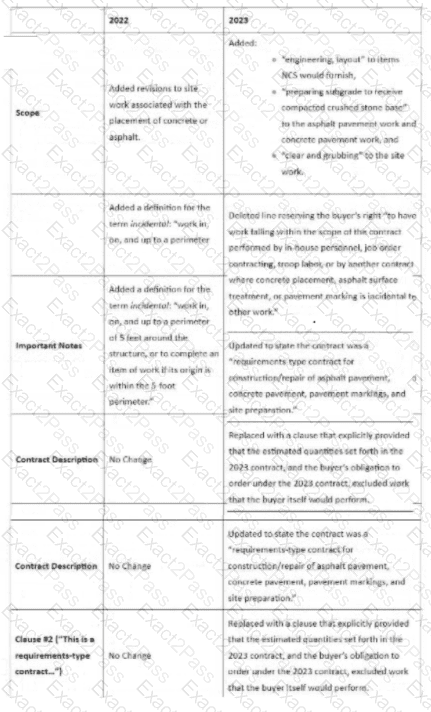
Following expiration of the 2020 contract, the buyer entered into additional one-year contracts in 2022 and 2023. Based on the comparison table provided, the key changes were:
2022: Added revisions to site work associated with the placement of concrete or asphalt; added a definition of “incident” as work in, on, and up to a perimeter of 5 feet around the structure or item to complete work if its origin is within that 5-foot perimeter; no change to contract description; no change to the clause stating the contract was a requirements-type contract.
2023: Added items NCS would furnish, including engineering/layout, preparing subgrade to receive compacted crushed stone base, and clear and grubbing; deleted the line reserving the buyer’s right to have certain work performed by in-house personnel, job order contracting, or another contract where concrete placement, asphalt surface treatment, or pavement marking was incidental to other work; updated the contract description to state the contract was a “requirements type contract for construction/repair of asphalt pavement, concrete pavement, pavement markings, and site preparation”; and replaced the clause with one stating that the estimated quantities set forth in the 2023 contract, and the buyer’s obligation to order under the 2023 contract, excluded work that the buyer itself would perform.
NCS claimed that during performance of the 2020, 2022, and 2023 contracts, the buyer diverted substantial portions of work within the scope sections to other contractors and claimed lost profits under each contract.
Question:
What could the buyer have done to reduce its risk in this contract?
Organizations use __________ to measure how long it takes to award a contract.
To excel in work, life, or as a leader, contract managers must commit to __________.
Scenario 5.0: 2
The buyer issued a request for proposals (RFP) for various support services. As part of these services, the seller would need to review the work of other contractors on existing and future programs. The RFP noted the potential for impaired objectivity or unfair competitive advantage organizational conflicts of interest (OCIs), and specified that the seller would be ineligible for involvement at any level on specifically identified contracts. The RFP also specified a second set of contracts—one of which was identified as “LKS”—that presented potential OCIs, and directed any seller performing work under these latter contracts to provide notice and an OCI mitigation plan that would be analyzed by the buyer.
The buyer intended to award a single cost-plus-fixed-fee, level-of-effort contract for a two-year base period with three option years to the offeror whose proposal provided the best value. This determination was to be based on an evaluation of proposals under the following three factors, in descending order of importance:
o Cost
o Mission suitability
o Past performance
For this contract, mission suitability and past performance, when combined, were to be approximately equal in importance to cost.
The RFP provided that the evaluation of cost proposals would assess both reasonableness and realism. To determine cost, the RFP provided estimates for both estimated level-of-effort hours and optional flex hours for nine labor categories, specifying the experience, skills, and description for each category. Under the mission suitability factor, the RFP included various management approach subfactors. These included a phase-in approach subfactor, which required offerors to specify an incumbent capture rate as a percentage of the total workforce and to justify the rate and methods used to achieve it. Both offerors in the competitive range indicated high incumbent capture rates. The proposed staffing approach was to be assessed under the technical approach subfactor.
The source selection plan provided a table that described how point scores would be assigned and which corresponding adjectival ratings would result from the scores. During the first evaluation, the buyer assigned a weakness to one of the two offerors in the competitive range, Offeror A, based on the fact that Offeror A offered at or below the average compensation for the low end of the required experience level, as well as the risk associated with Offeror A’s ability to capture a qualified workforce. In response, Offeror A showed the buyer that it had used commercial compensation rates to determine its compensation rates. As such, the compensation rates Offeror A had submitted in its proposal were less than the company’s engineers were currently being compensated.
After establishing the competitive range, the buyer held discussions with Offeror A and Offeror B. The buyer then requested final proposal revisions (FPRs).
In its FPR, Offeror A noted that its major subcontractor, Sub A, was the prime contractor on the “LKS project” mentioned in the RFP, and submitted an OCI mitigation plan that included a labor distribution and mapping template showing that the program supported by Sub A’s LKS project would not be overseen by Sub A’s staff performing work on the new contract. Contemporaneous records indicated a brief discussion by the evaluators of this approach, but did not discuss OCI mitigation directly and provided no indication that the potential OCI was analyzed.
After reevaluation, Offeror A had slightly higher scores in the technical approach and mission suitability subfactors, a lower past performance rating, and a lower probable cost. After receiving and evaluating the FPRs, the buyer awarded the contract to Offeror A.
Question:
Which of the following would have been the most appropriate goal for the buyer’s discussions with the offerors within the competitive range?
Under a/an __________ cost system, a company accounts for output by identifying specific physical units.
The correct sequence of presentation of items on the typical income statement is __________.
The Uniform Commercial Code applies to __________.
A combination of procedures and physical security used to avoid potential, real, or perceived conflicts of interest from affecting the business activities of either party is called a __________.
A(n) __________ contract is created when the parties state their intentions either verbally or in writing.
Scenario 4.0: 2 — “The Requirements of a Requirements Contract”
In 2019, the buyer awarded National Concrete Supply (NCS) the first of three consecutive contracts for concrete placement, asphalt surface treatments, and pavement markings at one of its facilities. The first one-year contract had an option to extend performance through April 30, 2022. The 2020 contract was a “requirements type contract to be ordered on individual delivery orders.” The scope of the contract required NCS to furnish all labor, materials, equipment, transportation, traffic control, and supervision for construction and repair services. The contract provided that services for concrete work would “include, but not be limited to” base course restoration, crack repair, joint repair, concrete headwalls, complete restoration, concrete curb and gutter, concrete porches, steps, and patios, slab jacking, concrete sidewalks, rapid-set concrete repair, culverts and drainage structures, repair or construction of roads, airfield surfaces, walkways, retaining walls, parking lots, and concrete footings.
The buyer reserved the right “to have work falling within the scope of the contract performed by in-house personnel, job order contracting, or by another contract where concrete placement, asphalt surface treatment, or pavement marking is incidental to other work.”
The 2020 contract also included clauses stating, among other things, that this was a requirements contract and that the estimated quantities were not the buyer’s total requirements, but only estimates of requirements exceeding quantities the buyer might furnish within its own capabilities.
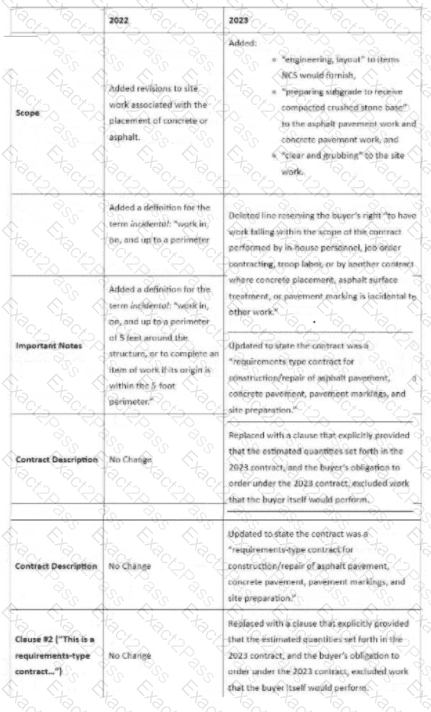
Following expiration of the 2020 contract, the buyer entered into additional one-year contracts in 2022 and 2023. Based on the comparison table provided, the key changes were:
2022: Added revisions to site work associated with the placement of concrete or asphalt; added a definition of “incident” as work in, on, and up to a perimeter of 5 feet around the structure or item to complete work if its origin is within that 5-foot perimeter; no change to contract description; no change to the clause stating the contract was a requirements-type contract.
2023: Added items NCS would furnish, including engineering/layout, preparing subgrade to receive compacted crushed stone base, and clear and grubbing; deleted the line reserving the buyer’s right to have certain work performed by in-house personnel, job order contracting, or another contract where concrete placement, asphalt surface treatment, or pavement marking was incidental to other work; updated the contract description to state the contract was a “requirements type contract for construction/repair of asphalt pavement, concrete pavement, pavement markings, and site preparation”; and replaced the clause with one stating that the estimated quantities set forth in the 2023 contract, and the buyer’s obligation to order under the 2023 contract, excluded work that the buyer itself would perform.
NCS claimed that during performance of the 2020, 2022, and 2023 contracts, the buyer diverted substantial portions of work within the scope sections to other contractors and claimed lost profits under each contract.
Question:
The buyer agreed that the 2020 contract was a requirements-type contract. However, the buyer and seller disagreed about whether the 2022 and 2023 contracts were requirements-type contracts. Were these contracts requirements-type contracts?

