
Spring Sale Special Limited Time 70% Discount Offer - Ends in 0d 00h 00m 00s - Coupon code: buysanta

Exact2Pass Menu

Certified Professional in Healthcare Quality Examination

Last Update 19 hours ago Total Questions : 813

The Certified Professional in Healthcare Quality Examination content is now fully updated, with all current exam questions added 19 hours ago. Deciding to include CPHQ practice exam questions in your study plan goes far beyond basic test preparation.

You'll find that our CPHQ exam questions frequently feature detailed scenarios and practical problem-solving exercises that directly mirror industry challenges. Engaging with these CPHQ sample sets allows you to effectively manage your time and pace yourself, giving you the ability to finish any Certified Professional in Healthcare Quality Examination practice test comfortably within the allotted time.

Question # 106

Following the opening of a new stand-alone behavioral health center, the director is challenged with development of a Quality Council. After identifying membership, the next step is to

A.

Educate members on regulatory processes

B.

Identify quality priorities

C.

Charter project improvement teams

D.

Develop quality indicators

Question # 107

As part of survey preparation, a quality professional follows the experience of care for several patients throughout the organization. This is an example of using

A.

system tracers.

B.

focused tracers.

C.

individual tracers.

D.

program-specific tracers.

Question # 108

Care that does not vary in quality because of gender, ethnicity, geographic location, or socioeconomic status is said to be

A.

Efficient

B.

Effective

C.

Equitable

D.

Evidence-based

Question # 109

What should a chief medical officer (CMO) do to avoid groupthink within a team?

A.

Explore the reason for strong cohesion.

B.

Encourage dissenting opinions.

C.

Train members in teamwork.

D.

Schedule frequent meetings.

Question # 110

A home health agency’s Performance Improvement Committee has decided to base staff educational programs onaggregated occurrence report data. Due to budgetary and time constraints, not every area identified from the data can be addressed. Which of the following would be most useful to the committee in determining their educational targets?

A.

force field analysis

B.

control chart

C.

Pareto chart

D.

scattergram

Question # 111

A healthcare quality professional is planning to discuss a problem related to delays in home-care visits with the home-care team. Which of the following is the most effective approach?

A.

Share personal knowledge of home care

B.

Present the problem and ask for feedback

C.

Communicate the quality assessment committee’s action plan

D.

State the cause of the problem and suggest a solution

Question # 112

In a confidential reporting system, the reporter ' s Identity Is

A.

hidden from authorities.

B.

known to legal authorities.

C.

known to regulatory groups.

D.

hidden from everyone.

Question # 113

The desired outcome of peer review Is to

A.

evaluate process Improvement Initiatives.

B.

compare provider performance.

C.

Improve the quality of care.

D.

limit privileges of at-risk providers.

Question # 114

A group of clinical staff has identified a new opportunity for improvement. The group is ready to identify a sponsor, and a meeting has been scheduled with the Chief Medical Officer to discuss the possibility for them to serve as the sponsor. What sponsor task should be discussed during the meeting?

A.

Perform data analysis to identify gaps or opportunities

B.

Influence peers to adopt proposed changes

C.

Demonstrate the ideal process to the staff

D.

Allocate resources to support the team’s work

Question # 115

An effective method to increase an organization’s board of directors engagement in patient safety is to

A.

foster teamwork and good communication at all levels of the organization and conduct training for both of these skill sets.

B.

structure the board agenda so that quality and safety are given the same amount of attention as financial issues.

C.

focus on improvement projects that are important to the medical staff in the organization.

D.

guide them through a recent failure mode and effects analysis (FMEA) that was conducted prior to the launch of a new technology.

Question # 116

A Pharmacy and Therapeutics Committee has reviewed the following control chart for presentation to a governing body:
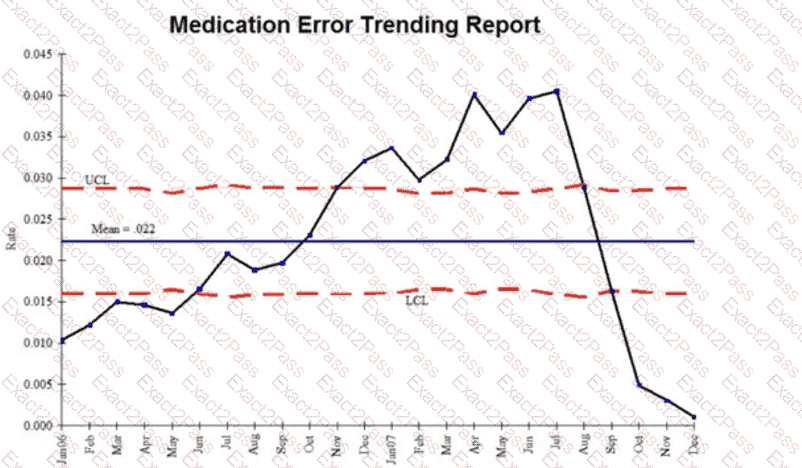
Which of the following conclusions is most appropriate?

A.

The strategic goal for improving reporting of errors has been met.

B.

The strategic goal for improving patient safety has been met.

C.

The most serious errors are occurring in the spring and summer.

D.

There has been a significant reduction in reported errors.

Question # 117

The benefits of performing a community health assessment include

A.

Increasing knowledge about public health within the community

B.

Targeting a neighborhood for a more manageable assessment

C.

Allocating resources to the top opportunities for improvement

D.

Improving core measure performance in the organization

Question # 118

Which of the following is an outcome indicator for a radiology unit?

A.

Utilization of CT scan for low back pain

B.

Contrast-induced complications

C.

Mammography result turnaround time

D.

" Time-out " performed for interventional cases

Question # 119

When prioritizing quality improvement initiatives, which of the following should take the highest priority?

A.

a high-performing patient experience metric with one month of decreased performance

B.

a process to comply with a new regulatory requirement beginning in the next quarter

C.

a high-risk, low-volume process with common cause variation in the past quarter

D.

an outcome measure outperforming the benchmark for the past 12 months

Question # 120

Which of the following conclusions might be drawn from failure mode and effects analysis (FMEA)?

A.

Key factors were identified, and corrective action plans were created.

B.

Actions were taken to address baseline performance and monitored for sustainment.

C.

Risks were identified and prioritized, and action plans were developed.

D.

Special causes were identified, and variation was reduced.

Go to page:
