Exact2Pass

Last Update 18 hours ago Total Questions : 45
The ISTQB Certified Tester Advanced Level - Technical Test Analyst (V4.0) content is now fully updated, with all current exam questions added 18 hours ago. Deciding to include CTAL-TTA_Syll19_4.0 practice exam questions in your study plan goes far beyond basic test preparation.
You'll find that our CTAL-TTA_Syll19_4.0 exam questions frequently feature detailed scenarios and practical problem-solving exercises that directly mirror industry challenges. Engaging with these CTAL-TTA_Syll19_4.0 sample sets allows you to effectively manage your time and pace yourself, giving you the ability to finish any ISTQB Certified Tester Advanced Level - Technical Test Analyst (V4.0) practice test comfortably within the allotted time.
A software company based in Spain that develops mobile applications expects many small updates in the future, e.g., due to changing configurations and customer feedback. The company also wants to focus on being able to change the software effectively and efficiently during initial development without introducing new defects.
Which maintainability sub-characteristic should be covered by the test approach during the initial development?
Assume you are involved in testing a Health Insurance Calculation system.
At the main screen one can enter information for a new client. The information to be provided consists of last name, first name and date of birth. After confirmation of the information, the system checks the age of the potential new client and calculates a proposed premium.
The system also has the option to request information for an existing client, using the client’s ID number.
A keyword-driven automation approach is being used to automate most of the regression testing.
Based on the information provided, which TWO of the options provided would be the MOST LIKELY keywords for this application? (Choose two.)
A new web site has been launched for a testing conference. There are a number of links to other related web sites for information purposes. Participants like the new site but complaints are being made that some (not all) of the links to other sites do not work.
Which type of test tool is most appropriate in helping to identify the causes of these failures?
Consider the pseudo code for the Price program:
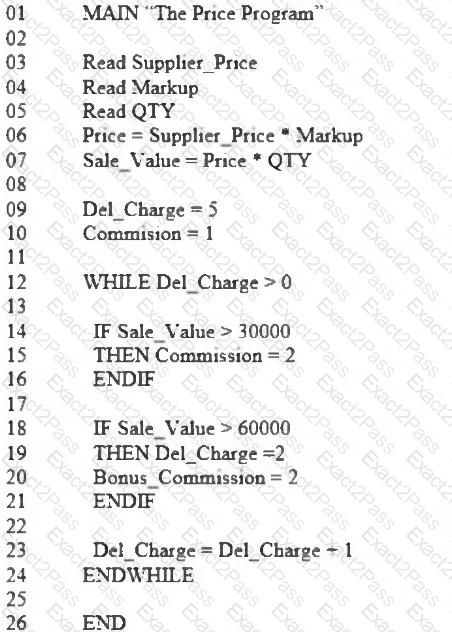
Which of the following statements about the Price program describes a control flow anomaly to be found in the program?
You have been assigned to perform a review on code provided below:
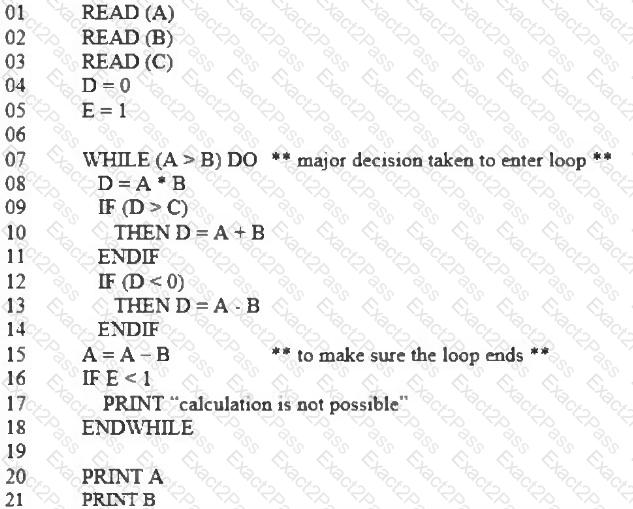
Which type of defect should you report as part of the code review?
Which of the following statements about performance testing tools is NOT correct?
A component has been analysed during a risk-assessment and rated as highly critical. Which of the following white-box test techniques provides the highest level of coverage and could therefore be used to test this component?
You are working on project where re-use of software is an objective. You are involved in the project as a Technical Test Analyst and have been given the task to develop a checklist for code reviews.
Which question from the list below should you implement as part of the code review checklist?
Subject to testing is a software system (COTS) for Project Administration and Control (PACS). PACS is a multi-project system for controlling the project time, e.g., in terms of scheduling and tracking, and managing the productivity of projects, e.g., in terms of effort and deliverables.
During various interviews with stakeholders the following information was gathered:
• Using PACS is not business critical. There is no impact such as high financial losses or problems to the operational continuity of an organization. Its application is not critical since the software package does not support directly the operational, or the primary, business processes of an organization. It supports (project) management in the project planning and tracking process. Of course, it will be highly annoying for users if the system “goes down” from time to time. Although this does not have a high impact for the business process as a whole, the Mean Time Between Failures (MTBF) still needs to be at a good level to be successful in the market.
• Users of PACS typically have an academic educational level, but have no prior experience with this particular type of project management software. The system will be used by a large number of users within an organization.
• The system will be used on a regular basis, e.g., several times per day by project managers and several times per week by project employees. This means that the system will not be used very intensively, often only for some data input or an information request. Its usage is not considered to be very time-critical.
• The data is recorded on-line and real-time. The system is expected to run in multiple hardware environments in various network environments. It is also expected that changes in the operational environments will happen in the upcoming period that also need to be supported.
Based on the information provided by the stakeholder, which combination of non-functional quality characteristics should you propose to test as part of your test approach?
As a technical test analyst, you are involved in a risk analysis session using the Failure Mode and Effect Analysis technique. You are calculating risk priorities. Which of the following are the major factors in this exercise?

