
Spring Sale Special Limited Time 70% Discount Offer - Ends in 0d 00h 00m 00s - Coupon code: buysanta

Exact2Pass Menu

Associate - Cloud Infrastructure and Services v.3 Exam

Last Update 3 hours ago Total Questions : 84

The Associate - Cloud Infrastructure and Services v.3 Exam content is now fully updated, with all current exam questions added 3 hours ago. Deciding to include DEA-2TT3 practice exam questions in your study plan goes far beyond basic test preparation.

You'll find that our DEA-2TT3 exam questions frequently feature detailed scenarios and practical problem-solving exercises that directly mirror industry challenges. Engaging with these DEA-2TT3 sample sets allows you to effectively manage your time and pace yourself, giving you the ability to finish any Associate - Cloud Infrastructure and Services v.3 Exam practice test comfortably within the allotted time.

Question # 1

What is a characteristic of thin LUNs?

A.

When a thin LUN is destroyed, its allocated capacity is automatically reclaimed to the pool.

B.

When a thin LUN is created, physical storage is fully allocated for it

C.

Once a thin LUN is created it cannot be destroyed until all data is deleted from it

D.

When a thin LUN is destroyed, its allocated capacity is reserved until an administrator reclaims it

Question # 2

What capability is provided by the “Open and extensible” attribute of software-defined infrastructure (SDI)?
A.

Uses APIs to integrate multivendor resources into the SDI environment

B.

Optimizes resource usage and generates value reports about the SDI environment

C.

Provides a control point for the entire SDI environment

D.

Provides multitenancy that enables consumers to share resources in the SDI environment

Question # 3

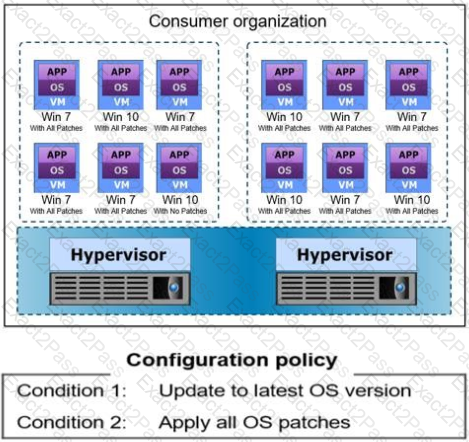
Refer to the exhibit, which represents a consumer environment consisting of multiple VMs running Windows operating systems (OSs).

For compliance reasons, the cloud service provider maintains version control over the OS provided to the consumer. The service provider also ensures that the configurations of the VMs comply with the configuration policy for the OS version. The configuration policy includes the two conditions shown in the exhibit. A monitoring tool verifies VM configurations against the configuration policy and provides the compliance results shown.

What is the percentage of compliance non-adherence?

A.

30.12%

B.

33.34%

C.

58.33%

D.

66.67%

Question # 4

What is a responsibility of the Service Account Manager?

A.

Maintaining day-to-day contact that consumers’ needs are met

B.

Designing, planning, managing, maintaining, and supporting the cloud infrastructure

C.

Understanding consumers’ needs and industry trends to drive an affective product strategy

D.

Streaming service delivery and execution, and handling early warnings for service issues

Question # 5

What is a function of service portfolio management?

A.

Ensure compliance to industry standards

B.

Enable capacity and availability management

C.

Perform market research and collect information about competitors

D.

Collect information about cloud services and their constituent elements

Question # 6

What is a responsibility of vendor relationship manager?

A.

Understand what consumers ' needs and industry trends to drive an effective product strategy

B.

Creating detailed designs for the cloud infrastructure.

C.

Streamline service delivery and execution.

D.

Understand service needs of LOBs, determines which needs are good candidates for CSP, and also works with service managers

Question # 7

What is an organizational benefit of adopting modern applications?

A.

Enhances competitiveness

B.

Removes dependency on IT completely

C.

Eliminates CAPEX

D.

Removes dependency on service provider

Question # 8

What condition can result in the development of a " shadow IT " organization?

A.

Increasing number of end user devices and different access points

B.

Bypassing of internal IT and looking elsewhere for IT services

C.

Lack of cloud extensibility inside an organization

D.

Aging facilities, and outdated policies and technology

Question # 9

Which method compares observed events with normal activities to identify abnormal patterns in a system?

A.

Encryption-based authentication

B.

Anomaly-based intrusion detection

C.

Multi-factor authentication

D.

Signature-based intrusion detection

Question # 10

What is a function of business relationship management?

A.

Determine if the capacity of IT services can deliver the agreed upon service levels

B.

Identify requirements and ensure that the appropriate services are provided

C.

Identify accurate information for all operational services

D.

Determine what the sufficient capacity is to meet business demand

Go to page:
