Spring Sale Special Limited Time 70% Discount Offer - Ends in 0d 00h 00m 00s - Coupon code: buysanta

Exact2Pass Menu

HCIA-Storage V4.5

Last Update 4 hours ago Total Questions : 536

The HCIA-Storage V4.5 content is now fully updated, with all current exam questions added 4 hours ago. Deciding to include H13-611_V4.5 practice exam questions in your study plan goes far beyond basic test preparation.

You'll find that our H13-611_V4.5 exam questions frequently feature detailed scenarios and practical problem-solving exercises that directly mirror industry challenges. Engaging with these H13-611_V4.5 sample sets allows you to effectively manage your time and pace yourself, giving you the ability to finish any HCIA-Storage V4.5 practice test comfortably within the allotted time.

Question # 151

The amount of data in an incremental backup is larger than that in a differential backup.

A.

TRUE

B.

FALSE

Question # 152

The NAS engine and the storage unit are interconnected by Ethernet switches.

A.

TRUE

B.

FALSE

Question # 153

iSCSI encapsulates the SCSI command and data description block into the iSCSI protocol.

A.

TRUE

B.

FALSE

Question # 154

Which of the following statements about Huawei RAID 2.0+ are correct? (Multiple choice)

A.

Hot spare space cannot cross engine

B.

RAID 2.0+ uses an independent hot spare disk

C.

Chunk size and Extent size are not adjustable

D.

Automatically reserve a certain amount of hot spare space in the hard disk domain according to the hot spare strategy

Question # 155

Which mirroring scenarios are mainly used in HyperMirror? (Multiple choices)

A.

Mirroring of two LUNs in this array

B.

Cooperate with the heterogeneous virtualization function to realize the mirroring of the LUN of the heterogeneous array and the array

C.

Cooperate with the heterogeneous virtualization function to realize the mirroring of two heterogeneous LUNs

D.

The mirrors of the two LUNs of the volume mirror are not under the same home controller

Question # 156

The initial capacity allocation strategy of HUAWEI OceanStor storage system defaults to automatic allocation.

A.

TRUE

B.

FALSE

Question # 157

The difference between DAS and SAN, which of the following descriptions is wrong?

A.

SAN redundant networking provides higher reliability

B, DAS and SAN are all external storage, so storage resource sharing can be easily achieved

C, DAS is suitable for small and medium-sized LAN environment with only a few servers

B.

SAN is suitable for high-end storage application environments, such as key databases, centralized storage, large-scale storage, backup and

Disaster recovery and other scenarios

Question # 158

There are two descriptions about backups:

Description 1: You can use the data backed up on the tape for data recovery at any time, but you can only recover to the backup moment

Historical data, not the data at the time of failure.

Description 2: Using tape as the backup medium is the highest RTO backup method.

A.

description 1 is correct, description 2 is correct

B.

Description 1 is right, description 2 is wrong

C.

description 1 is wrong, description 2 is right

D.

Description 1 is wrong, description 2 is wrong

Question # 159

The following description of NAS is correct:

Description 1: NAS is always based on file sharing.

Description 2: The distance of the network connection affects the performance of the NAS.

A, Description 1 and Description 2 are correct.

B. Description 1 is correct, description 2 is incorrect

C. Description 1 is wrong, description 2 is correct

D, description 1 and description 2 are wrong

Question # 160

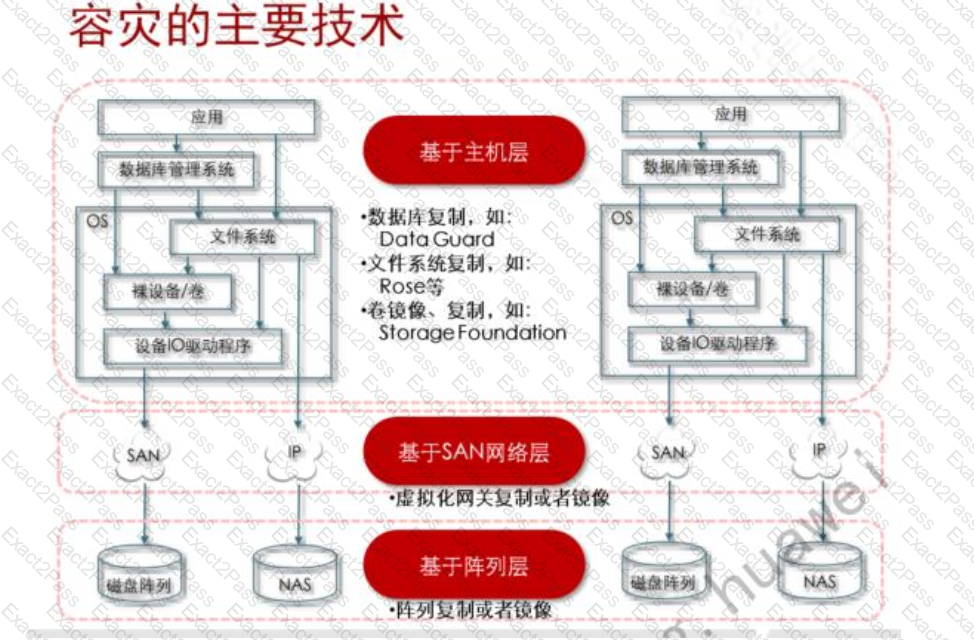
The advantages and disadvantages of the disaster recovery technology of the host layer, network layer and array layer, the following statement is correct? (Multiple choice)


A.

For host layer disaster recovery, host layer replication will occupy certain host resources, which will affect the application system

B.

The initial construction cost of network layer disaster recovery is relatively low, and many manufacturers can provide solutions

C.

Array layer disaster recovery, the arrays at both ends must be products of the same manufacturer, unable to solve the heterogeneous problem

D.

Host layer disaster recovery is implemented on the host side, without considering the compatibility between the underlying devices

Go to page: