Exact2Pass

Last Update 2 hours ago Total Questions : 60
The HCIA-Cloud Service V3.5 content is now fully updated, with all current exam questions added 2 hours ago. Deciding to include H13-811_V3.5 practice exam questions in your study plan goes far beyond basic test preparation.
You'll find that our H13-811_V3.5 exam questions frequently feature detailed scenarios and practical problem-solving exercises that directly mirror industry challenges. Engaging with these H13-811_V3.5 sample sets allows you to effectively manage your time and pace yourself, giving you the ability to finish any HCIA-Cloud Service V3.5 practice test comfortably within the allotted time.
An ECS can be billed on a pay-per-use, yearly or monthly, or spot price basis. Only pay-per-use billing can reduce costs.
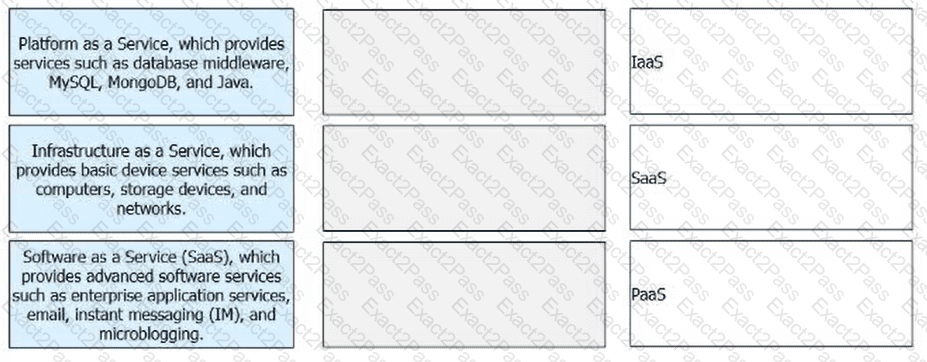
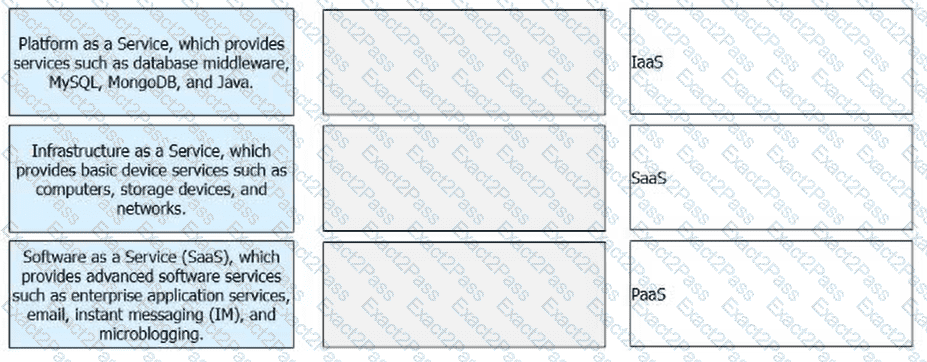
The three cloud computing service models are continuously being improved. Match the acronyms of the three models with their respective functions:
Which of the following statements is incorrect about the relationship between Bare Metal Server (BMS) and other cloud services?
Which of the following statements are true about the relationship between account and Identity and Access Management (IAM) users?
The underlying physical resources of an Elastic Cloud Server (ECS) can be shared between users, but those of a Bare Metal Server (BMS) are exclusive to a single user.
On HUAWEI CLOUD, if a user wants to enable an Elastic Cloud Server (ECS) to access the Internet, the only way is to bind an Elastic IP (EIP) to the ECS.
Which of the following statements is incorrect about Scalable File Service (SFS) Capacity-Oriented and SFS Turbo file systems?
In HUAWEI CLOUD Object Storage Service (OBS), an object policy is only applied to a single object in a bucket. A bucket policy applies to some or all of the objects in a bucket.
Hybrid cloud is a flexible cloud computing model. It may contain two cloud architectures: public cloud and private cloud, or even more. The infrastructure of a hybrid cloud is owned and operated by a single organization. Therefore, user services can switch between these clouds as required.
Which of the following statements are false about Auto Scaling (AS)?