Spring Sale Special Limited Time 70% Discount Offer - Ends in 0d 00h 00m 00s - Coupon code: buysanta

Exact2Pass Menu

Aruba Certified Mobility Associate Exam

Last Update 2 hours ago Total Questions : 131

The Aruba Certified Mobility Associate Exam content is now fully updated, with all current exam questions added 2 hours ago. Deciding to include HPE6-A70 practice exam questions in your study plan goes far beyond basic test preparation.

You'll find that our HPE6-A70 exam questions frequently feature detailed scenarios and practical problem-solving exercises that directly mirror industry challenges. Engaging with these HPE6-A70 sample sets allows you to effectively manage your time and pace yourself, giving you the ability to finish any Aruba Certified Mobility Associate Exam practice test comfortably within the allotted time.

Question # 31

A network administrator examines a list of 2.4GHz clients with low performance in the Mobility Master (MM) dashboard. Which property for a client should pose a concern as a potential performance issue?

A.

Radio PHY of HT 20MHz

B.

Max speed of 72Mbps

C.

Goodput data rate of 12 Mbps

D.

Usage of 10 MB

Question # 32

How does a high-gain omni-directional antenna compare to a typical omni-directional antenna?

A.

it provides more multi-user spatial streams.

B.

it provides more coverage in the horizontal direction than in the vertical direction.

C.

it provides more single-user spatial streams.

D.

it provides more coverage in both the horizontal and vertical directions.

Question # 33

What is a requirement for the Dashboard > Traffic Analysis window on the Aruba Mobility Master (MM) to show data?

A.

Airmatch and ClientMatch must be enabled.

B.

The solution must have active PEFNG licenses.

C.

Firewall policies must include application filtering rules.

D.

WLANs must use the decrypt-tunnel forwarding option.

Question # 34

A network administrator reduces an AP radio transmit power from 18 dBm to 15 dBm. This is a loss of 3 dBms.

What is the current power as a percentage of the original power?

A.

10%

B.

33%

C.

50%

D.

83%

Question # 35

What is one difference between captive portal authentication and 802.1X authentication?

A.

802.1X authentication always authenticates the wireless client, while captive portal authentication always authenticates the wireless user.

B.

802.1X authentication occurs at Layer 2, while captive portal authentication occurs at Layer 3.

C.

802.1X authentication must use an LDAP server, while captive portal authentication can use a RADIUS server or an LDAP server.

D.

802.1X authentication is typically implemented without encryption, while captive authentication is often combined with WPA or WPA2.

Question # 36

Refer to the exhibit.

A network administrator adds a global rule in the area shown in the exhibit. Where does the global rule take effect?

A.

It immediately applies only to the guest role, as part of the final policy applied to the role. Administrators cannot apply the rule to other roles.

B.

It immediately applies to the guest role and other roles, as part of the first policy applied to the role.

C.

It immediately applies to the guest role and other roles, as part of the final policy applied to the role.

D.

It immediately applies only to the guest role and other roles, as part of the first policy applied to the role. Administrators can choose to apply the rule to other roles.

Question # 37

Refer to the exhibits.

Exhibit 1

Exhibit 2
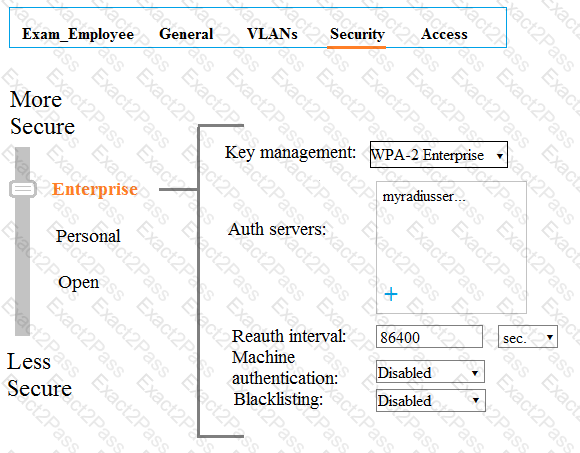
Network administrators use the Aruba Mobility Master (MM) wizard to create a WLAN and do not manually alter any of the profiles for that WLAN. The exhibits show some of the settings for the WLAN. Some wireless users cannot successfully connect to the WLAN. Network administrators attempt to connect on their own machines with a test account, and the connection is successful. They attempt to connect with the same account on user clients, and the connection fails.

Which issue could prevent authentication from completing correctly?

A.

The user clients have unauthorized MAC addresses, so the RADIUS server rejects the authentication even though the username and password are correct.

B.

The user clients do not trust the RADIUS server certificate and are configured not to prompt users to trust new certificates.

C.

Some access points (APs) are not configured as clients on the RADIUS server, so user clients connected to them cannot authenticate.

D.

The RADIUS server has reached the maximum number of RADIUS clients that it can support, so it rejects new wireless clients.

Question # 38

A network administrator needs to configure firewall rules for three roles:

    Finance

    Sales

    Employee

Several rules apply to both the Employee and Sales roles, but not to the Finance role. What is the simplest way to configure these rules?

A.

Define the Employee and Sales roles as internal roles, and then configure the rules as global rules for internal users.

B.

Apply these rules as a subnet-based policy, and then ensure that only Employee and Sales users are assigned IP addresses in that subnet.

C.

Select either the Employee or Sales role, and then configure these rules within the global policy.

D.

Create a policy with these rules, and then apply that policy to the Employee and Sales roles.

Question # 39

A network manager wants to implement an Aruba wireless solution that accommodates 802.1X with EAP-TLS. All wireless users will utilize Active Directory (AD) accounts to authenticate.

Which device will the authenticator forward the authentication requests to in this type of solution?


A.

APs

B.

RADIUS server

C.

Mobility Controller (MC)

D.

Mobility Master (MM)

Go to page: