Exact2Pass

Last Update 12 hours ago Total Questions : 171
The Aruba Certified Mobility Professional Exam content is now fully updated, with all current exam questions added 12 hours ago. Deciding to include HPE6-A71 practice exam questions in your study plan goes far beyond basic test preparation.
You'll find that our HPE6-A71 exam questions frequently feature detailed scenarios and practical problem-solving exercises that directly mirror industry challenges. Engaging with these HPE6-A71 sample sets allows you to effectively manage your time and pace yourself, giving you the ability to finish any Aruba Certified Mobility Professional Exam practice test comfortably within the allotted time.
An administrator configures the MultiZone feature for a company network, where a mobility cluster is the primary zone and a standalone controller in the company’s DMZ represents a secondary data zone. The administrator configures two AP Groups and respective VAPs for the zones on the Mobility Master (MM) in the primary zone. When the APs boot up and establish connections to both zones, the administrator notices that no data connections are established to the data zone.
What must the administrator do to fix this problem?
Refer to the exhibit.
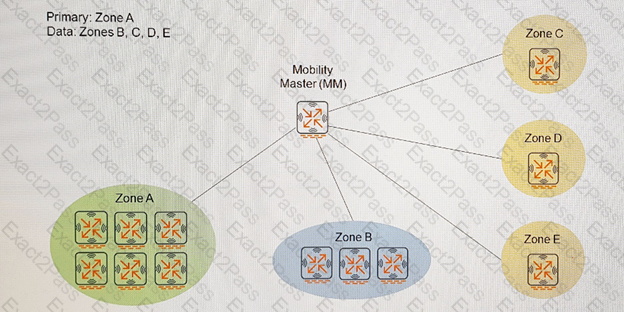
An administrator implements the MultiZone feature. The administrator sets up five zones as shown in the exhibit in this configuration:
-Zone A has six controllers that form a cluster.
-Zone B has three controllers that from a cluster.
-Zones C, D, and E have a single standalone controller each.
A total of 13 VAPs are created across the five zones. Aruba Mobility Controllers (MCs) in Zones A, B and C run ArubaOS 8.1.0.1 MCs in zones D and E run ArubaOS 8.1.0.2. Some APs do not join their respective data zones.
What could cause this problem?
An administrator purchases a pair of Mobility Masters (MM) and wants to deploy 16 Virtual Mobility Controllers (VMCs). What is the minimum number of clusters that the administrator needs to implement to support the number of VMCs?
Where would an administrator define the split-tunneling mode for a RAP located at a branch office?
Refer to the exhibit.

What is true about the configuration shown in the exhibit?
An AP connects to a controller. Then, the AP loses power and reboots.
Which parameters will the AP remember and use from its initial connection? (Select two.)
An administrator deploys a RAP at a branch office. The RAP should send all employee corporate traffic to the Mobility Controller (MC) and Internet traffic should stay local.
Which forwarding mode should the administrator configure for the employee WLAN to allow for this forwarding?
An administrator configures a port on a RAP through the association of an AAA profile with 802.1X authentication to a RAP Ethernet port. This port connects to a switch with user desktops attached. The administrator notices that when users connect wirelessly to the RAP, a user role correctly restricts their traffic. But, when users connect with their wired desktops, they are assigned an initial role and routed to a Captive Portal page.
What must the administrator do to enable desktop usage based on the user’s role assignment?
An administrator stages an AP and re-provisions it as a RAP from the Mobility Master (MM). When re-provisioning the RAP, the administrator must enter a user’s credentials. What is the purpose of these credentials?
An administrator configures two Mobility Masters (MMs) for redundancy and database synchronization. Which protocol transports database information between the two MMs?

