Exact2Pass

Last Update 7 hours ago Total Questions : 60
The Certified RapidResponse Author Level 3 Exam content is now fully updated, with all current exam questions added 7 hours ago. Deciding to include KX3-003 practice exam questions in your study plan goes far beyond basic test preparation.
You'll find that our KX3-003 exam questions frequently feature detailed scenarios and practical problem-solving exercises that directly mirror industry challenges. Engaging with these KX3-003 sample sets allows you to effectively manage your time and pace yourself, giving you the ability to finish any Certified RapidResponse Author Level 3 Exam practice test comfortably within the allotted time.
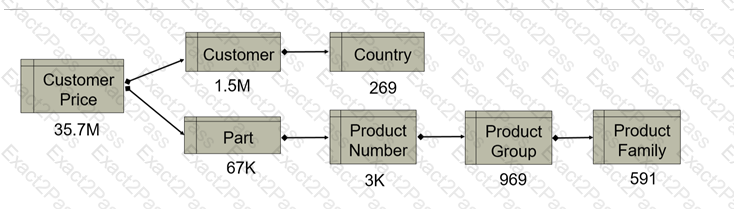
The graphic shows a path to generate a list of customer prices with record counts for each table in the path. Given the following filter expression:
Part.ProductNumber.ProductGroup.ProductFamily In ('bikes','trikes')
AND Customer.Country IN ("US", "CA")
In this situation, what is the chosen line of descent from the query engine?
At a customer site, there are multiple TimePhasedSafety records that are duplicated in the Baseline scenario. This is caused by the cross-scenario update from a child scenario.
What are two Kinaxis best practices for cross-scenario updates to prevent this situation? (Choose two.)
Choose 2 answers
You are creating a metric worksheet to calculate the number of late orders for a specified time period. The metric worksheet will be based on the IndependentDemand table and it has two columns: DueDate and Count. The expression for Count is 1. The worksheet's filter expression is: DaysLate > 0 and Order.Type = 'Actual' .
In this situation, what is the column sequence and grouping properties for the metric worksheet?
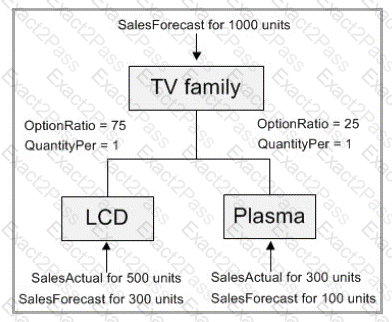
Referring to the graphic, the TV Family represents an MPSConfig planning BOM. No supply is available.
What will be the quantity of the planned order created for the TV family?
You need to create a workbook to allow users to manage their demand forecast by product, customer region, and distribution site. You also want to simplify user controls and use hierarchies to allow each user to make several selections in the same hierarchy.
In this situation, which two actions should you take? (Choose two.)
Choose 2 answers
You need to create a new custom field to be used for record filtering that will be populated with the salesperson's name. Each order will have a single associated salesperson's name.
Following database design principles and Kinaxis best practices, which action accomplishes this task?
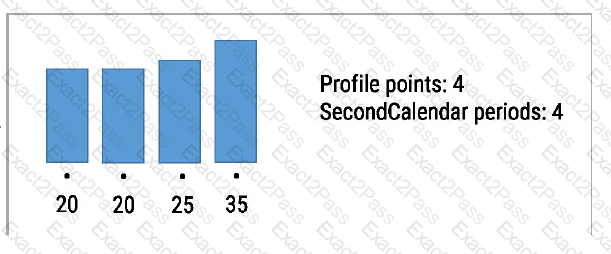
Forecasts are being received on a monthly basis and you are asked to spread these forecasts into weekly intervals. The month has four weeks, and you are using the spreading profile shown in the graphic where the first week is on the left. The monthly forecast is for a quantity of 500. The PlanningCalendars.ForecastCalendar=Month and PlanningCalendars.SecondCalendar=Week.
Referring to the graphic, what will the weekly forecast quantities be?
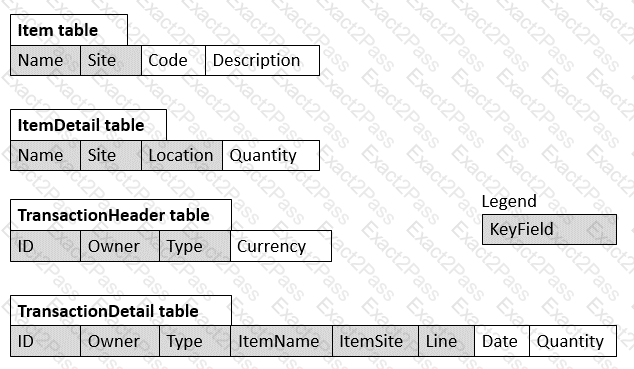
The tables shown in the graphic are from an SQL database. Shaded fields indicate key fields in SQL.
Which three actions should you take to design this data model in RapidResponse? (Choose three.)
Choose 3 answers

