Exact2Pass

Last Update 10 hours ago Total Questions : 273
The Salesforce Certified MuleSoft Platform Integration Architect (Mule-Arch-202) content is now fully updated, with all current exam questions added 10 hours ago. Deciding to include MuleSoft-Integration-Architect-I practice exam questions in your study plan goes far beyond basic test preparation.
You'll find that our MuleSoft-Integration-Architect-I exam questions frequently feature detailed scenarios and practical problem-solving exercises that directly mirror industry challenges. Engaging with these MuleSoft-Integration-Architect-I sample sets allows you to effectively manage your time and pace yourself, giving you the ability to finish any Salesforce Certified MuleSoft Platform Integration Architect (Mule-Arch-202) practice test comfortably within the allotted time.
How should the developer update the logging configuration in order to enable this package specific debugging?
An organization plans to migrate its deployment environment from an onpremises cluster to a Runtime Fabric (RTF) cluster. The on-premises Mule applications are currently configured with persistent object stores.
There is a requirement to enable Mule applications deployed to the RTF cluster to store and share data across application replicas and through restarts of the entire RTF cluster,
How can these reliability requirements be met?
Refer to the exhibit.
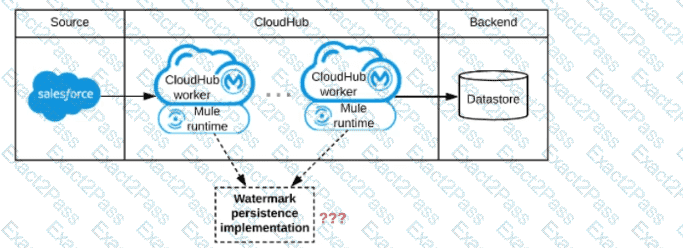
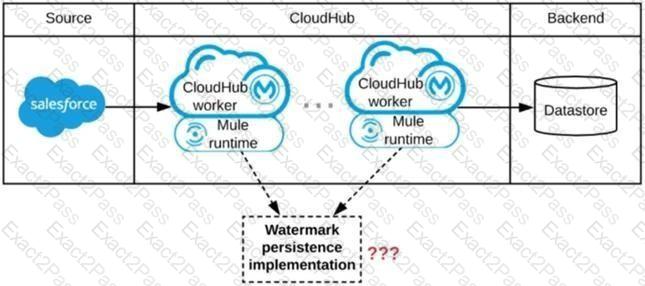
A Mule application is being designed to be deployed to several CIoudHub workers. The Mule application ' s integration logic is to replicate changed Accounts from Satesforce to a backend system every 5 minutes.
A watermark will be used to only retrieve those Satesforce Accounts that have been modified since the last time the integration logic ran.
What is the most appropriate way to implement persistence for the watermark in order to support the required data replication integration logic?
Which type of communication is managed by a service mesh in a microservices architecture?
What limits if a particular Anypoint Platform user can discover an asset in Anypoint Exchange?
According to MuleSoft, which system integration term describes the method, format, and protocol used for communication between two system?
A DevOps team has adequate observability of individual system behavior and performance, but it struggles to track the entire lifecycle of each request across different microservices.
Which additional observability approach should this team consider adopting?
A rale limiting policy has been applied to a soap VI.2 API published in Clondhub. The API implementation catches errors in a global error handler on error propagate in the main flow for HTTP: RETRY_EXHAUSTED with HTTP status set to 429 and any with the HTTP status set to 500.
What is the expected H1TP status when the client exceeds the quota of the API calls?
What condition requires using a CloudHub Dedicated Load Balancer?
What API policy would LEAST likely be applied to a Process API?

