Exact2Pass

Last Update 3 hours ago Total Questions : 118
The Sustainability and Climate Risk content is now fully updated, with all current exam questions added 3 hours ago. Deciding to include SCR practice exam questions in your study plan goes far beyond basic test preparation.
You'll find that our SCR exam questions frequently feature detailed scenarios and practical problem-solving exercises that directly mirror industry challenges. Engaging with these SCR sample sets allows you to effectively manage your time and pace yourself, giving you the ability to finish any Sustainability and Climate Risk practice test comfortably within the allotted time.
The risk team at an agricultural company in Easter Europe evaluates crop yield production performance. The evaluation reveals high temperature and water shortages will likely harm crop production, and current company insurance will not mitigate this exposure. The team recommends increasing coverage by purchasing an additional insurance policy that includes area yield protection.
According to the COSO ERM framework, which risk response strategy did the team recommend?
As climate change poses new financial risks to a central bank’s monetary policy operations, the bank decides to adapt operations with NGFS guidelines. Because the central bank does not include climate change in supervision practices, the bank consults subject matter experts (SMEs) to develop a proposal for central bank action on climate change. After completing the risk assessment, SMEs recommend the bank incorporate microprudential and macroprudential measures to embed climate change into supervision practices.
Which action are SMEs likely to recommend?
As climate change poses new financial risks to a central bank’s monetary policy operations, the bank decides to adapt operations with NGFS guidelines. Because the central bank does not include climate change in supervision practices, the bank consults subject matter experts (SMEs) to develop a proposal for central bank action on climate change. After completing the risk assessment, SMEs recommend the bank incorporate microprudential and macroprudential measures to embed climate change into supervision practices.
Which action are SMEs likely to recommend?
A national regulator develops a new taxonomy for environmentally sustainable activities and policies. The taxonomy will provide clarity for companies, capital markets, and policymakers on sustainable activities. During the development process, regulators survey taxonomies used across various jurisdictions and decide to model after the EU Taxonomy.
Which characteristic of the EU Taxonomy will the regulator most likely implement in the new taxonomy?
After recent summer and winter temperature extremes disrupt operations, a national oil company evaluates its 10-year business plan. The risk department reviews how corporate assets, both physical and human, are resilient to climate change. Early in the planning process, a risk team member emphasizes the importance of planning for both acute and chronic climate hazards.
How should the team member describe acute and chronic hazards in terms of the 10-year strategy?
To improve sustainability, a railroad and transportation services company will revitalize its rail network by installing an operating system that reduces idle time. A reduction in idle time will decrease GHG emissions. To finance this plan, the company will issue green bonds beginning in 2024. The company sustainability director develops sustainability objectives and eligibility criteria to communicate to investors.
The director is fulfilling which core component of the Green Bond Principles?
A European bank surveyed its most prominent clients to assess interest in sustainability-linked loans (SLLs) and green loans. The survey came after a recent study showed higher profitability rates of SLLs and green products than classical banking products. After positive feedback, the bank decides to introduce SLLs and green loans. The bank’s sustainability loan officer writes a new loan product guideline for corporate clients that explains SLLs and green loans.
How will the bank officer describe these loan types?
The climate risk team at a global bank works on a sustainability and climate risk report for a forthcoming company strategy meeting. The meeting will focus on bank goals to achieve net zero GHG emissions by 2050. Bank leaders will discuss potential risk exposures the bank may face, as well as possible financial systemic effects.
Which of the following is an example of how systemic climate risk can translate into liquidity risk for the bank?
A telecommunications corporation issues a green bond to finance energy efficiency improvements for the company’s office space worldwide. The company’s risk management department commissions an independent advisory assessment of the bond to check bond alignment with components of the Green Bond Principles.
What action does the corporation take to align the bond with the “process for project evaluation and selection” component of the Green Bond Principles?
The CRO for a large agriculture company reviews reference scenarios as part of an annual climate scenario analysis exercise. The CRO creates a transition risk matrix that compares four different scenarios - W, X, Y, Z. Scenarios are compared according to scale of emissions cuts and pace of emission cuts. Scale is depicted as business as usual (BAU) to net-zero. Pace is depicted as orderly to disorderly. The CRO uses this matrix to explain transition risk to the company’s executive members:
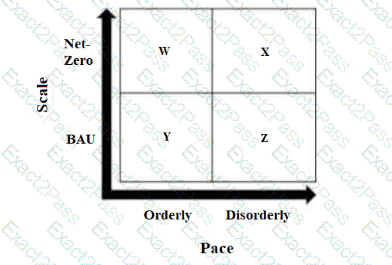
How should the CRO rank the reference scenarios from lowest level of transition risk to highest level of transition risk?

