Exact2Pass

Last Update 8 hours ago Total Questions : 90
The Administration of Veritas InfoScale Storage 7.1 for UNIX/Linux content is now fully updated, with all current exam questions added 8 hours ago. Deciding to include VCS-257 practice exam questions in your study plan goes far beyond basic test preparation.
You'll find that our VCS-257 exam questions frequently feature detailed scenarios and practical problem-solving exercises that directly mirror industry challenges. Engaging with these VCS-257 sample sets allows you to effectively manage your time and pace yourself, giving you the ability to finish any Administration of Veritas InfoScale Storage 7.1 for UNIX/Linux practice test comfortably within the allotted time.
What is an advantage of using Dynamic Multi-Pathing (DMP)?
What is the architecture of Veritas Cluster Volume Manager (CVM)?
What does migrating from thick to thin LUNs involve?
Refer to the exhibit.
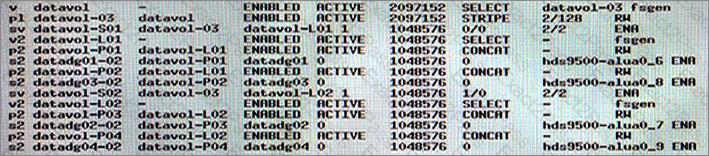
What is the layout of the volume described in the vxprint output provided in the exhibit?
How many days does an administrator have to either enter a valid license key or register a system with Veritas InfoScale Operations Management server if they have chosen to use keyless licensing during the installation of Veritas InfoScale Storage for UNIX/Linux?
A disk has been initialized for use in Veritas Volume Manager.
Which command is used to create a disk group named datadg on a device shown as device_tag and using a disk media name of datadg01?
Each Veritas Volume Manager disk group has a configuration database that contains persistent configuration data (or metadata) about the objects in the disk group.
Where is VxVM internal configuration information stored?
What is the advantage of making storage checkpoints automatically accessible through a directory named .checkpoint in the root of the file system?
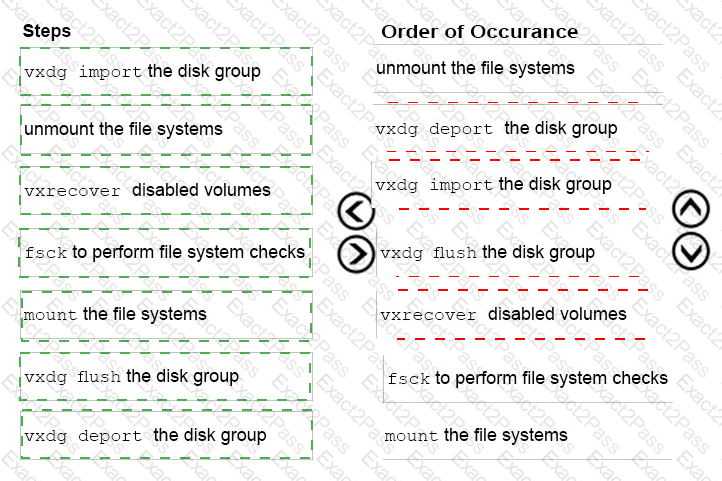
A fibre connection failure causes a system to lose connection to the disk array resulting in the disk group and all mounted file systems being disabled due to I/O errors.
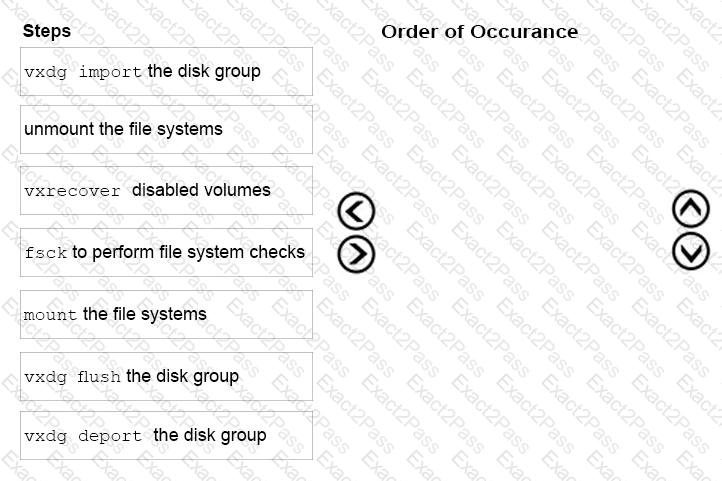
Drag five steps on the left to the right column to show the correct sequence of actions the administrator should perform to recover the disabled disk group and five systems after the physical connection is restored.
What are two benefits of multi-volume file systems (MVFS)? (Select two.)