
Summer Sale Special Limited Time 70% Discount Offer - Ends in 0d 00h 00m 00s - Coupon code: buysanta

Exact2Pass Menu

Oracle Database Administration I

Last Update 20 hours ago Total Questions : 142

The Oracle Database Administration I content is now fully updated, with all current exam questions added 20 hours ago. Deciding to include 1z0-082 practice exam questions in your study plan goes far beyond basic test preparation.

You'll find that our 1z0-082 exam questions frequently feature detailed scenarios and practical problem-solving exercises that directly mirror industry challenges. Engaging with these 1z0-082 sample sets allows you to effectively manage your time and pace yourself, giving you the ability to finish any Oracle Database Administration I practice test comfortably within the allotted time.

Question # 11

Which three statements are true about table data storage in an Oracle Database? (Choose three.)

A.

Data block headers contain their own Data Block Address (DBA)

B.

A table row piece can be chained across several database blocks

C.

Multiple row pieces from the same row may be stored in different database blocks

D.

Multiple row pieces from the same row may be stored in the same block

E.

Data block free space is always contiguous in the middle of the block

F.

Index block free space is always contiguous in the middle of the block

Question # 12

Which two queries execute successfully?

A.

SELECT NULLIF(NULL, 100) FROM DUAL;

B.

SELECT COALESCE (100, ' AM FROM DUAL;

C.

SELECT 2TOLLIF(100, ' A ' ) FROM DUAL;

D.

SELECT NULLIF(100,100) FROM DUAL;

E.

SELECT COALESCE(100, NULL, 200) FROM DUAL;

Question # 13

Examine the description of the CUSTOMERS table:
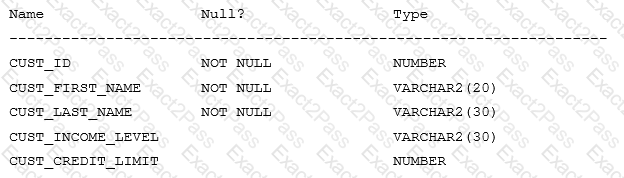
For customers whose income level has a value, you want to display the first name and due amount as 5% of their credit limit. Customers whose due amount is null should not be displayed.

Which query should be used?

A.

SELECT cust_first_name, cust_credit_limit * .05 AS DUE_AMOUNTFROM customersWHERE cust_income_level IS NOT NULLAND due_amount IS NOT NULL;

B.

SELECT cust_first_name, cust_credit_limit * .05 AS DUE_AMOUNTFROM customersWHERE cust_income_level != NULLAND cust_credit_level !=NULL;

C.

SELECT cust_first_name, cust_credit_limit * .05 AS DUE_AMOUNTFROM customersWHERE cust_income_level < > NULLAND due_amount < > NULL;

D.

SELECT cust_first_name, cust_credit_limit * .05 AS DUE_AMOUNTFROM customersWHERE cust_income_level != NULLAND due_amount != NULL;

E.

SELECT cust_first_name, cust_credit_limit * .05 AS DUE_AMOUNTFROM customersWHERE cust_income_level IS NOT NULLAND cust_credit_limit IS NOT NULL;

Question # 14

Which three instance situations are possible with the Oracle Database server without multi-tenant? (Choose three.)

A.

two or more instances on separate servers all associated with one database

B.

one instance on one server associated with one database

C.

one instance on one server associated with two or more databases on the same server

D.

one instance on one server not associated with any database

E.

one instance on one server associated with two or more databases on separate servers

Question # 15

Which three statements are true about the Automatic Diagnostic Repository (ADR)?

A.

It Is held Inside an Oracle database schema.

B.

The ADR base is specified In the diagnostic_dest database parameter.

C.

It is only used for Oracle Database diagnostic information.

D.

It is a file-based repository held outside any database.

E.

It can be used for problem diagnosis of a database when that database ' s instance is down.

Question # 16

Which three statements are true about roles?

A.

All roles granted to a user are set on by default when the user logs in,

B.

Object privileges may not be granted to roles.

C.

The SET ROLE statement can disable one or more roles for a session.

D.

Roles must be password protected.

E.

Roles may be granted to roles.

F.

The SET ROLE statement can enable one or more roles for a session.

Question # 17

Which statement is true about the INTERSECT operator used in compound queries?

A.

Multiple INTERSECT operators are not possible in the same SQL statement

B.

It processes NULLs in the selected columns

C.

INTERSECT is of lower precedence than UNION or UNION ALL

D.

It ignores NULLs

Question # 18

The CUSTOMERS table has a CUST_CREDIT_LIMIT column of data type NUMBER.

Which two queries execute successfully? (Choose two.)

A.

SELECT NVL(cust_credit_limit * .15, ‘Not Available’) FROM customers;

B.

SELECT NVL2(cust_credit_limit * .15, ‘Not Available’) FROM customers;

C.

SELECT NVL(TO_CHAR(cust_credit_limit * .15), ‘Not Available’) FROM customers;

D.

SELECT TO_CHAR(NVL(cust_credit_limit * .15, ‘Not Available’)) FROM customers;

E.

SELECT NVL2(cust_credit_limit, TO_CHAR(cust_credit_limit * .15), ‘Not Available’) FROM customers;

Question # 19

Which compression method is recommended for Direct-Path Insert operations?

A.

COLUMN STORE COMPRESS BASIC

B.

COLUMN STORE COMPRESS ADVANCED

C.

RON STORE COMPRESS BASIC

D.

ROW STORE COMPRESS ADVANCED

Question # 20

Examine this description of the TRANSACTIONS table:
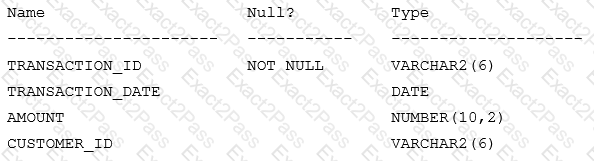
Which two SQL statements execute successfully? (Choose two.)


A.

SELECT customer_id AS “CUSTOMER-ID”, transaction_date AS DATE, amount + 100 “DUES” FROM transactions;

B.

SELECT customer_id AS “CUSTOMER-ID”, transaction_date AS “DATE”, amount + 100 DUES FROM transactions;

C.

SELECT customer_id AS CUSTOMER-ID, transaction_date AS TRANS_DATE, amount + 100 “DUES AMOUNT” FROM transactions;

D.

SELECT customer_id CUSTID, transaction_date TRANS_DATE, amount + 100 DUES FROM transactions;

E.

SELECT customer_id AS ‘CUSTOMER-ID’, transaction_date AS DATE, amount + 100 ‘DUES AMOUNT’ FROM transactions;

Go to page: