
Summer Sale Special Limited Time 70% Discount Offer - Ends in 0d 00h 00m 00s - Coupon code: buysanta

Exact2Pass Menu

Oracle Database Administration I

Last Update 19 hours ago Total Questions : 142

The Oracle Database Administration I content is now fully updated, with all current exam questions added 19 hours ago. Deciding to include 1z0-082 practice exam questions in your study plan goes far beyond basic test preparation.

You'll find that our 1z0-082 exam questions frequently feature detailed scenarios and practical problem-solving exercises that directly mirror industry challenges. Engaging with these 1z0-082 sample sets allows you to effectively manage your time and pace yourself, giving you the ability to finish any Oracle Database Administration I practice test comfortably within the allotted time.

Question # 21

Which two statements are true regarding Oracle database space management within blocks managed by Automatic Segment Space Management (ASSM)? (Choose two.)

A.

PCTFREE defaults to 10% for all blocks in all segments for all compression methods

B.

ASSM assigns blocks to one of four fullness categories based on what percentage of the block is allocated for rows

C.

Update operations always attempt to find blocks with free space appropriate to the length of the row being updated

D.

Insert operations always attempt to find blocks with free space appropriate to the length of the row being inserted

E.

A block will always be eligible for inserts if the row is short enough to fit into the block

Question # 22

Which three statements are true about views in an Oracle database? (Choose three.)

A.

Views can be updated without the need to re-grant privileges on the view

B.

Tables in the defining query of a view must always exist in order to create the view

C.

The WITH CHECK clause prevents certain rows from being displayed when querying the view

D.

Data Manipulation Language (DML) can always be used on views

E.

Inserting one or more rows using a view whose defining query contains a GROUP BY clause will cause an error

F.

Deleting one or more rows using a view whose defining query contains a GROUP BY clause will cause an error

G.

The WITH CHECK clause prevents certain rows from being updated or inserted

Question # 23

You want to write a query that prompts for two column names and the WHERE condition each time it is executed in a session but only prompts for the table name the first time it is executed.

The variables used in your query are never undefined in your session.

Which query can be used?

A.

SELECT & & col1, & & col2FROM & tableWHERE & & condition = & & cond;

B.

SELECT & col1, & col2FROM & & tableWHERE & condition;

C.

SELECT & col1, & col2FROM “ & table”WHERE & condition;

D.

SELECT ‘ & & col1’, ‘ & & col2’FROM & tableWHERE ‘ & & condition’ = ‘ & cond’;

E.

SELECT & & col1, & & col2FROM & tableWHERE & & condition;

Question # 24

You want to use table compression suitable for OLTP that will:

Compress rows for all DML statements on that table

Minimize the overheads associated with compression

Which compression option is best suited for this?

A.

COLUMN STORE COMPRESS FOR QUERY LOW

B.

ROW STORE COMPRESS BASIC

C.

COLUMN STORE COMPRESS FOR ARCHIVE LOW

D.

COLUMN STORE COMPRESS FOR ARCHIVE HIGH

E.

ROW STORE COMPRESS ADVANCED

Question # 25

Which two statements are true about UNDO and REDO? (Choose two.)

A.

The generation of UNDO generates REDO

B.

DML modifies Oracle database objects and only generates UNDO

C.

The generation of REDO generates UNDO

D.

DML modifies Oracle database objects and only generates REDO

E.

DML modifies Oracle database objects and generates UNDO and REDO

Question # 26

What is true about non-equijoin statement performance? (Choose two.)

A.

Table aliases can improve performance

B.

The BETWEEN condition always performs better than using the > = and < = conditions

C.

The join syntax used makes no difference to performance

D.

The BETWEEN condition always performs less well than using the > = and < = conditions

E.

The Oracle join syntax performs better than the SQL:1999 compliant ANSI join syntax

Question # 27

In one of your databases, the user HR has the password HRMGR.

You want to connect to a database instance whose listener listens on port 1531 by using this statement:

CONNECT HR/HRMGR@orcl

No name server is used.

Which statement is true about ORCL?

A.

It must be the value of the SERVICE_NAMES parameter on the client side

B.

It must resolve to a valid connect descriptor in the server’s tnsnames.ora file

C.

It must resolve to a valid connect descriptor in the client’s tnsnames.ora file

D.

It must be the name of the database to whose instance HR wishes to connect

E.

It must be the name of the server running the database to whose instance HR wishes to connect

Question # 28

Which three statements are true about the tools used to configure Oracle Net Services? (Choose three.)

A.

The Oracle Net Configuration Assistant is only used when running the Oracle installer

B.

Oracle Net Manager can be used to centrally configure listeners on any database server target

C.

The lsnrctl utility requires a listener.ora file to exist before it is started

D.

Oracle Net Manager can be used to locally configure naming methods on a database server

E.

Enterprise Manager Cloud Control can be used to centrally configure listeners on any managed database server

F.

Enterprise Manager Cloud Control can be used to centrally configure net service names for any database server target

Question # 29

Which three statements are true about the DESCRIBE command? (Choose three.)

A.

It displays the PRIMARY KEY constraint for any column or columns that have that constraint

B.

It can be used from SQL Developer

C.

It displays the NOT NULL constraint for any columns that have that constraint

D.

It can be used to display the structure of an existing view

E.

It displays all constraints that are defined for each column

F.

It can be used only from SQL*Plus

Question # 30

Examine these SQL statements which execute successfully:
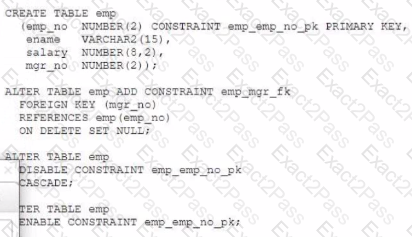
Which two statements are true after execution?


A.

The primary key constraint will be enabled and deferred.

B.

The foreign key constraint will be enabled and deferred.

C.

The foreign key constraint will be disabled.

D.

The foreign key constraint will be enabled and immediate.

E.

The primary key constraint will be enabled and immediate.

Go to page: