Exact2Pass

Last Update 22 hours ago Total Questions : 93
The Oracle Cloud Infrastructure 2025 Cloud Operations Professional content is now fully updated, with all current exam questions added 22 hours ago. Deciding to include 1z0-1067-25 practice exam questions in your study plan goes far beyond basic test preparation.
You'll find that our 1z0-1067-25 exam questions frequently feature detailed scenarios and practical problem-solving exercises that directly mirror industry challenges. Engaging with these 1z0-1067-25 sample sets allows you to effectively manage your time and pace yourself, giving you the ability to finish any Oracle Cloud Infrastructure 2025 Cloud Operations Professional practice test comfortably within the allotted time.
You have been brought In to help secure an existing application that leverages Object Storage buckets to distribute content. The data is currently being shared from public buckets and the security team Is not satisfied with this approach. They have stated that all data must be stored In storage buckets. Your application should be able to provide secure access to the data. The URL that is provided for access to the data must be rotated every 30 days. Which design option will meet these requirements?
You set up a bastion host in your Virtual Cloud Network (VCN) to allow only your IP ad-dress (140.19.2.140) to establish SSH connections with your compute instances that are deployed in a private subnet. The compute instances have an attached Network Security Group (NSG) with a Source Type: Network Security Group (NSG), Source NSG: NSG-050504. To secure the bastion host, you add the following ingress rules to its NSG: Type: All TCP Proto-col: TCP Port Range: 22 Source: 140.19.2.140/32 Type: All TCP Protocol: TCP Port Range: 22 Source: NSG-050504 However, when you check the bastion host logs, you discover that there are IP addresses other than your own that can access your bastion host. What is the root cause of this issue?
As a solution architect of the Oracle Cloud Infrastructure tenancy, you have been asked to provide members of group CloudOps the ability to view and retrieve monitoring metrics, but only for all monitoring-enabled compute instances. Which policy statement will you define to grant this access?
You have configured an Alarm Definition in the Oracle Cloud Infrastructure (OCI) Monitoring service to send notifications through email. The alarm should resend notifications at specified intervals if the alarm. continues to be in the firing state. A subscriber in the Notifications Topic complains about not receiving multiple emails upon failures. Which of the following could be the possible cause of this issue?
Which option is NOT a possible return value for an OCI health check?
Here is a partial code from a Terraform template written for Oracle Cloud Infrastructure (OCI):
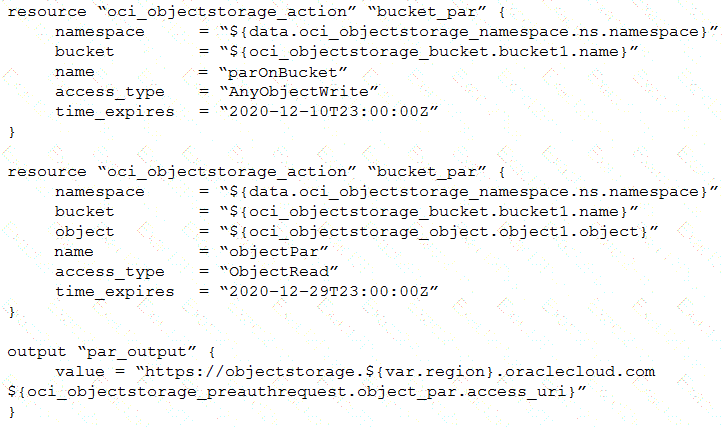
What operation(s) does it perform? (Choose the best answer.)
In your root compartment, you have two subcompartments, A and B. You have three in-stances in each compartment, including the root (for a total of nine). What does the following metric query return if you use the console to run it in the root compartment? CpuUtiliza-tion[1m].mean()
Scenario: 2 (Oracle Cloud-init and AutoScaling: Use cloud-init to Configure Apache on Instances in an Autoscaling Instance Pool)
Scenario Description: (Hands-On Performance Exam Certification)
You ' re deploying an Apache-based web application on OCI that requires horizontal autoscaling.
To configure instances upon provisioning, write a cloud-init script for Oracle Linux 8 that installs and enables Apache (httpd), and opens the firewall for HTTP on TCP port 80. Create an instance configuration and include the cloud-init script in it. Use this instance configuration to create an instance pool and autoscaling configuration.
Pre-Configuration:
To fulfill this requirement, you are provided with the following:
Access to an OCI tenancy, an assigned compartment, and OCI credentials
A VCN Cloud-Init Challenge VCN with an Internet gateway and a public subnet. The security list for the subnet allows ingress via TCP ports 22 and 80 (SSH and HTTP). The route table forwards all egress to the Internet gateway.
Access to the OCI Console
Required IAM policies
An SSH key pair for the compute instance
Public Key https://objectstorage.us-ashburn-1.oraclecloud.com/n/tenancyname/b/PBT_Storage/o/PublicKey.pub
Private Key https://objectstorage.us-ashburn-1.oraclecloud.com/n/tenancyname/b/PBT_Storage/o/PKey.key
Note: Throughout your exam, ensure to use assigned Compartment , User Name , and Region.
Complete the following tasks in the provisioned OCI environment:
Task 1(a): Develop the cloud-init Script:
Task 1(b): Use cloud-init to Configure Apache on Instances in an Autoscaling Instance Pool:
Scenario: 4 (Write Identity and Access Management Policies to Secure a Tenancy)
Scenario Description: (Hands-On Performance Exam Certification)
Your company has signed up for an OCI tenancy to migrate an e-commerce application, a supply chain management (SCM) system, and a customer relationship management (CRM) system. You have been tasked with setting up the requisite identity and access management (IAM) policies for your team to begin developing on OCI.
You start by setting up the following compartment hierarchy:
Tenancy (root)
Common-Infra
Network
Security
Applications
E-Comm
SCM
CRM
You create the following groups:
Network-Admins
Security-Admins
E-Comm-Admins
SCM-Admins
CRM-Admins
Write the IAM policies for the following use cases:
Assumptions:
Assume that all policies will be attached to the root compartment.
Write one policy per given text box.
Keep policies as simple as possible by using verbs instead of permissions (for example, “inspect orm-stacks” instead of “ORM_STACK_INSPECT”) and aggregate resource types instead of individual ones (for example, “file-family” instead of “file-systems” and “mount-targets”)
Task 1
Write a policy statement to enable Network-Admins to create and destroy network-related resources, such as VCNs, subnets, gateways, and so on in the Network compartment.
Task 2
Write policy statements to enable E-Comm-Admins to provision and destroy compute instances in the E-Comm compartment by using networking resources in the Network compartment.[Write one policy per given text box]
Task 3
Write a policy statement to enable SCM-Admins to provision, destroy, and back up block volumes in the SCM compartment—but only in Phoenix and London.
Scenario: 3 (Use the OCI CLI to Work with Object Storage from a Compute Instance)
Scenario Description: (Hands-On Performance Exam Certification)
Your company runs a web application in OCI that generates log files. You want to upload these files to OCI Object Storage to meet data retention requirements. Some files need to be retained indefinitely, whereas others can be deleted after 30 days. Use the OCI CLI to create bucket and upload the log directory and create a lifecycle policy rule to delete temporary files after 30 days.
Pre-Configuration:
To fulfill this requirement, you are provided with the following:
Access to an OCI tenancy, an assigned compartment, and OCI credentials
A compute instance with OCI CLI installed and a set of files in ~/dir_to_upload to use
Access to the OCI Console
Required IAM policies
Assumptions:
Perform the tasks by using the OCI CLI on the compute instance.
Use instance principal authentication for all CLI commands; the instance has been given the policies necessary.
Connect to the compute instance using Cloud Shell’s private networking and the provided SSH key.
An SSH key pair has been provided to you for the compute instance.
Private Key https://objectstorage.us-ashburn- 1.oraclecloud.com/n/tenancyname/b/PBT_Storage/o/PKey.key
Note: Throughout your exam, ensure to use assigned Compartment , User Name and Region.
Complete the following tasks in the provisioned OCI environment:
Task 1: Create a Bucket in Object Storage
Task 2: Upload a Directory’s Contents to Object Storage
Task 3: Add a Lifecycle Policy to the Bucket

