
Summer Sale Special Limited Time 70% Discount Offer - Ends in 0d 00h 00m 00s - Coupon code: buysanta

Exact2Pass Menu

Oracle Communications Session Border Controller 7 Basic Implementation Essentials

Last Update 1 day ago Total Questions : 70

The Oracle Communications Session Border Controller 7 Basic Implementation Essentials content is now fully updated, with all current exam questions added 1 day ago. Deciding to include 1z0-404 practice exam questions in your study plan goes far beyond basic test preparation.

You'll find that our 1z0-404 exam questions frequently feature detailed scenarios and practical problem-solving exercises that directly mirror industry challenges. Engaging with these 1z0-404 sample sets allows you to effectively manage your time and pace yourself, giving you the ability to finish any Oracle Communications Session Border Controller 7 Basic Implementation Essentials practice test comfortably within the allotted time.

Question # 1

You want to view an existing multiple-instance element’s configuration.

What step should you perform after you go to the correct branch of the configuration tree?

A.

Select the element and then issue the show command.

B.

Type show < element name > .

C.

Type show ? and select from the displayed list.

D.

Type is –a.

E.

Enter the name of the element and then issue the show command.

Question # 2

You are configuring a sip-interface configuration element. You encounter the error message: Error 409 saving configuration SipInterface.

Identify the cause of the error.

A.

You are creating a sip-port element with the same address parameter value of another sip-port.

B.

You are creating a sip-port element with the same port parameter value of another sip-port.

C.

You are creating a sip-port element with the same transport-protocol parameter value of another sip-port.

D.

You are creating a sip-interface element with the same realm-id parameter value of another sip-interface.

E.

You are creating a sip-interface element with a different realm-id parameter value of another sip-interface.

Question # 3

You are configuring the boot parameters in the Session Border Controller.

Which three statements are true about the boot parameters? (Choose three.)

A.

A reboot is always required to apply any change to the boot parameters.

B.

The target name is used for domain name resolution.

C.

The system clock is a boot parameter.

D.

The boot parameters are stored in Non-Volatile Random Access Memory (NVRAM).

E.

The boot parameters are not affected by the activate-config command.

Question # 4

Which two states are needed by the active node while transitioning to standby? (Choose two.)

A.

Out of service

B.

Becoming-active

C.

Relinquishing-standby

D.

Relinquishing-active

E.

Becoming-standby

Question # 5

After configuring Header Manipulation Rules (HMRs) for topology hiding, your subsequent testing shows that the manipulation is not taking effect.

Identify two causes for this (Choose two.)

A.

You have not configured the out-manipulationid parameter of the sip-interface configuration element.

B.

You have not enabled policy-based realm-bridging.

C.

The value of the name parameter in the header-rule configuration element is different than the value of the out-manipulationid parameter in the sip-interface configuration element.

D.

The value of the match-val-type parameter is not written correctly.

E.

The home-proxy-address value does not match the $LOCAL_IP value in the new-value parameter.

Question # 6

Examine the output below from the show sipd invite command:
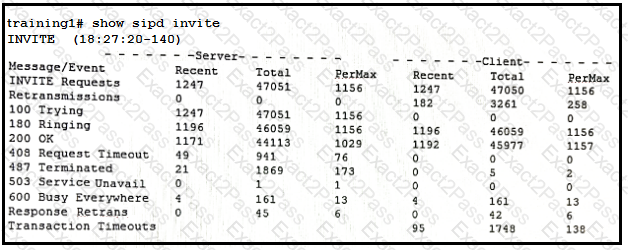
How many 600 Busy Everywhere messages sent by the Session Border Controller in the last 140 seconds did not originate from a downstream device?

A.

157

B.

13

C.

4

D.

161

E.

0

Question # 7

You are configuring access rules in a Session Border Controller Peering architecture.

Which two configuration steps are required to allow access only from User Agents (UAs) configured as session agents? (Choose two.)

A.

Navigate to the sip-port configuration element and set the allow-anonymous parameter to all.

B.

Navigate to the session-agent configuration element and set the ip-address parameter to the IP subnet of your trusted User Agent (UA).

C.

Navigate to the realm-config configuration element and set the addr-prefix parameter to the IP subnet of your trusted User Agent (UA).

D.

Navigate to the sip-port configuration element and set the allow-anonymous parameter to agents-only.

E.

Navigate to the sip-port configuration element and set the allow-anonymous parameter to address-prefix .

Question # 8

To return the Session Border Controller configuration to a known, factory default state, you must____________.

A.

press the reset button on the front panel

B.

issue the delete-config command

C.

issue the set-system-state offline command

D.

issue the set-system-state offline

E.

issue the delete-config and reboot commands

Question # 9

You used the no command to delete a configuration element.

Which statement is true?

A.

The deletion is lost on immediate reboot.

B.

The deletion is reflected when viewing the running configuration.

C.

The deletion takes effect immediately in the saved configuration.

D.

The deletion always requires a reboot to take effect.

E.

The deletion requires auto-save enabled.

Question # 10

Which configuration step is correct for a phy-interface configuration element used for signaling and/or media?


A.

A phy-interface element must be configured for each interface used for High Availability (HA) heartbeats, but not for signaling and/or media.

B.

After configuring a phy-interface configuration element for signaling and/or media, a reboot of the Session Border Controller is required.

C.

A phy-interface configuration element must be configured for each interface used.

D.

A unique phy-interface configuration element is created for all signaling/media interfaces.

E.

A phy-interface configuration element for signaling and/or media has the operation-type parameter set to control.

Go to page: