
Spring Sale Special Limited Time 70% Discount Offer - Ends in 0d 00h 00m 00s - Coupon code: buysanta

Exact2Pass Menu

Oracle Database 12c Essentials

Last Update 4 hours ago Total Questions : 150

The Oracle Database 12c Essentials content is now fully updated, with all current exam questions added 4 hours ago. Deciding to include 1z0-497 practice exam questions in your study plan goes far beyond basic test preparation.

You'll find that our 1z0-497 exam questions frequently feature detailed scenarios and practical problem-solving exercises that directly mirror industry challenges. Engaging with these 1z0-497 sample sets allows you to effectively manage your time and pace yourself, giving you the ability to finish any Oracle Database 12c Essentials practice test comfortably within the allotted time.
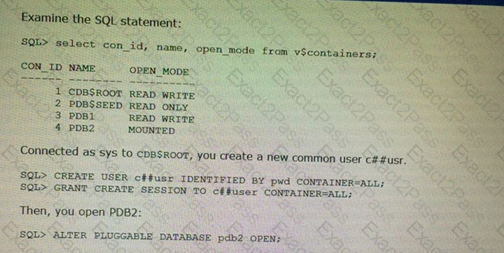
Question # 31

Which two statements are true about this common user?

A.

SQL > conn c##usr/pwd@pdb1

You are connected to PDB1 successfully.

B.

SQL > conn c##usr/pwd@pdb2

You are connected to PDB2 successfully.

C.

SQL > conn c##usr/pwd@pdb2

You are unable to create a connection. You first need to sync PDB2 by executing:

SQL > conn / as sysdba

SQL > exec DBMS_PDB.SYNC_PDB;

D.

SQL > conn c##usr/pwd@pdb2

You are unable to create a connection. You need to create the common user c# #usr explicitly in PDB2 by executing:

SQL > conn system/pwd@pdb2

SQL > CREATE USER c##usrIDENTIFIED BYpwd CONTAINER=CURRENT;

Now you are able to connect as common user c##usr to PDB2.

Question # 32

Which targets can be managed by using Enterprise Manager Cloud Control?

A.

Hosts and databases

B.

Hosts, databases, and application servers

C.

Application servers and web applications

D.

Databases, Oracle Management Server (OMS), and Oracle Management Repository (OMR)

E.

Databases, application servers, and web applications

F.

Hosts, databases, application servers, web applications, OMS, and OMR

Question # 33

In this SQL statement, what is the partitioning criteria?

CREATE TABLE books_part

PARTITION BY RANGE (cell_id) (

PARTITION p0l VALUES LESS THAN (2),

PARTITION p02 VALUES LESS THAN (3) ,

. . .

PARTITION pl4 VALUES LESS THAN (15),

PARTITION pl5 VALUES LESS THAN (16),

PARTITION pl6 VALUES LESS THAN (MAXVALUE)

)

AS SELECT * FROM books;

A.

books

B.

pxx

C.

MAXVALUE

D.

cell_id

E.

There is no partitioning criteria.

Question # 34

Which logical storage relationship is correct?

A.

Tablespace < Segment < Extent < Oracle Datablock

B.

B) Segment < Extent < Oracle Datablock < Tablespace

C.

Tablespace < Extent < Segment < Oracle Datablock

D.

Data File < Tablespace < Segment < Extent < Oracle Datablock

Question # 35

You want to start a global service on your database. Which three conditions must be met?

A.

The database is open and registered with a global service manager.

B.

The service has been disabled on that database.

C.

The database role is different from the role attribute of the service.

D.

The replication lag on the database does not exceed the maximum value specified for the service.

E.

The service has reached its cardinality defined by the number of preferred databases.

F.

No other database in the pool is a better candidate for starting the service.

Question # 36

Several tables are accidentally deleted from a PDB. Which database would you immediately connect to, and as which user, to recover these tables?

A.

the CDB as the ROOT user

B.

the CDB as the CDBADMIN user

C.

the PDB as the ROOT user

D.

the PDB as the PDB Admin user

Question # 37

The session of user SCOTT receives the following error after executing an UPDATE command on the EMP table:

ERROR at line 1:

ORA-00060: deadlock detected while waiting for resource

You find out that a session opened by user JIM has a transaction that caused the deadlock. Which two statements are true about SCOTT ' s session in this scenario?

A.

The session is terminated after receiving the error and JIM can continue with his transaction.

B.

SCOTT should perform a COMMIT or ROLLBACK to allow JIM to continue with his transaction.

C.

The session is rolled back after receiving the error and JIM can continue with his transaction.

D.

SCOTT has to re-execute the last command in the transaction after he commits the transaction.

Question # 38

Which two statements are true about a buffer cache?

A.

When a buffer is read from a buffer cache, it may be inconsistent and require undo data to make it consistent.

B.

A buffer cache stores copies of data blocks from all files of the database.

C.

Buffer access is kept efficient by maintaining a least recently used (LRU) list for dirty and clean buffers.

D.

A buffer cache always resides completely in System Global Area (SGA).

E.

A buffer cache contains exactly three pools: default, keep, and recycle pool.

Question # 39

When you start up a CDB, which operations are performed automatically and in what order?

a - The instance is started.

b - Control files are opened.

c - The root container is opened (redo logs and root data files).

d - Seed pluggable database is in READ ONLY mode.

e - Other PDBs are still in MOUNTED mode.

f - Triggers may fire if they exist to open other PDBs.

A.

a, b, c, d, e, f

B.

b, c, a, d, e, f

C.

c, b, a, d, f, e

D.

a, b, c, d

E.

b, c, a, d

Question # 40

Which statement is true about loading data by using the conventional path of SQL*Loader?

A.

Redo is not generated while performing conventional path loads.

B.

Only PRIMARY KEY, UNIQUE KEY, and NOT NULL constraints are checked,

C.

No exclusive locks are acquired when the conventional path loads are performed.

D.

Instead of performing transactions, SQL*Loader directly writes data blocks to the data files.

E.

INSERT triggers are disabled before the conventional path load and re-enabled at the end of the load.

Go to page:
