
Spring Sale Special Limited Time 70% Discount Offer - Ends in 0d 00h 00m 00s - Coupon code: buysanta

Exact2Pass Menu

MySQL 5.7 Database Administrator

Last Update 23 hours ago Total Questions : 124

The MySQL 5.7 Database Administrator content is now fully updated, with all current exam questions added 23 hours ago. Deciding to include 1z0-888 practice exam questions in your study plan goes far beyond basic test preparation.

You'll find that our 1z0-888 exam questions frequently feature detailed scenarios and practical problem-solving exercises that directly mirror industry challenges. Engaging with these 1z0-888 sample sets allows you to effectively manage your time and pace yourself, giving you the ability to finish any MySQL 5.7 Database Administrator practice test comfortably within the allotted time.

Question # 21

Which statement is correct about how InnoDB storage engine uses disk space?

A.

It stores data in .MYD files and its index and undo information in the common tablespace.

B.

It stores data in .MYD files, index information in .MYI files, and undo information the common tablespace.

C.

It stores its data in tablespace file(s). Index and data dictionary details are stored in .FRM files.

D.

It stores its data, index and undo information in .MYD and .MYI files.

E.

It stores data, index and undo information in tablespace file(s).

Question # 22

The MySQL installation includes the mysql_config_editor utility for managing login paths stored in a .mylogin.cnf file.

Which two are true about the login path feature? (Choose two.)

A.

mysql_config_editor is the only MySQL-provided utility that can print the values stored in .mylogin.cnf.

B.

A .mylogin.cnf file can store at most one login path.

C.

It provides a FIPS-compliant keyring for storing MySQL login details.

D.

A .mylogin.cnf file can be edited using a text editor, such as vim or Notepad++.

E.

It is an alternative to storing the MySQL login details in a my.cnf file.

F.

It provides means to help avoid accidentally exposing the MySQL login details.

Question # 23

SQL injection is a common security threat.

Which two methods would help protect against this risk?

A.

using stored procedures to validate values that are input

B.

using SQL variables to secure input values

C.

using prepared statements to handle unsecured values

D.

installing the SQL Protection plugin to catch such attempts

E.

starting the server with the –-injection-protection command-line option.

Question # 24

Which two statements are true regarding MySQL security? (Choose two.)

A.

The mysql user needs to have sudo privileges.

B.

The mysqld process owner should own all files and directories to which the server writes.

C.

The root or administrator users should own all files and directories to which the server writes.

D.

The mysqld process should be run as root or administrator.

E.

The mysqld process should not be run as root or administrator.

Question # 25

Which two options describe how MySQL Server allocates memory? (Choose two.)

A.

Each connection may have its own per-thread memory allocations.

B.

Thread memory is pre-allocated up to thread_cache_size for performance.

C.

Each thread allocates memory from a global pool.

D.

Global memory resources are allocated at server startup.

Question # 26

What is the order of tables shown in an EXPLAIN output?

A.

It lists tables from the smallest to the largest.

B.

It lists tables in the order in which their data will be read.

C.

It lists tables from the most optimized to the least optimized.

D.

It lists tables in the order in which they are specified in the statement that is being explained.

Question # 27

You have a MySQL instance with the following variables in the /etc/my.cnf file:
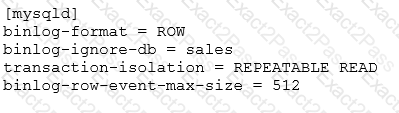
You issue these statements:

USE prices;

UPDATE sales.january SET amount=amount+1000;

An hour after excluding the statements, you realize that you made a mistake and you want to go to the binary log and look at the statements again.

Which statement is true? (Choose two.)

A.

You would receive an error on the statement because you cannot update a different database that what is specified with the USE statement.

B.

The changes caused by the UPDATE statement are logged to the binary log because the instance is using --binlog-format = ROW

C.

The statement would fail because you cannot update more than one row at a time when using --binlog-format = ROW.

D.

Nothing is logged because you are executing an UPDATE statement that will cause changes to more than one row, and you do not have the --binlog-format value set to STATEMENT.

E.

Nothing was written to the binary log because you cannot perform a calculation in a query without enclosing the statement in single quotation marks.

Question # 28

You inherited a busy InnoDB OLTP Instance with 100 schemas and 100 active users per schema.

    Total dataset size is 200G with an average schema size of 2G.

    The data is transient and is not backed up and can be repopulated easily.

    Performance and responsiveness of the DB is paramount.

    The query pattern for the DB instance is split 90/10 read/write.

    DB host is dedicated server with 256G RAM and 64 cores.

One of your colleagues made some recent changes to the system and users are now complaining of performance impacts.

Which four configuration file edits might your colleague have performed to cause the negative DB performance? (Choose four.)

A.

table_open_cache = 64

B.

innodb_buffer_pool_instances=64

innodb_buffer_pool_size=200G

C.

log_bin=mysql –bin

Innodb_flush_log_at_trx_commit=1

D.

sync_binlog=10

E.

innodb_flush_method=O_DIRECT

F.

max_heap_table_size = 2G

tmp_table_size=2G

G.

query_cache_size = 2G

query_cache_enabled=1

Question # 29

A crucial database, ‘db_prod’, just disappeared from your production MySQL instance.

In reviewing the available MySQL logs (General, Audit, or Slow) and your own application-level logs, you identified this command from a customer facing application:

SELECT id FROM users WHERE login=’payback!’;DROP DATABASE db_prod;’

Which three methods could have been used to prevent this SQL injection attack from happening? (Choose three.)

A.

writing your client code to properly escape all user input

B.

giving limited privileges to accounts used by application servers to interact with their backing databases

C.

using SSL/TLS on your outward facing web servers (https://) to encrypt all user sessions

D.

using a hashing or encryption method to secure all user passwords in your MySQL tables

E.

removing any remaining anonymous accounts from your MySQL instance

F.

validating all user input before sending it to the database server

G.

changing all passwords for the MySQL account ‘root’@’%’ immediately after losing an employee who knew the current password

Question # 30

Consider the CHECK TABLE command.

In which two situations should this command be used? (Choose two.)

A.

to find out why a query takes a long time to execute on a given table

B.

to make sure a table has no structural problems

C.

to improve performance by updating index distributing statistics on InnoDB tables

D.

to repair table structure problem

E.

to make sure that no table indexes are corrupted

Go to page:
