
Spring Sale Special Limited Time 70% Discount Offer - Ends in 0d 00h 00m 00s - Coupon code: buysanta

Exact2Pass Menu

LPIC-3: Mixed Environments - Exam 300 - version 3.0

Last Update 20 hours ago Total Questions : 53

The LPIC-3: Mixed Environments - Exam 300 - version 3.0 content is now fully updated, with all current exam questions added 20 hours ago. Deciding to include 300-300 practice exam questions in your study plan goes far beyond basic test preparation.

You'll find that our 300-300 exam questions frequently feature detailed scenarios and practical problem-solving exercises that directly mirror industry challenges. Engaging with these 300-300 sample sets allows you to effectively manage your time and pace yourself, giving you the ability to finish any LPIC-3: Mixed Environments - Exam 300 - version 3.0 practice test comfortably within the allotted time.

Question # 1

Which of the following statements is true about raw printing with Samba?

A.

Print jobs are submitted as vector files, including font files, which are rendered and printed by Samba.

B.

Printing jobs are always submitted to Samba in raw postscript.

C.

Any printed file, e.g. an office document, is submitted to the printer without any further processing in exactly the same bit sequence as it is stored on disk.

D.

Samba converts printer-specific jobs to raw data to make them printable on an arbitrary printer.

E.

Printing jobs are rendered on the client and passed on to the printer by Samba.

Question # 2

Which of the following groups exists by default in an Active Directory domain?

A.

Domain Administrators

B.

Domain Users

C.

Domain 31aclclisc

D.

Domain Update Role Accounts

E.

Unassigned Users

Question # 3

Which of the following are valid Samba backends to store user and group information? (Choose two.)

A.

sdb

B.

smbpasswd

C.

ldapsam

D.

krb

E.

smb

Question # 4

Which of the following keywords are module types for PAM? (Choose three.)

A.

cache

B.

authentication

C.

password

D.

session

E.

account

Question # 5

Which of the following names identify services within a SSSD configuration file? (Choose three.)

A.

kerberos

B.

ssh

C.

smb

D.

nss

E.

sudo

Question # 6

Which option in smb.conf defines the domain of which the server is a member?

A.

ad

B.

member domain

C.

basedn

D.

domain

E.

realm

Question # 7

Which of the following options can be used to limit access to a Samba share? (Choose two.)

A.

untrusted users

B.

write list

C.

valid groups

D.

valid users

E.

accept list

Question # 8

Which Samba utility, when launched with the appropriate parameters, generates the following output?
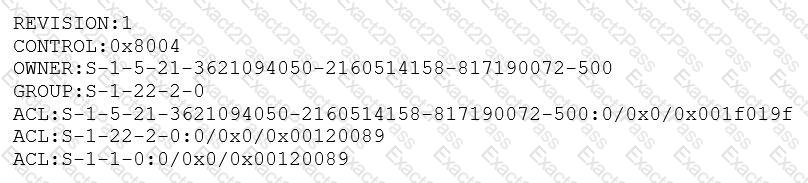
A.

smbcacls

B.

smbclient

C.

getfacl

D.

smbxattr

E.

smbfacl

Question # 9

Which parameter within a share definition in the Samba configuration makes Samba only show files and directories on a file share which a user can access?

A.

hide unreadable = yes

B.

valid files = read,write

C.

browse mask = 000

D.

browseable = readable

E.

display mode = 100

Question # 10

How is Samba instructed to read its entire configuration from the registry?

A.

By starting all Samba processes with the option --regconf.

B.

By putting config backend = registry in the [global] section of smb.conf.

C.

By starting the regd service in addition to the other Samba services.

D.

By replacing private.tdb with a plain text registry file holding the server's configuration.

E.

By creating a symbolic link from smb.conf to the .reg file holding the configuration.

Go to page:
