Spring Sale Special Limited Time 70% Discount Offer - Ends in 0d 00h 00m 00s - Coupon code: buysanta

Exact2Pass Menu

Implementing Cisco Application Centric Infrastructure - Advanced (DCACIA)

Last Update 4 hours ago Total Questions : 119

The Implementing Cisco Application Centric Infrastructure - Advanced (DCACIA) content is now fully updated, with all current exam questions added 4 hours ago. Deciding to include 300-630 practice exam questions in your study plan goes far beyond basic test preparation.

You'll find that our 300-630 exam questions frequently feature detailed scenarios and practical problem-solving exercises that directly mirror industry challenges. Engaging with these 300-630 sample sets allows you to effectively manage your time and pace yourself, giving you the ability to finish any Implementing Cisco Application Centric Infrastructure - Advanced (DCACIA) practice test comfortably within the allotted time.

Question # 21

What is the advantage of implementing an active-active firewall cluster that is stretched across separate pods when anycast services are configured?

A.

A different MAC/IP combination can be configured for the firewall in each pod.

B.

The local pod anycast node is preferred by the local spines.

C.

A cluster can be deployed in transparent mode across pods.

D.

Local traffic in a pod is load-balanced between the clustered firewalls.

Question # 22

An engineer configures a new Cisco ACI Multi-Pod setup. Which action should be taken for fabric discovery to be successful for the nodes in Pod 2?

A.

Select the Route Reflector field in Pod Peering

B.

Enable the DSCP class-cos translation policy for Layer 3 traffic

C.

Configure POD 2 Data Plane TEP under the Pod Connection Profile

D.

Add the IPN subnet under the Fabric External Routing Profile

Question # 23

What is the outer destination IP address in the VXLAN encapsulated packet for Layer 2 Broadcast. Unknown-unicast and Multicast (BUM) that is sent between two Cisco AC I sites?

A.

Overlay Unicast TEP

B.

MP-BGPEVPN Router-ID

C.

Multi-Pod Data-Plane TEP

D.

Overlay Multicast TEP

Question # 24

What are two characteristics of Cisco ACI and Spanning Tree Protocol interaction? (Choose two.)

A.

When a TCN BPDU is received in a VLAN, Cisco ACI flushes the endpoints for the associated encapsulation.

B.

STP BPDUs are dropped due to MCP.

C.

MST BPDUs are flooded correctly in Cisco ACI fabric without additional configuration.

D.

BPDU filter and BPDU guard can be configured on Cisco ACI leaf edge ports.

E.

Cisco ACI must be configured as the STP root for all VLANs.

Question # 25

An engineer must implement a full mesh Cisco ACI Multi-Site architecture. Which action must be taken on each spine to accomplish this goal?

A.

Configure BGP-EVPN Router-ID

B.

Configure Multi-Pod Data-Plane TEP

C.

Configure Overlay Unicast TEP

D.

Configure Overlay Multicast TEP

Question # 26

An engineer configures Cisco ACI Multi-Site and must specify the control plane TEP IP for spines. Which statement describes control plane TEP IP in this situation?

A.

The unique IP address is defined on each spine node that belongs to a fabric and is used to establish MP-BGP EVPN and VPNv4 adjacencies with the spine nodes in remote sites.

B.

The unique IP address is defined on each spine node that belongs to a fabric and is used to establish VXLAN adjacencies with the spine nodes in remote sites.

C.

The common anycast address is shared by all the spine nodes in the same site and is used to perform headend replication for BUM traffic.

D.

The common anycast address is shared by all the spine nodes at the same site and is used lo source and receive unicast VXLAN data plane traffic.

Question # 27

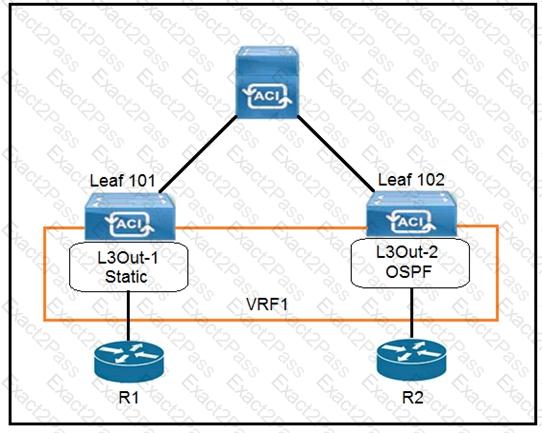
Refer to the exhibit.

The 0.0.0.0/0 is configured as a default static route on L3Out-1. Which action should be taken for the 0.0.0.0/0 prefix to advertise out on L3Out-2 OSPF?

A.

Enable Shared Security Import Subnet

B.

Enable Aggregate Export Subnet

C.

Enable Shared Route Control Subnet

D.

Enable Export Route Control Subnet

Question # 28

What is the purpose of the Forwarding Tag (FTAG) in Cisco ACI?

A.

FTAG is used in Cisco ACI to add a label to the iVXLAN traffic in the fabric to apply the correct policy.

B.

FTAG is used in Cisco ACI to add a label to the VXLAN traffic in the fabric to apply the correct policy.

C.

FTAG trees in Cisco ACI are used to load balance unicast traffic.

D.

FTAG trees in Cisco ACI are used to load balance mutli-destination traffic.

Question # 29

An engineer designs a Cisco ACI Multi-Pod solution that requires a pair of active-standby firewalls in different pods for external connectivity. How should the firewalls be implemented?

A.

PBR for routed firewalls

B.

separate L3Out peerings for routed firewalls

C.

routed firewall for the default gateway

D.

transparent firewalls

Question # 30

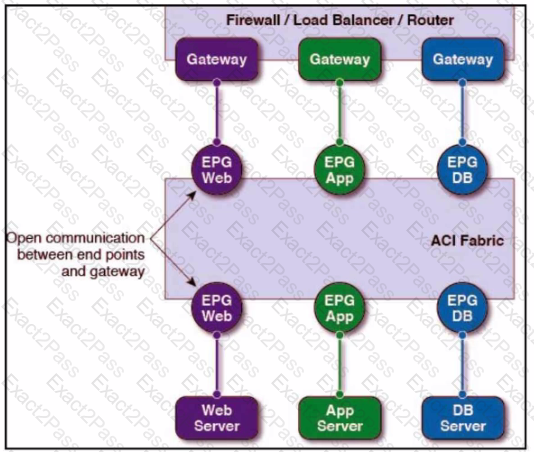
Refer to the exhibit.

Which type of design approach is shown?

A.

traditional VLAN/subnet model

B.

edge-core-edge model

C.

application-centric

D.

network-centric

Go to page: