Spring Sale Special Limited Time 70% Discount Offer - Ends in 0d 00h 00m 00s - Coupon code: buysanta

Exact2Pass Menu

Nokia Virtual Private Routed Networks

Last Update 8 hours ago Total Questions : 214

The Nokia Virtual Private Routed Networks content is now fully updated, with all current exam questions added 8 hours ago. Deciding to include 4A0-106 practice exam questions in your study plan goes far beyond basic test preparation.

You'll find that our 4A0-106 exam questions frequently feature detailed scenarios and practical problem-solving exercises that directly mirror industry challenges. Engaging with these 4A0-106 sample sets allows you to effectively manage your time and pace yourself, giving you the ability to finish any Nokia Virtual Private Routed Networks practice test comfortably within the allotted time.

Question # 11

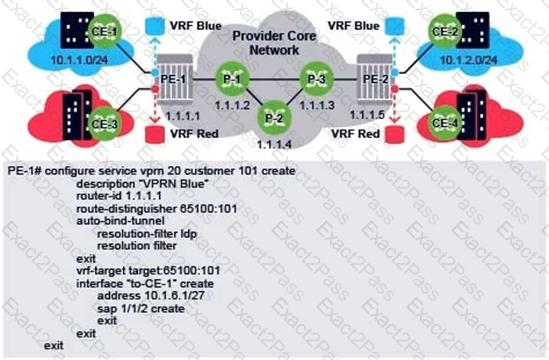
What is wrong with the VPRN configuration applied on this Nokia 7750 SR?
A.

The VPRN ID must match the value 101 used in the vrf-target command.

B.

The VPRN ID must match the value 101 used in the route-distinguisher command.

C.

The router-id command should not be used in this context.

D.

The “no shutdown” command must be configured for the VPRN to be operationally UP.

Question # 12

Which of the following about a full mesh VPRN is FALSE?

A.

Dual CEs connected to redundant PEs can provide redundancy within a single site.

B.

Site redundancy can be achieved by dual homing a single CE to one or more PEs.

C.

Provider core LSPs can be LDP-based or RSVP-based.

D.

The provider core maintains a full mesh of LSP tunnels and MP-BGP sessions between all P devices.

Question # 13

Click the exhibit.

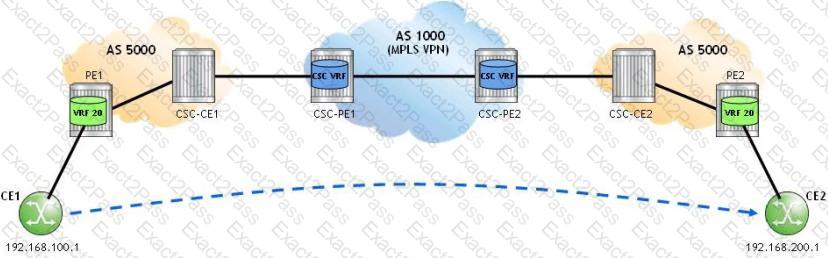
A Carrier Supporting Carrier (CSC) VPRN is configured for a customer carrier who is a BGP/MPLS service provider. If CE1 sends an IP packet to 192.168.200.1, which of the following is FALSE?

A.

CE1 forwards the data packet to PE1 via the VPRN 20 interface.

B.

PE1 pushes two labels on the IP packet: a BGP label and an LDP transport label.

C.

CSC-CE1 pops the LDP label and swaps the BGP label.

D.

CSC-PE1 pops the BGP label and pushes a VPN label and an MPLS transport label.

Question # 14

Where are VPN-IPv4 addresses used in a VPRN?

A.

In the routing updates exchanged from CE to PE

B.

In the routing updates exchanged from PE to PE

C.

In the routing updates exchanged from P to PE

D.

In customer packets as they traverse the provider core

E.

In all route tables of the VPRN control plane

Question # 15

Click the exhibit.

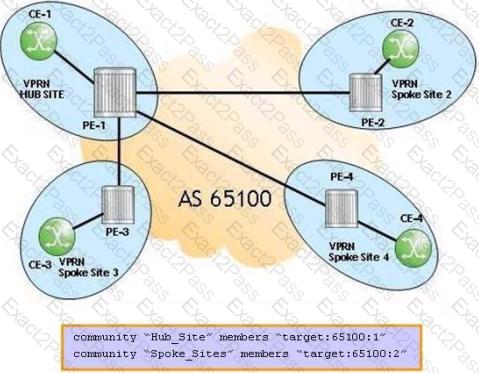
For the PE hub and spoke VPRN, on which PE(s) should the VPRN service command target export target: 65100:1 import target: 65100: 2 " be configured?

A.

PE1

B.

PE2, PE3 and PE4

C.

PE1, PE2, PE3 and PE4

D.

This command is not required for the configuration of this PE hub and spoke VPRN.

Question # 16

Which of the following about inter-AS model AVPRN is TRUE?

A.

It is the most scalable of the Inter-AS models.

B.

VRF configuration is not required on the ASBRs.

C.

Most routers that support VPRN functionality do not support model A by default.

D.

It is not necessary to run MPLS at the boundary between autonomous systems.

Question # 17

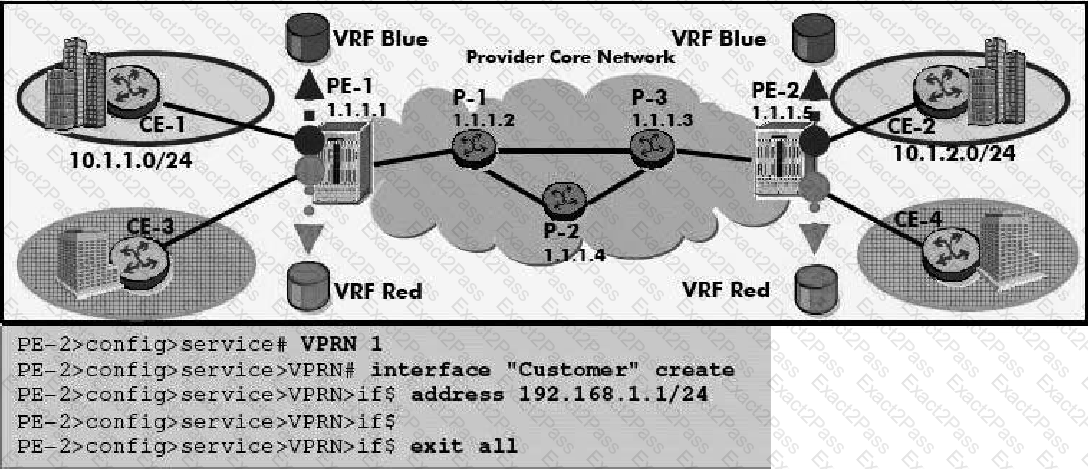
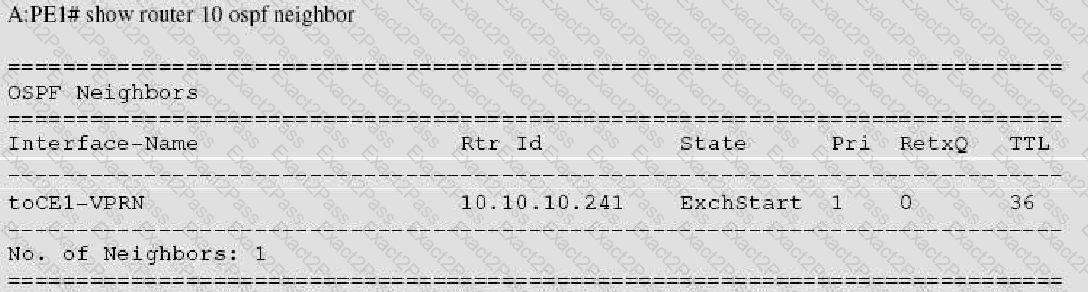
After configuring OSPF as the PE to CE routing protocol for a VPRN service you get the following output from an Nokia 7750 SR: What is most likely wrong with the configuration?
A.

OSPF is not configured on the CE router

B.

There is a problem with OSPF authentication

C.

The operational MTU does not match

D.

The PE and CE router have different OSPF interface types configured

E.

None of the above

Question # 18

When configuring a VPRN service on an Nokia 7750 SR, where should the following policy be applied?
A.

On the CE under the RIP context

B.

On the PE under the BGP context

C.

On the PE under the RIP context

D.

On the CE under the BGP context

E.

This policy is not required

Question # 19

Which of the following statements best describes the output from an Nokia 7750 SR shown below?

A.

The BGP session from PE to P is not operational

B.

The BGP session between PEs is operational

C.

The BGP session between PE and CE is not operational

D.

The BGP session from PE to CE is operational

E.

The BGP session between PEs is not operational

Question # 20

The policies shown below from the configuration of an Nokia 7750 SR have been created to implement an Extranet VPRN between the main sites of two separate VPRNs. How should these policies be applied?


A.

ample Policy should be applied as an export policy on the PE connected to the main site of Customer 1

B.

ample Policy 3 should be applied as an export policy on the PE connected to the main site of Customer 2

C.

ample Policy 3 should be applied as an export policy on both PEs connected to the main site of Customer 1 and the main site of Customer 2

D.

ample Policy should be applied as an export policy on both PEs connected to the main site of Customer 1 and the main site of Customer 2

E.

ample Policy should be applied as an export policy on all PEs connected to sites of Customer 1

Go to page: