Spring Sale Special Limited Time 70% Discount Offer - Ends in 0d 00h 00m 00s - Coupon code: buysanta

Exact2Pass Menu

Nokia Virtual Private Routed Networks

Last Update 8 hours ago Total Questions : 214

The Nokia Virtual Private Routed Networks content is now fully updated, with all current exam questions added 8 hours ago. Deciding to include 4A0-106 practice exam questions in your study plan goes far beyond basic test preparation.

You'll find that our 4A0-106 exam questions frequently feature detailed scenarios and practical problem-solving exercises that directly mirror industry challenges. Engaging with these 4A0-106 sample sets allows you to effectively manage your time and pace yourself, giving you the ability to finish any Nokia Virtual Private Routed Networks practice test comfortably within the allotted time.

Question # 51

Which of the following statements is FALSE when providing Internet access using route leaking between a VRF and the global routing table?

A.

It is best used when a single VPN is required to provide Internet access, as well as to maintain VPN connectivity between different customer sites.

B.

If there is no requirement for the VRF to contain the full Internet routing table, a default route to the Internet gateway router is sufficient.

C.

Only one interface on the CE is required for both VPN and Internet connectivity.

D.

The Nokia 7750 SR supports route leaking in full mesh and extranet VPRN topologies only.

Question # 52

For a Carrier Supporting Carrier (CSC) VPRN where the customer carrier is an ISP that provides Internet connectivity to its end-customers, which of the following is TRUE?

A.

The customer carrier network must be MPLS-enabled.

B.

VPRN instances are created on the CSC-CE routers.

C.

All traffic exchanged between end-customers is carried over a single CSC VRF.

D.

Customer carrier PEs residing in different sites must run MP-iBGP between them to exchange customers ' routes.

Question # 53

On a PE router, the VRF table for VPRN 10 contains: one local route, two BGP routes learned from a local CE. and three tunneled routes learned from a remote site. If we execute the command " configure service vprn 10 maximum-routes 2 log-only " on this PE router, how many routes are expected to be in the VRF?

A.

Five routes: the local route, the two BGP routes learned from the local CE, and two tunneled routes.

B.

Six routes: the local route, the two BGP routes learned from the local CE, and three tunneled routes.

C.

Two routes: the local route and one tunneled route.

D.

Three routes: the local route and two tunneled routes.

E.

Two routes: the local route and one BGP route learned from the local CE.

Question # 54

Click the exhibit.

A Carrier Supporting Carrier (CSC) VPRN is configured on an Nokia 7750 SR for a customer carrier offering VPRN services. Which of the following configuration steps is NOT required?

A.

Creating an export policy on CSC-CE1 and CSC-CE2 to advertise local PE addresses to the network provider.

B.

Configuring eBGP between CSC-CE and CSC-PE routers; setting the address family to IPv4; and enabling the advertisement of labels for IPv4 routes.

C.

Configuring iBGP between PE and CSC-CE within each customer carrier site; setting the address family to IPv4; and enabling the advertisement of labels for IPv4 routes.

D.

Configuring MP-iBGP between PE1 and PE2; setting the address family to IPv4; and enabling the advertisement of labels for IPv4 routes.

Question # 55

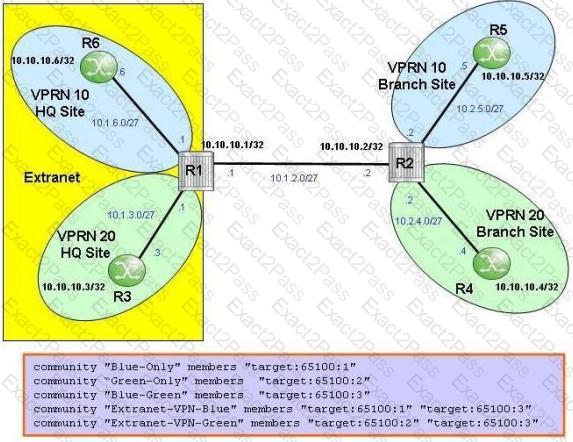
Click the exhibit.

The headquarter sites of VPRN 10 and VPRN 20 are part of an extranet VPRN. Which route targets should be exported under the VPRN 20 service on router R1?

A.

target:65100:2 and target:65100:3

B.

target:65100:1 and target:65100:2

C.

target:65100:1 and target:65100:3

D.

target:65100:1, target:65100:2 and target:65100:3

Question # 56

Which of the following is not a valid BGP design for a network provider supporting VPRNs?

A.

Full mesh of MP-BGP between all P devices

B.

Full mesh of MP-BGP between PE devices

C.

Route reflector configuration between PE devices

D.

Confederation configuration between PE devices

Question # 57

Click the exhibit.

How many route targets and route distinguishers are required to implement the extranet VPRN?

A.

Three route targets and three route distinguishers

B.

Five route targets and three route distinguishers

C.

Three route targets and two route distinguishers

D.

Five route targets and two route distinguishers

Question # 58

Which of the following is NOT a viable option when implementing inter-AS VPRN?

A.

An MP-eBGP session between route reflectors in different autonomous systems to exchange IPv4 routes.

B.

An MP-eBGP session between ASBRs to exchange labeled IPv4 routes.

C.

An eBGP session between ASBRs to exchange IPv4 routes.

D.

An MP-eBGP session between ASBRs to exchange VPN-IPv4 routes.

Question # 59

On an Nokia 7750 SR, which CLI command displays the Route Target(s) associated to a prefix?

A.

Show router bgp routes

B.

Show router route-table summary

C.

Show router bgp routes vpn-ipv4 detail

D.

Show router route-table

Question # 60

In a VPRN that uses MPLS transport tunnels, which of the following is NOT configured on the PE device?


A.

MP-BGP for exchanging customer routes with other PEs.

B.

A routing protocol for exchanging customer routes with the CE.

C.

A label signaling protocol for defining transport tunnels between the PE and CE.

D.

MPLS for exchanging labels with other provider core devices.

Go to page: