Summer Sale Special Limited Time 70% Discount Offer - Ends in 0d 00h 00m 00s - Coupon code: buysanta

Exact2Pass Menu

Nokia Quality of Service

Last Update 14 hours ago Total Questions : 231

The Nokia Quality of Service content is now fully updated, with all current exam questions added 14 hours ago. Deciding to include 4A0-107 practice exam questions in your study plan goes far beyond basic test preparation.

You'll find that our 4A0-107 exam questions frequently feature detailed scenarios and practical problem-solving exercises that directly mirror industry challenges. Engaging with these 4A0-107 sample sets allows you to effectively manage your time and pace yourself, giving you the ability to finish any Nokia Quality of Service practice test comfortably within the allotted time.

Question # 21

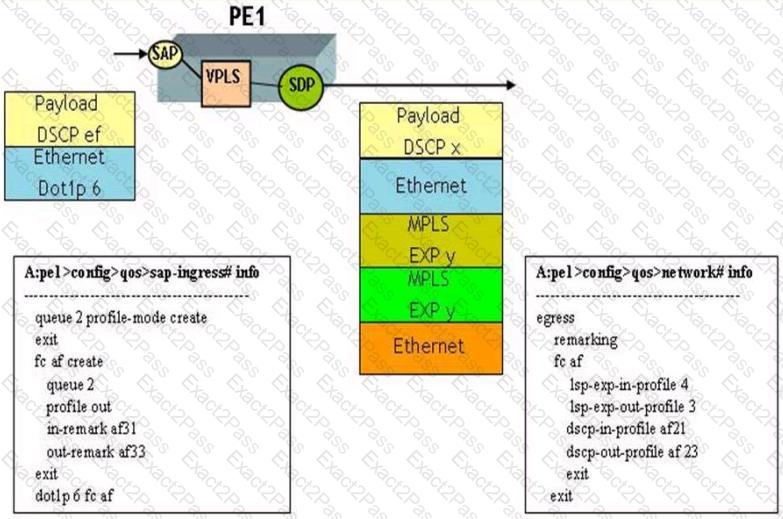
Click the exhibit button below.

At router PE1, customer packets are arriving tagged with a dotlp value of 6 and marked with a DSCP value of EF.

Based on the configuration shown below for a VPLS service, what will be the DSCP and EXP marking for the packet egressing the network port on this PE router? (Choose two)

A.

The DSCP value will be set to af21.

B.

The DSCP value will be set to af23.

C.

The DSCP value will remain as ef.

D.

The EXP value, in the MPLS headers, will be set to 4.

E.

The EXP value, in the MPLS headers, will be set to 3.

Question # 22

On the Nokia 7750 SR, which of the following QoS-related policies can be configured on a SAP? (Choose three)

A.

The slope-policy

B.

The SAP-ingress policy

C.

The SAP-egress policy

D.

The network-queue policy

E.

The scheduler-policy

Question # 23

Which of the following rate-limiting approaches are used on the Nokia 7750 SR? (Choose two)

A.

Shapeless policing at SAP-ingress only.

B.

Shapeless policing at SAP-ingress and egress.

C.

Biased round robin queuing at ingress only.

D.

Soft shaping at all network interfaces.

E.

Soft shaping at network ingress only.

Question # 24

Which of the following is NOT a reason for configuring a slope policy on a queue?

A.

To have control over the amount of the low priority packets that enter the queue.

B.

To control any traffic flowing through the shared buffer space of the queue.

C.

To limit the number of the TCP sessions that go into slow start during congestion.

D.

To force the TCP algorithm to increase its transmission window upon detecting a congestion.

Question # 25

Which of the following statements describe the operation of WRED on the Nokia 7750 SR? (Choose three)

A.

WRED monitors the shared buffer space utilization over a period of time.

B.

WRED disables the TCP slow-start congestion control mechanism.

C.

WRED uses two configurable slopes for each buffer pool: a high slope and a low slope.

D.

WRED uses the shared buffer utilization, instead of the individual queue depth, to get a better picture of the average resource utilization of the shared buffer space.

E.

WRED polices the shared buffer pool and marks all packets above a certain rate as " discard eligible. "

Question # 26

In which of the following scenarios is the egress port scheduler useful? (Choose two)

A.

A customer is complaining that his VoIP traffic is being dropped even though it is sending the correct DSCP markings. Packets are not being dropped on ingress.

B.

A customer is complaining that his VoIP traffic is being dropped even though it is sending the correct DSCP markings. Packets are being dropped on ingress.

C.

A commercial builder has requested numerous dot1Q epipes, VPRNs, and VPLS services to a business park and is only paying up to a maximum 200Mbps.

D.

An equipment manufacturer has requested a NULL epipe service that will transparently pass dot1Q between the new location and national headquarters.

Question # 27

Which of the following statements about queue modes, and profile marking of packets when leaving a queue is FALSE?

A.

Profile-mode and priority-mode queues can only be configured on SAP ingress.

B.

For network egress, egress re-classification can change the profile marked at ingress.

C.

For SAP egress, the profile marked at ingress may change based on the scheduling loop.

D.

For network ingress, the network policy can classify the packet as either in-profile, or out-of-profile.

Question # 28

Which of the following fields can be marked or remarked for frames belonging to a Layer 2 service?

A.

DSCP

B.

PREC

C.

Dot1p

D.

ToS

E.

Q-in-Q

Question # 29

Which of the following policies does NOT exist by default on a network port?

A.

A network policy for every network interface configured on the port.

B.

A slope policy for the port on ingress.

C.

A network queue policy for the corresponding MDA on ingress.

D.

A network queue policy for the port on egress.

Question # 30

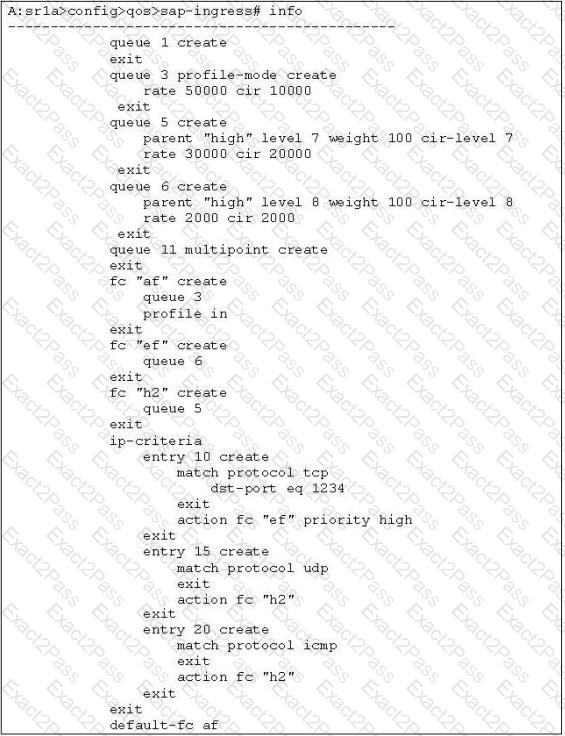
Click the exhibit button below. Given the SAP-ingress policy, which of the following statements are TRUE? (Choose three)

A.

All AF traffic will be marked " in-profile " at the SAP-ingress.

B.

All TCP traffic will be mapped to forwarding class EF.

C.

UDP traffic is placed in queue 3 while ICMP traffic is placed in queue 5.

D.

EF traffic will receive higher scheduling priority than H2 traffic.

E.

Traffic that does not match any of the IP criteria will be placed in queue 3.

Go to page: