
Spring Sale Special Limited Time 70% Discount Offer - Ends in 0d 00h 00m 00s - Coupon code: buysanta

Exact2Pass Menu

Nokia Quality of Service

Last Update 7 hours ago Total Questions : 231

The Nokia Quality of Service content is now fully updated, with all current exam questions added 7 hours ago. Deciding to include 4A0-107 practice exam questions in your study plan goes far beyond basic test preparation.

You'll find that our 4A0-107 exam questions frequently feature detailed scenarios and practical problem-solving exercises that directly mirror industry challenges. Engaging with these 4A0-107 sample sets allows you to effectively manage your time and pace yourself, giving you the ability to finish any Nokia Quality of Service practice test comfortably within the allotted time.
Question # 41

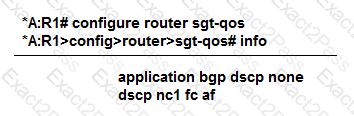
According to the configuration shown above, which of the following about the classification and marking of self- generated BGP traffic is TRUE?

A.

It will be marked as DSCP BE and classified into forwarding class BE.

B.

It will be marked as DSCP NC1 and classified into forwarding class BE.

C.

It will be marked as DSCP NC1 and classified into forwarding class NC.

D.

It will be marked as DSCP NC1 and classified into forwarding class AF.

Question # 42

Which of the following statements about behavior aggregate and multi-field classification in a Nokia 7750 SR is TRUE?

A.

Multi-field classification can use both MAC criteria and IP criteria in the same SAP-ingress QoS policy.

B.

Behavior aggregate classification can use both lsp-exp and dscp in the same SAP-ingress QoS policy.

C.

Multi-field classification cannot use both IP criteria and IPv6 criteria in the same SAP-ingress QoS policy.

D.

Behavior aggregate classification cannot use both dot1p and lsp-exp in the same SAP-ingress QoS policy.

Question # 43

Traffic assigned to forwarding classes is placed into queues, while the contents of the queues are serviced in a controlled manner using____________.

A.

WRED

B.

shapers

C.

schedulers

D.

markers

E.

weighted fair queues (WFQ)

Question # 44

Which of the following statements BEST describes where shaping mechanisms should be applied?

A.

On all ports on the Nokia 7750 SR.

B.

At the junction of high-speed to low-speed links or at places of traffic aggregation.

C.

At the junction of low-speed to high-speed links or at places of traffic aggregation.

D.

On low-speed WAN links.

E.

Nowhere. Shaping is only performed in hardware and serviced in a round-robin.

Question # 45

On the Nokia 7750 SR, where can network-queue policies be applied? (Choose two)

A.

On the network egress port.

B.

On the SDP.

C.

On the access ingress port.

D.

On the egress MDA.

E.

On the SAP.

F.

On the ingress MDA.

Question # 46

A profile-mode queue is configured with MBS = 100 KB, CBS = 50 KB and High-Priority-Only = 40%. Assume there is no CBS overbooking, and the slope-policy is disabled. If the current queue depth is 70 KB, what will happen to an out-of-profile packet when it is transmitted to the queue?

A.

It will be stored in the reserved buffer space and remain out-of-profile.

B.

It will be stored in the reserved buffer space and become in-profile.

C.

It will contend for shared buffer space with packets from other queues.

D.

It will be discarded because the high-priority-only threshold has been reached.

Question # 47

Which of the following components are NOT configured in a hierarchical scheduler policy?

A.

Queue parameters with which the queue will compete for bandwidth.

B.

The level of hierarchy with which a group of schedulers is associated.

C.

Bandwidth controls that limit each child scheduler or child queues associated with the scheduler.

D.

The maximum bandwidth that the parent scheduler can offer its child queues or schedulers.

Question # 48

Which of the following statements is considered best practice when changing a network policy that has been associated with an interface?

A.

The policy should be placed in a " shutdown " state before changes are made.

B.

A new network policy should be created and applied to the interface, overwriting the previous policy.

C.

The policy must first be removed from the interface, then modified and re-applied to the interface.

D.

Before the policy can be changed, it must be deleted with the no network qos < policy-id > command.

E.

Before any changes are made to the policy, all network interfaces where the policy is applied have to be shut down.

Question # 49

Which of the following statements about buffer admission control techniques is FALSE?

A.

A packet is accepted into a queue based on its priority and forwarding class.

B.

Buffer admission control limits the number of out-of-profile packets that enter the queue.

C.

Both high priority-only buffer space and WRED can be used in a queue.

D.

Priority is used when a packet enters a SAP-ingress queue.

Question # 50

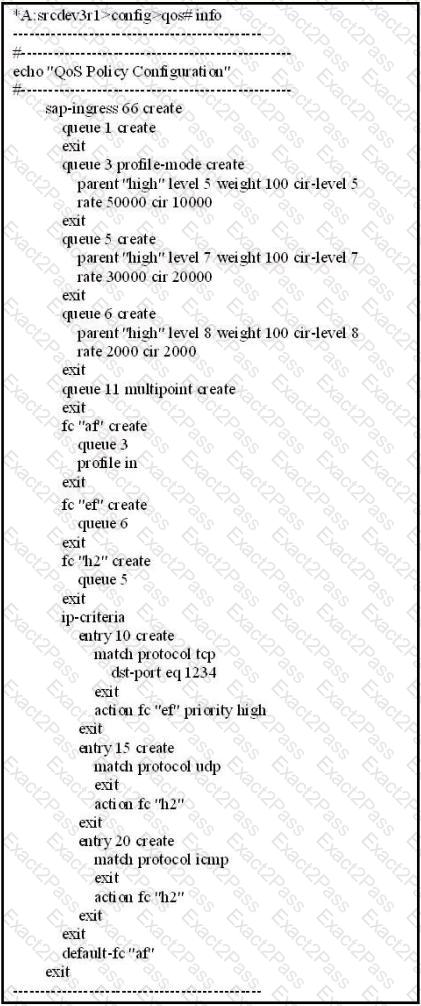
Click the exhibit button below. Given the SAP-ingress policy, which of the following statements are FALSE? (Choose three)

A.

Queue 5 is using priority mode.

B.

UDP traffic can be serviced at a maximum rate of 20 Mbps.

C.

Ping traffic is place in queue 5.

D.

Queues 5 and 6 will receive equal portions of any remaining available bandwidth to meet their above-CIR bandwidth requirements.

E.

Queue 3 is scheduled before queue 5.

Go to page:
