Summer Sale Special Limited Time 70% Discount Offer - Ends in 0d 00h 00m 00s - Coupon code: buysanta

Exact2Pass Menu

Nokia SR Linux EVPN and Data Center Interconnect

Last Update 4 hours ago Total Questions : 56

The Nokia SR Linux EVPN and Data Center Interconnect content is now fully updated, with all current exam questions added 4 hours ago. Deciding to include 4A0-D03 practice exam questions in your study plan goes far beyond basic test preparation.

You'll find that our 4A0-D03 exam questions frequently feature detailed scenarios and practical problem-solving exercises that directly mirror industry challenges. Engaging with these 4A0-D03 sample sets allows you to effectively manage your time and pace yourself, giving you the ability to finish any Nokia SR Linux EVPN and Data Center Interconnect practice test comfortably within the allotted time.

Question # 11

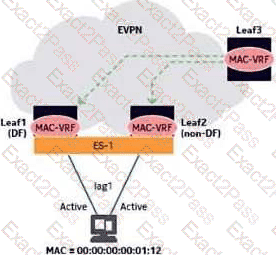
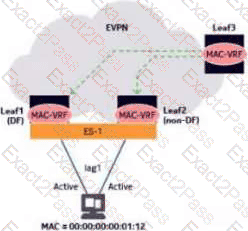
Leaf routers are configured to support Layer 2 multi-homing all-active mode.

Which of the following statements is FALSE?

A.

All of the sub-interfaces of the LAG must be configured in the Ethernet segment.

B.

The 2nd through 7th octets of the ESI must not be all zeros.

C.

The multi-homing mode of all-active must be configured for the Ethernet segment.

D.

The Ethernet segment must be administratively enabled.

Question # 12

Consider the exhibit.

The network is going to be designed to use interface-less symmetric routing.

Which of the following statements is TRUE?

A.

An instance of each mac-vrf is required on each leaf.

B.

The ingress PE will perform layer 2 and layer 3 lookups while the egress PE will perform layer 2 lookup.

C.

The IRB configuration does not require anycast gateway configuration on the ip-vrf.

D.

Forwarding information will be exchanged between the PEs using EVPN route-type 2 updates.

Question # 13

Which of the following statements about the configuration of a distributed Layer 2 EVPN in a Nokia SR Linux is FALSE?

A.

Each PE participating in the Layer 2 EVPN must be configured with the same EVPN instance ID (EVI).

B.

The route distinguisher is auto-generated using the autonomous system number and EVI.

C.

Only one VXLAN-interface can be associated to the Layer 2 EVPN.

D.

The route-targets are manually configured when the leaf routers are in different autonomous systems.

Question # 14

Which of the following statements about the configuration of a Layer 3 multi-homing with a centralized router is FALSE?

A.

The centralized router must be a member of the Ethernet segment.

B.

All routers participating in the Ethernet segment must have the multi-homing mode set to all-active.

C.

Remote leaf routers can load balance traffic to customer prefixes through the leaf routers connected to the Ethernet segment.

D.

The centralized router will advertise the customer prefixes using an EVPN route-type 5 update.

Question # 15

Consider the exhibit.

All connected leaf routers have the same Ethernet segment configuration. The IP-VRF is configured properly and is operational.

Which of the following statements is FALSE?

A.

This Ethernet segment is configured for Layer 3 multi-homing.

B.

The EVI for the IP-VRF using this segment is 1000.

C.

A LAG must be configured on the connected leaf routers and the host.

D.

The redundancy mode for this Ethernet segment is all-active.

Question # 16

Which of the following statements about a BGP route target is FALSE?

A.

The route-target is a BGP extended community.

B.

It is defined in MP-BGP to allow for overlapping MAC addresses from multiple tenants.

C.

It is advertised with every EVPN route update.

D.

It identifies the EVPN instance in the control plane.

Go to page: