Exact2Pass

Last Update 16 hours ago Total Questions : 68
The Adobe Real-TimeCustomer Data Profile Developer Expert(RTCDP) content is now fully updated, with all current exam questions added 16 hours ago. Deciding to include AD0-E605 practice exam questions in your study plan goes far beyond basic test preparation.
You'll find that our AD0-E605 exam questions frequently feature detailed scenarios and practical problem-solving exercises that directly mirror industry challenges. Engaging with these AD0-E605 sample sets allows you to effectively manage your time and pace yourself, giving you the ability to finish any Adobe Real-TimeCustomer Data Profile Developer Expert(RTCDP) practice test comfortably within the allotted time.
A company uses Real-Time Customer Profile and provides the following Customer Profile schema to the data architect in charge of designing the Real-Time Customer Profile:

They have business requirements to carry out customer segmentation based on purchasing behavior, demographic data (including gender), and multi-channel marketing activities and need to consider data consistency, and minimizing system complexity for future data ingestion and updates.
What would be the recommended modeling approach to accommodate these requirements?
A marketer needs to target their ads to premium customers who are frequent visitors and have made purchases over the value of $10,000 in the past six months. What type of segmentation criteria would best suit this use case in Adobe Real-Time CDP?
A customer is bringing their brand data using Mobile and Web SDK into AEP to use for brand marketing using Adobe Real-Time CDP. The client has a license limited to 5 million Addressable Audience. What strategy should be adopted by the Data Architect to keep profile count in check and within license limits?
A retail organization is Introducing an e-commerce channel and would like to integrate the customer's browsing and online purchase data into the Real-Time Customer Profile The data structure of the clickstream event being captured is as follows:
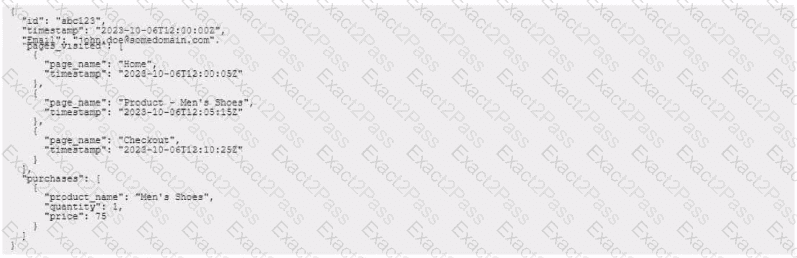
The architect decides to separate 'pages.vislted" and 'purchases' Into different schemas.
Which Experience Data Model XDM schema classes would be used to model the browsing activity and the purchase activity?
A data engineer has been loading profile fragments into the Real-Time Customer Profile on a daily basis using the REST API with data structured based on a predefined schema. Recently, there was an update to add new attributes to the schema, including a new field for 'Preferred Channel'. The data engineer ran an ingestion process with the new schema changes and noticed that the new attribute is not appearing in the Real-Time Customer Profile for some profiles. What should the data engineer investigate first to troubleshoot this issue?
A data engineer is troubleshooting an issue where clickstream data being ingested via Adobe's Web SDK into Adobe Real-Time CDP is not populating the desired segment. The segment is looking for visitors who have added an item to their cart but have not made a purchase in over 30 days. The source data consists of user interactions, collected in real-time. It is available in a structured format and includes information like click timestamp, visitor ID, event type (page view, item added to cart, purchase, etc.), and item details.
What is the possible cause for the error when trying to create the Edge Segment?
A company is deploying Adobe Experience Platform and plans to use both Edge and Real-Time Customer Profile functionality. What are the main differences between the composition and usage of these profiles?
A large retail company is currently using a traditional relational database management system (RDBMS) to store and manage order data. However, the company is experiencing scalability and performance issues as the number of orders continues to grow. The company is considering loading to Adobe Real-Time CDP to take advantage of its Experience Data Model (XDM) data model and real-time data capabilities.
The company's order table includes the following attributes:
Order ID
Customer ID
Order date
Order status
Shipping address
Billing address
The company's order items table includes the following attributes:
Order ID
Item ID
How would the architect translate this data model into Adobe Experience Platform XDM data model?
A large retail customer has built thousands of audiences and wishes to activate them on social media destinations. What is the maximum number of audiences to a single destination permitted by guardrail?
A data architect is tasked with designing an Adobe Experience Platform architecture for a multi-channel retail business. Which two identity namespaces would be used to model the identities on the dataset of online and offline transactions? (Choose two.)

